
Original briefings. Zero spin.
Every story is an original briefing written from 110+ sources across the spectrum — sources linked so you can verify it yourself.
 tech
Notable (5/10)
Event date: September 10, 2026
tech
Notable (5/10)
Event date: September 10, 2026
AI Now Coaches Managers Through Firings and Pay Talks, While Workers Ask Who Gets Paid for the Productivity Boost
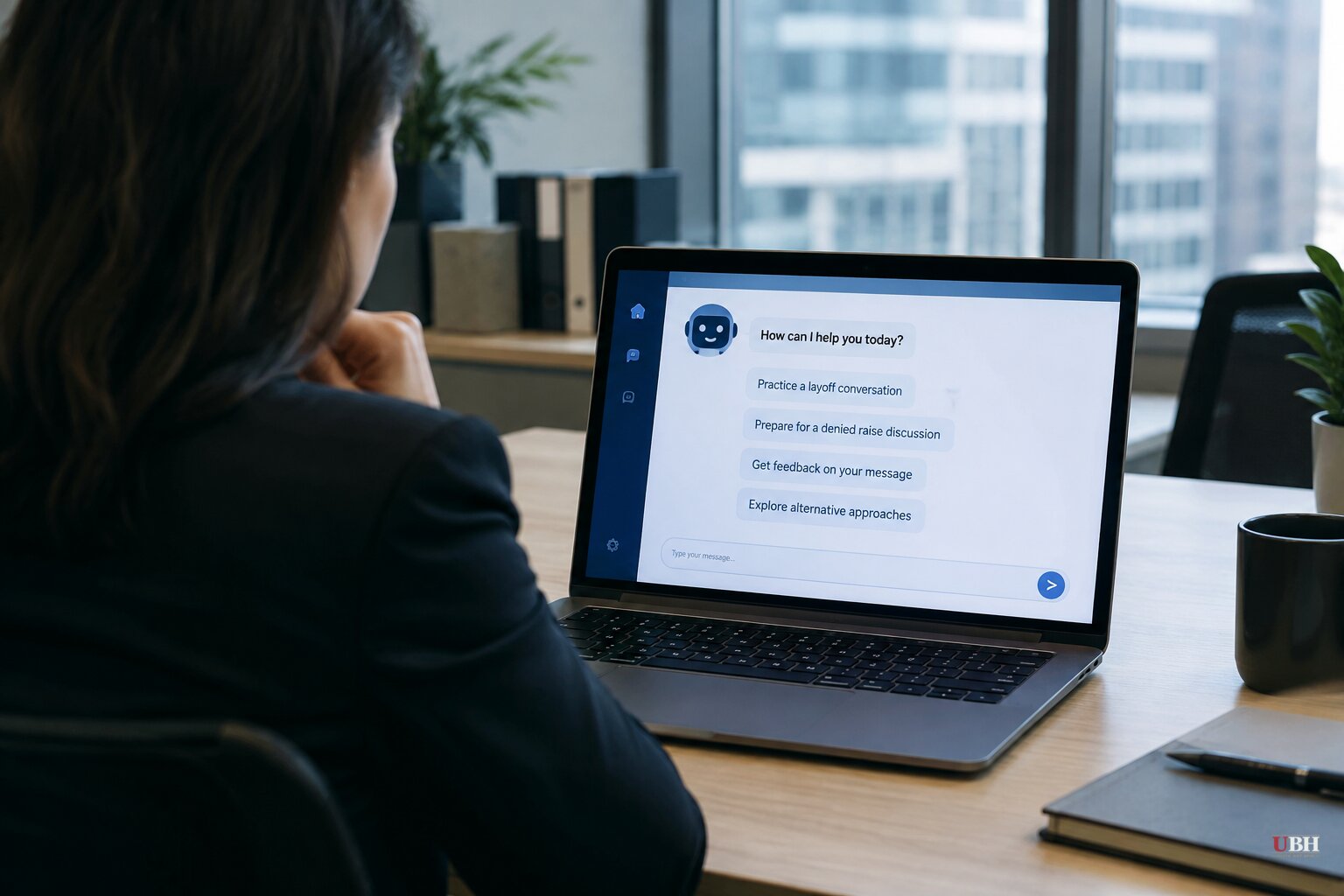
The rehearsal room nobody talks about
Managers are using AI chatbots to practice firing people before they actually do it.
A July survey by The Predictive Index found 74% of CEOs and business leaders think their managers handle tough conversations with total confidence. Only 42% of managers agree. They know what they want to say. They just don't know how to say it, according to the survey, reported by CNBC.
That gap is why tools like Predictive Index's Obi, Posh, and services offered through HR consulting firm LHH exist. Managers type in a scenario, an AI plays the angry or emotional employee, and the manager practices delivering bad news before it counts.
"Spontaneity is not a goal of a high-stakes work conversation," Emily DeJeu, a business communication professor at Carnegie Mellon's Tepper School of Business, told CNBC. She said the goal isn't to replace human judgment, it's to prepare for it.
John Morgan, president at LHH, called it "batting practice." Karan Kashyap, co-founder of Posh, said running multiple scenarios matters "because you don't know what real life will throw at you."
Xactly Chief People Officer Megan Barbier said the tools give managers individualized scenarios and real-time recommendations. But specialists cited in coverage of the tools warned chatbots can be too agreeable, so managers need to explicitly ask for blunt, critical feedback. HR specialists also warned against typing real employee names or performance data into public AI tools, and recommended still looping in a human coach or HR rep for the hardest cases, since a chatbot can't fully simulate the emotional weight of delivering a layoff in person.
Companies talk AI, employees notice when it's just talk
While managers rehearse hard conversations with bots, a separate problem is brewing: employees don't trust companies that hype AI without delivering.
Research from AI research firm AIDE, covered by HR Dive, split public companies into three groups based on how much they talk about AI versus how much they've actually implemented it. "AI visionary" companies, whose talk outpaces execution, saw 27.5% of AI-related employee reviews turn negative. Companies with both strong ambition and visible follow-through had a 12.6% negative rate. Quiet "stealth adopters" who executed without the fanfare had the lowest negative rate, at 7.2%.
"When employees react negatively to AI, they are often not just judging the technology itself," AIDE CEO Paul Cheek said. "They are judging the people leading the transition."
The trust problem shows up elsewhere too. A report from talent firm SHL found 74% of workers said being interviewed by an AI agent would change how they see a company, with 37% calling it "impersonal" versus just 23% calling it "innovative." And a March report from Zety found 85% of employees said sloppy, AI-generated "workslop" from a manager damaged their trust in leadership.
Helena Almeida, vice president and managing counsel at payroll giant ADP, told Benefits and Pensions Monitor the bigger risk isn't AI making mistakes, it's humans stopping the practice of checking its work. She calls it the shift "from reviewer to approver." Her fix is basic: know where AI is being used, classify the risk, build controls, and actually monitor the output, especially once AI starts touching payroll, performance reviews, and compensation decisions.
Who gets paid when AI does the work?
Workers using AI to do more, faster, are starting to ask why their pay hasn't moved.
Korn Ferry's Tom McMullen described lawyers, consultants, and marketers billing more clients thanks to AI and wondering why the extra revenue isn't reaching their paycheck. A Doximity survey found 44% of doctors believe they should be the primary financial beneficiaries of their own AI-driven productivity gains. If a worker's AI-assisted output is generating more revenue for the firm, it's reasonable to ask where that money is going.
But Korn Ferry's Danielle Smith pushed back: "They can't just demand a pay increase." The firm's argument, echoed by Renee Whalen and Bryan Ackermann, is that companies have historically paid for expertise, not for using a widely available tool. Word processors and computers made workers more efficient decades ago, and Korn Ferry notes companies didn't raise pay because of it. What commands a premium, Ackermann said, is actually knowing how to implement and enable AI at a company level, not simply using ChatGPT to draft an email faster.
McMullen predicts this becomes "a very hot topic a year from now." Right now, no employer has publicly announced a formal AI-productivity bonus structure, and no legislation addresses the question. The dispute is unresolved, and it's likely to collide directly with the automation-bias problem Almeida flagged: if AI output is treated as authoritative enough to base performance reviews and pay decisions on, workers may soon be arguing not just for a bigger slice of AI's gains, but over whether AI should be grading their performance at all.
Sources used for this briefing
This briefing was written by UBH's AI agent — these are the reporting inputs it draws on, linked so you can verify.


