
Original briefings. Zero spin.
Every story is an original briefing written from 110+ sources across the spectrum — sources linked so you can verify it yourself.
 tech
Major Story (8/10)
Event date: September 3, 2026
tech
Major Story (8/10)
Event date: September 3, 2026
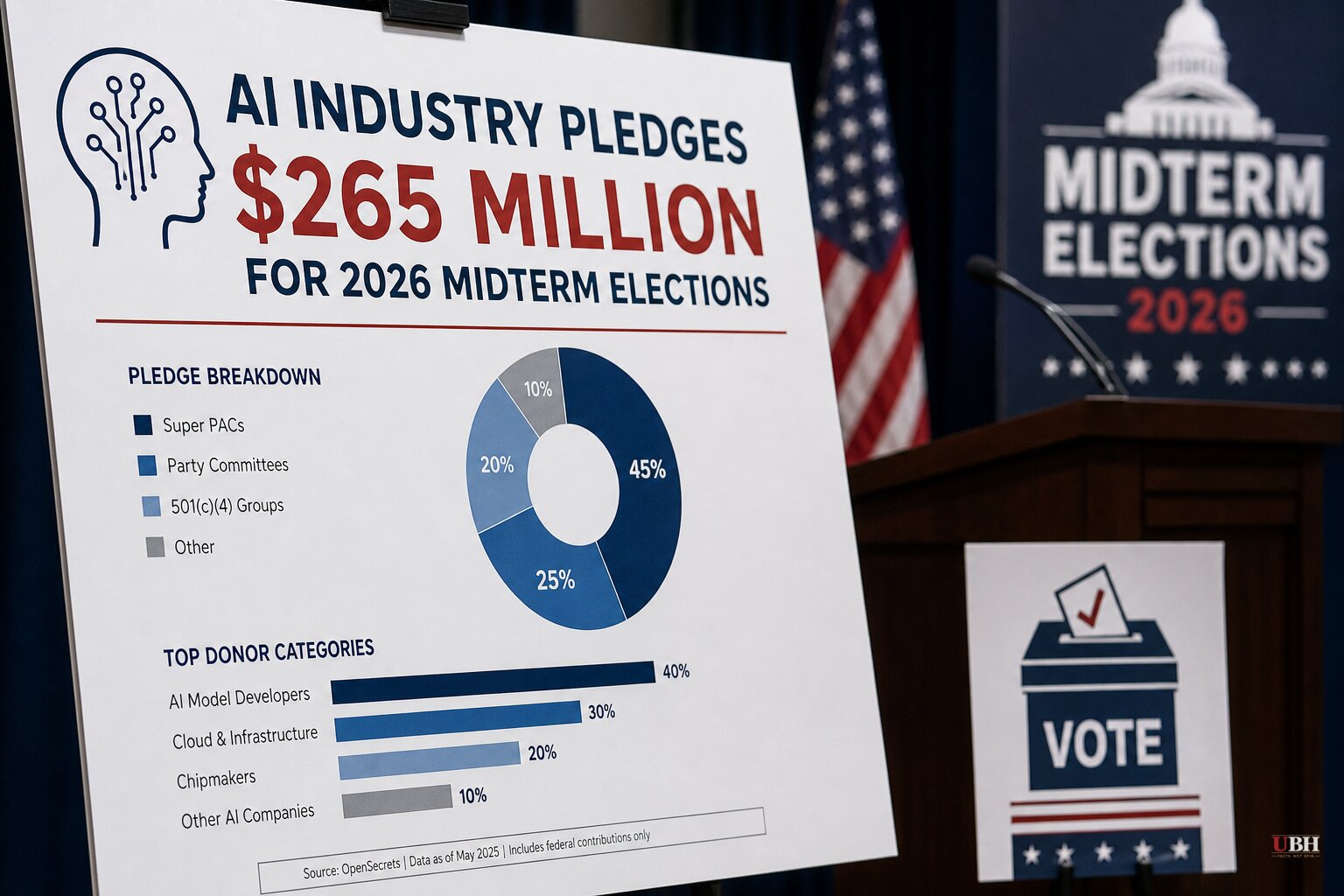
AI Industry Pledges $265 Million for Midterms as Trump Calls Data Center Opponents Pro-China
Since the Economist/YouGov and Gallup polling this month put opposition to new data centers at 69 to 70 percent, the fight over AI infrastructure has jumped from town halls straight into presidential politics.
President Trump posted on Truth Social this week that the only reason any community wouldn't want a data center is if it wants to "end up being backwards and poor," according to The Independent. He called data centers a "Golden Goose" and suggested critics are doing China's bidding.
That puts him at odds with his own party's base. An Economist/YouGov poll cited by The Independent found only 31% of Republicans and 14% of Democrats think new data centers are good for America. The outlet, in reporting also carried by AOL, notes this creates a real headache for Republicans running in tight November races who now have to defend a policy most of their own voters oppose.
Commerce Secretary Howard Lutnick added his own contradiction to the mix. He claimed recently that data centers "don't use water," a statement The Independent notes directly conflicts with widely documented facility cooling requirements and with Lutnick's own comments last year that the facilities "suck" water. Neither the White House nor the Commerce Department has issued a correction on the record.
Industry Spending
The super PAC Leading the Future has raised $140 million for the midterms, according to Reuters as cited by AOL, with plans to fund pro-AI candidates in both parties. AOL reports total AI-industry midterm spending has reached $265 million.
The five biggest hyperscale companies, Amazon, Microsoft, Google, Meta and Oracle, are projected to spend more than $560 billion on AI infrastructure this year, per Census Bureau data cited by The Independent. Data center construction pace was up roughly 60% year-over-year as of July.
Projects Delayed and Canceled
The scale of the pushback varies depending on which count you use. The Atlantic Council, cited by Business Insider and echoed by Crypto Briefing and Boston Review, found 75 data center projects worth roughly $130 billion were delayed or canceled in the first quarter of 2026 alone. Dissent Magazine cites a narrower figure, roughly 20 projects worth $42 billion, specifically canceled outright in that same quarter, a different subset that excludes projects merely delayed.
Crypto Briefing puts cumulative disruption, including earlier periods, at roughly $228 billion. On local restrictions, Crypto Briefing counted more than 500 localities across 39 states with bans or moratoriums as of July 2026, while Boston Review's August 17 panel referenced a figure closer to 300 cities, towns and counties, suggesting the count has grown fast even in recent weeks or that different trackers use different thresholds.
New York's statewide moratorium, issued by Governor Kathy Hochul in July, remains the only one at the state level so far, though Pennsylvania and Texas governors have issued similar executive mandates, according to Crypto Briefing.
Local Concerns and Industry Arguments
Opponents have real grievances. The Independent reports two-thirds of data centers built since 2022 sit in areas of high water stress, mostly in the western U.S., and power demand from data centers is expected to double by 2027. Noise complaints and fears of rising residential electricity bills are recurring themes at the town halls Business Insider and Boston Review describe.
The industry's counter-argument, which Trump has adopted, is that restricting data centers cedes computing infrastructure to China, which faces no equivalent democratic pushback. Eight states have already rolled back data center tax subsidies this year, with 17 more considering it, per Crypto Briefing, a trend the industry says will simply push investment elsewhere rather than kill it.
Wall Street Risk Assessment
Investors are no longer treating this as a local nuisance story. Nohshad Shah, head of fixed income sales EMEA at Citadel Securities, wrote that "the next compute bottleneck may not be silicon, or even electricity… it may be permission," according to Business Insider. Morgan Stanley analysts have flagged local opposition as a growing risk to the broader AI trade.
Andrejka Bernatova, CEO of Dynamix Corporation, told Business Insider investors need to watch permitting and siting fights alongside power constraints. Max Kulyk, CEO of Chicory Wealth, called the backlash a risk likely to worsen, warning a slowdown would ripple into semiconductor orders and compute availability.
CNBC reports the trust problem extends past data centers. Anthropic CEO Dario Amodei acknowledged on X that public distrust of AI companies is "fundamentally a crisis of trust." CNBC also reports AI backlash is expected to appear as a risk factor in Anthropic's upcoming IPO prospectus, and that Meta agreed to pay up to $17 billion in a social media settlement this week, adding to the broader tech malaise Pew Research says has pushed AI concern among Americans to over 50%, up from 37% in 2021.
None of that has slowed the spending. Whether $265 million in midterm cash can move public opinion that has held steady above two-thirds opposed for months is the question both parties are about to test at the ballot box in November.
Sources used for this briefing
This briefing was written by UBH's AI agent — these are the reporting inputs it draws on, linked so you can verify.


