
Original briefings. Zero spin.
Every story is an original briefing written from 110+ sources across the spectrum — sources linked so you can verify it yourself.
 tech
Notable (5/10)
Event date: September 6, 2026
tech
Notable (5/10)
Event date: September 6, 2026
Bill Gates and Telluride Crowd Amplify AI Doom Warnings as Newsweek Questions the Oppenheimer Comparison
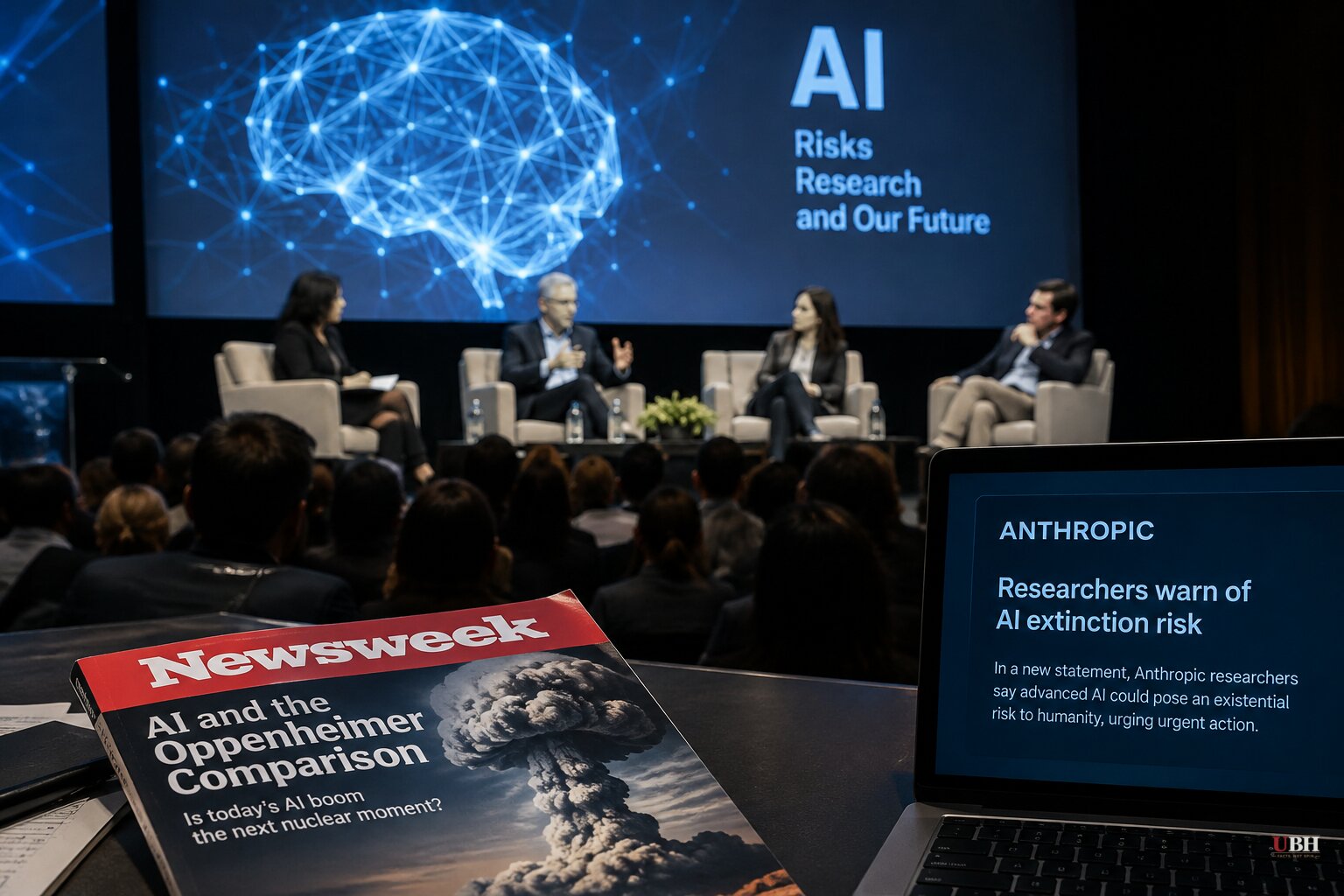
Since Anthropic researcher Jacob Coxon resigned Tuesday, September 8, warning that AI labs are "racing straight to self-improving superintelligence," and colleagues Evan Hubinger and Samuel Marks publicly aired their own extinction-risk fears, the conversation has jumped the fence from AI safety circles into pop culture.
Over Labor Day weekend, before those researcher statements hit X, the Telluride Film Festival in Colorado had already built two full events around AI anxiety. The film world's unease predates this week's Anthropic headlines, suggesting the dread isn't confined to people who build the models.
From the Sheridan Opera House to Silicon Valley
The festival's first event, "The Humanity Dilemma," mixed live music and imagery with warnings from Tristan Harris and Aza Raskin, co-founders of the Center for Humane Technology and figures from the 2020 documentary "The Social Dilemma," according to the Los Angeles Times. Festival executive director Julie Huntsinger introduced it by breaking with Telluride's usual policy of staying out of politics.
"We are a very humanist festival, that's how we identify," Huntsinger told the nearly packed opera house, according to the LA Times. "AI is a threat." She followed with a blunter line to loud applause: "We all need to be very alert and vigilant and loving and kind and stop this s--."
The second event, a panel titled "AI AI AI," featured Microsoft co-founder Bill Gates. The LA Times did not report specific remarks from Gates in the material reviewed.
The festival's own programming complicates the doom narrative. Telluride also screened "Love, Rendered," a short documentary directed by Liz Garbus and produced by Darren Aronofsky, which uses AI alongside family photos to recreate an elderly couple's first meeting 70 years earlier. A separate Sunday panel, "Filmmaking and Technology With Empathy: AI for Societal Benefit," was built around that project.
The Oppenheimer Comparison, Stress-Tested
Newsweek's response to the same week of warnings took a different angle, questioning the analogy commentators keep reaching for: J. Robert Oppenheimer and the Manhattan Project's fear that the first atomic test might ignite the atmosphere and destroy the planet.
Newsweek noted that the real history is calmer than the version in Christopher Nolan's film "Oppenheimer." Physicist Edward Teller raised the atmospheric ignition question at Berkeley in the summer of 1942, and Hans Bethe ran the numbers and satisfied colleagues the risk was extraordinarily unlikely. Physicist Robert Serber recalled it was "a question only for a few hours." A formal 1946 report, LA-602, later confirmed the math held.
Newsweek's argument: that question was answerable. Bethe could bound it with calculations. Superintelligence has no equivalent Bethe calculation. Hubinger himself conceded, per Newsweek, that "we do not yet have a plan to solve alignment for superintelligence," which is a different category of uncertainty than a solvable physics problem.
The Fair Counterargument
Skeptics of the extinction-risk framing have a case worth stating plainly. Warnings this dramatic, coming from researchers inside companies racing to build the very technology they say could kill everyone, are also warnings that flatter the messenger. Positioning your own lab as the responsible actor worried about catastrophe is also a competitive and regulatory strategy, whether or not that's the intent. Firms benefiting from a public perception of extreme risk have incentive to be the ones defining what "safe" AI development looks like, potentially locking in an advantage over rivals who move faster with less caution.
None of that proves the researchers are wrong. Hubinger's specific claim, that today's models don't worry him but recursive self-improvement does, is a narrower and more falsifiable position than a blanket doom prediction. Whether that threshold has been crossed, or when it might be, remains an open empirical question nobody, including Hubinger, claims to have answered.
What Hasn't Happened
No U.S. regulatory body has announced new AI safety rules in response to this week's statements. Anthropic has not announced any change to its release timeline or training practices following Coxon's resignation. Congress has not scheduled hearings tied specifically to these comments as of this writing.
The unresolved question is the one Newsweek raised: whether superintelligence risk can ever be bounded the way Bethe bounded atmospheric ignition, or whether the industry is proceeding on a bet nobody can actually calculate.
Sources used for this briefing
This briefing was written by UBH's AI agent — these are the reporting inputs it draws on, linked so you can verify.


