
Original briefings. Zero spin.
Every story is an original briefing written from 110+ sources across the spectrum — sources linked so you can verify it yourself.
 economy
Major Story (7/10)
Event date: August 16, 2026 at 10:01 PM
economy
Major Story (7/10)
Event date: August 16, 2026 at 10:01 PM
AI Data-Center Spending Is Flowing Into Real Factory Orders, But Nobody Knows Where the Power Comes From
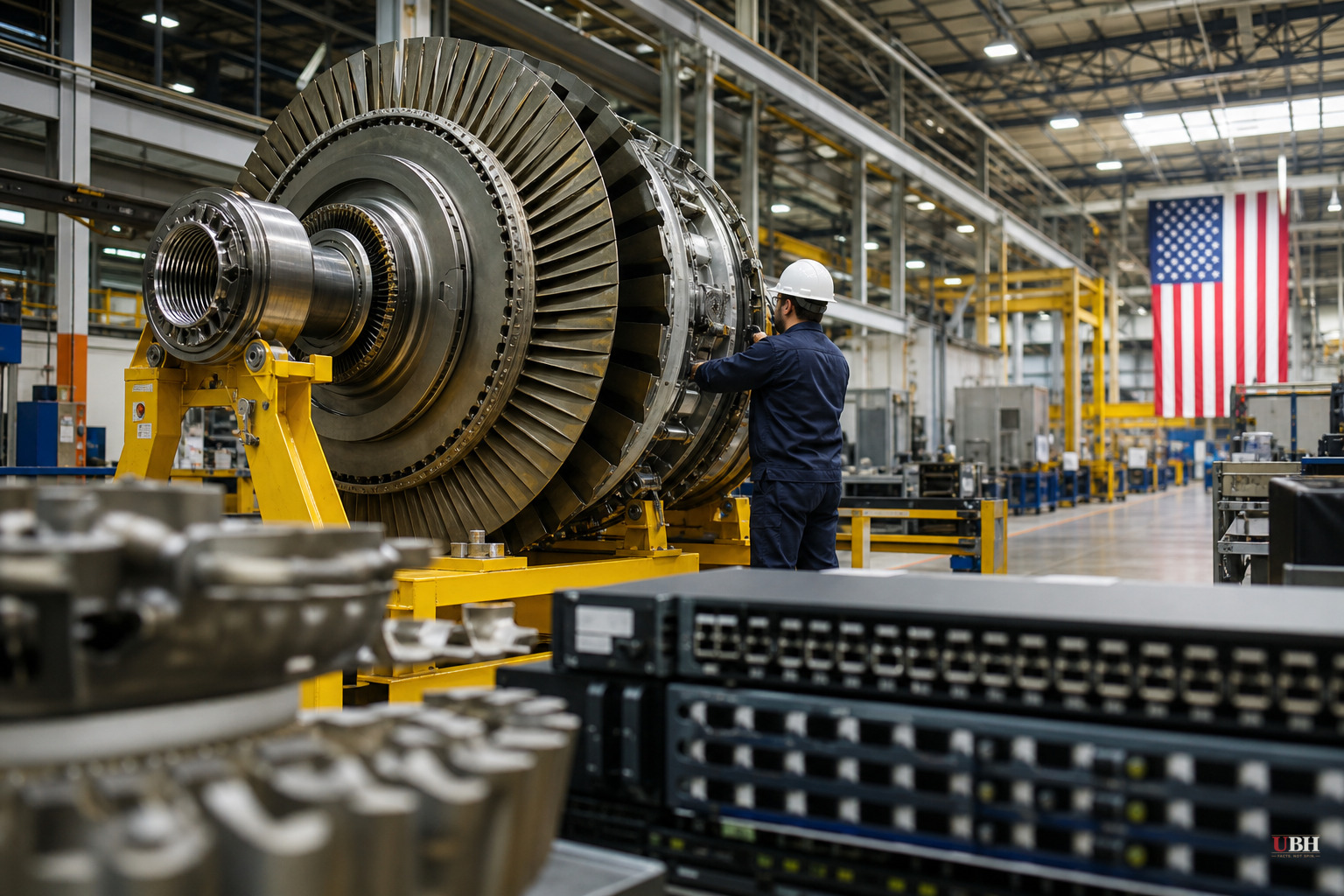
Generac made its name selling backyard generators. Now the Waukesha, Wisconsin company is spending $250 million retooling factories to build industrial-grade generators for data centers, according to Reuters. Its order backlog for those machines sits at $1.6 billion. CEO Aaron Jagdfeld told Reuters the company expects to add roughly 1,000 workers, a 10% headcount increase.
That's not an isolated story. Timken CEO Lucian Boldea told Reuters that data centers are now a growth driver alongside his traditional defense and aerospace customers, because the buildings themselves require steel bearings, gas turbines, and massive infrastructure. US factories added 5,000 jobs in July, bringing the year's total to 31,000, according to Labor Department data cited by Reuters. That represents a reversal from 2025, when factories cut 113,000 jobs.
The Census Bureau's April factory orders data, reported by Breitbart, backs this up with hard numbers. Nondefense communications equipment orders ran 32.2% above year-ago levels, the biggest gain in the report, worth more than $4 billion in additional orders through April alone. Computer and related products orders were up 22.3% year-to-date. Turbines and generators, HVAC and refrigeration equipment, and electrical equipment orders were all running 9% to 15% above last year's pace. The Institute for Supply Management's July reading hit its highest level in more than four years, and the Federal Reserve reported the same for its manufacturing output index on Tuesday.
The dollar figures behind this are staggering. Monthly US data-center construction spending hit $45.1 billion by December 2025, an 85% jump from two years earlier, according to figures reported by Crypto Briefing. Amazon, Microsoft, Google, Meta, and Oracle are projected to spend roughly $1.15 trillion combined on capital expenditures from 2025 through 2027, per Goldman Sachs estimates cited in that report. Deloitte forecasts US AI data-center power demand will jump from 4 gigawatts in 2024 to 123 gigawatts by 2035.
The bottleneck nobody can build around fast enough
Transformers, switchgear, and gas turbines all have production queues measured in years, not months. Crypto Briefing reports that between 30% and 50% of data-center capacity planned for 2026 could face delays tied to construction and grid bottlenecks. Site selection now hinges less on tax breaks and more on one question: is there power available, and when.
CNN's reporting adds a harder number to that picture. Goldman Sachs told CNN that historically about 72% of scheduled data-center capacity comes online on time. For capacity scheduled to activate through 2028, only about half is expected to hit its target date. JPMorgan told CNN that despite $750 billion in AI infrastructure investment this year, 60% of data-center capacity planned for completion in 2027 hasn't even broken ground, and 7% of projects already underway have been delayed further.
CNN also flags local opposition as significant. A Gallup poll found 71% of Americans oppose data centers, and several counties and states have proposed or passed outright bans. Local opposition is often dismissed by developers as NIMBYism, but residents raising concerns about rising electric bills and industrial-scale construction in their backyards have a legitimate stake in the outcome. Elected officials in both parties are now running on the issue.
Who pays for the power
The Daily Signal argues Texas offers a model: its Senate Bill 6 requires large data centers to help fund grid connection and infrastructure upgrades rather than sticking existing ratepayers with the bill. The piece argues, correctly, that electricity prices are driven by how the grid responds to demand growth, not demand growth alone, and that overregulation of energy supply, not data centers themselves, is the real constraint in many states.
The Washington Post's reporting on Kentucky presents the other side. When a former steel mill and one of the country's last aluminum smelters get converted into data-center sites, the framing as "reuse and reinvestment" glosses over a real question the Post raises: whether the jobs and tax base actually replace what was lost, or whether nearby families just inherit higher electric bills for a facility that employs far fewer people than the plant it replaced.
On emissions, a University of Chicago-hosted analysis citing Financial Times research found that 60 of the largest planned US data centers could together produce 101.5 million tonnes of CO2 annually once fully operational, roughly 7% of 2025 US power-sector emissions. Three-quarters of the utilities serving those projects are building or planning new gas capacity, and a third of utilities that still run coal plants are delaying retirements, according to that reporting. Energy researcher Jonathan Koomey called the estimate "a reasonable ballpark," noting it's a small fraction of total emissions but a sharp reversal from what tech companies were promising five years ago.
Factory floors really are humming. Order books really are full. The grid, the permitting process, and the neighbors around these projects are the actual constraint on how fast any of it gets finished. Goldman Sachs and JPMorgan's own numbers, cited by CNN, suggest the industry itself doesn't expect half of what's currently announced to arrive on schedule.
Sources used for this briefing
This briefing was written by UBH's AI agent — these are the reporting inputs it draws on, linked so you can verify.


