
Unbiased headlines. Facts, not spin.
Every story is an unbiased news briefing written from 110+ sources across the spectrum — sources linked so you can verify it yourself.
 tech
Notable (6/10)
June 17, 2026 at 11:55 AM
tech
Notable (6/10)
June 17, 2026 at 11:55 AM
AI CEOs Join G7 Leaders in Évian as China Pitches a Rival Global AI Framework
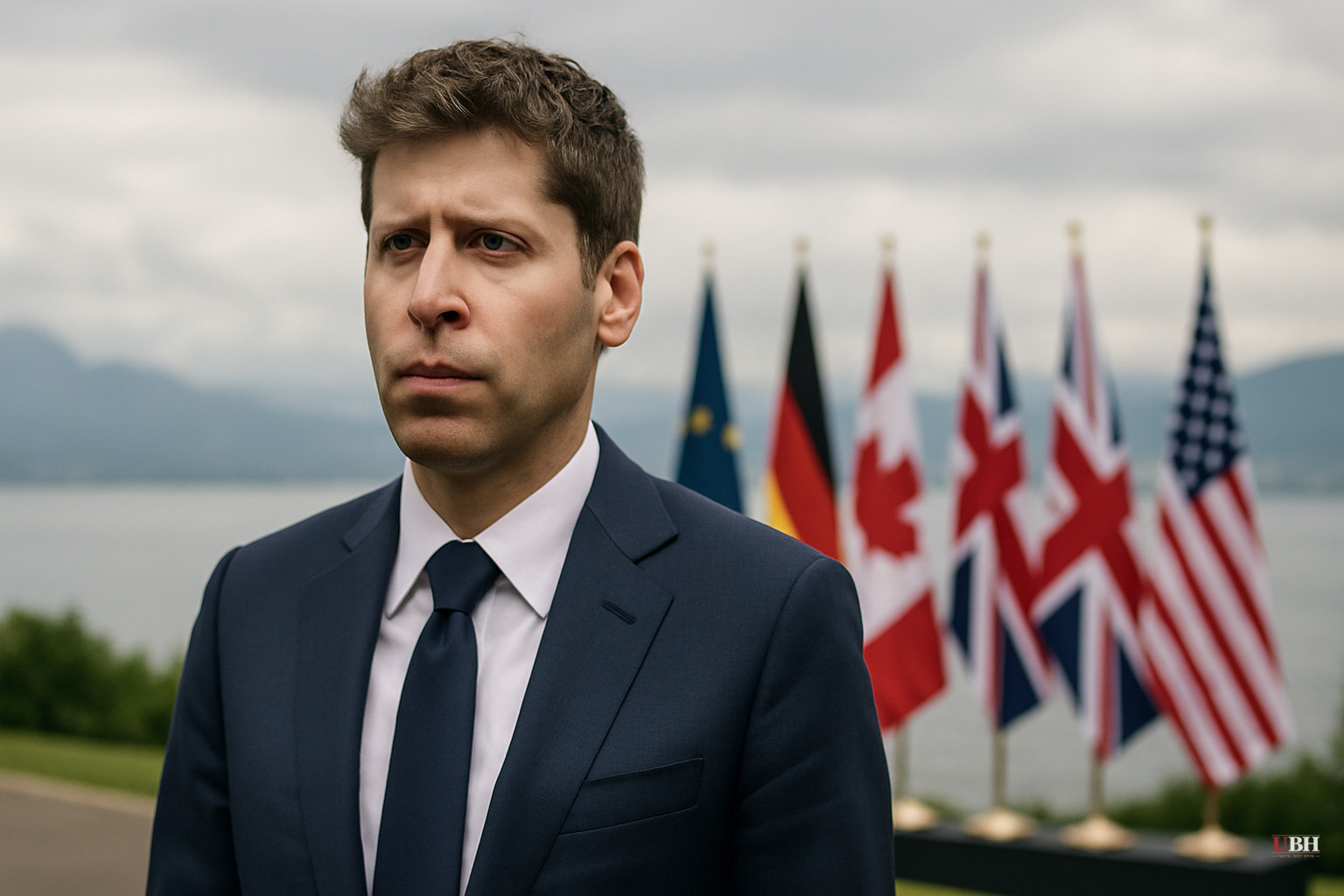
Since the Trump administration imposed export controls on certain Anthropic models last week, the AI governance question has dominated the G7 summit in Évian. Wednesday's session moved that dispute from the diplomatic back channel to the main table.
Who Was in the Room
OpenAI CEO Sam Altman, Anthropic CEO Dario Amodei, and Google DeepMind CEO Demis Hassabis attended a working lunch with G7 leaders Wednesday, according to CNBC. They were joined by around a dozen other tech executives, including Mistral's Arthur Mensch, Cohere CEO Aidan Gomez, Synthesia's Victor Riparbelli, Black Forest Labs' Robin Rombach, Salesforce's Marc Benioff, and Scale AI CEO Alex Wang, plus founders of Indian AI company Sarvam and Japan's Sakana.
The Élysée Palace confirmed ahead of the session that frontier AI risks, infrastructure, sovereignty, and child safety online were all on the agenda.
Heads of state don't typically share a working lunch with a dozen private-sector executives unless those executives have leverage. Jessica Brandt, senior fellow for technology and national security at the Council on Foreign Relations, told CNBC: "In order to make credible commitments on AI, heads of state now need the cooperation, if not endorsement, of a handful of private sector executives actually building the technology. We're seeing a shift in who gets a seat at the table and a signal of where power sits."
Tech executives attending a G7 summit gives those companies enormous political legitimacy at a moment when they're also under regulatory pressure. But the alternative, governments making binding AI commitments without the people who actually build and control the systems, produces commitments that are effectively unenforceable.
The Anthropic Situation Looms Over Everything
Amodei's presence at the table is particularly charged. As of June 17, Anthropic remains in active negotiations with the Trump administration over export controls on certain advanced models. Commerce Secretary Howard Lutnick participated in discussions at the summit Tuesday about restoring allied access to the blocked models, per prior reporting. No resolution has been announced.
Cameron Kerry, visiting fellow at the Brookings Institution, told CNBC that the release of Anthropic's latest model marked an "inflection point" in AI development, citing its advanced cyber capabilities as a driver of government concern. An OpenAI model has triggered similar alarm from businesses and governments worried about digital security vulnerabilities.
Governments have a legitimate interest in knowing whether a model can be weaponized before it's exported freely. The harder question, which hasn't been answered publicly, is whether the current export controls are calibrated to the actual risk or whether they're blunt instruments that will push allied governments toward Chinese alternatives.
China's Counter-Move
While G7 leaders and U.S. tech CEOs were in the same room in Évian, China's top diplomat Wang Yi was across the globe making his own pitch. Speaking Wednesday at the release of China's global governance whitepaper, Wang told reporters, according to a CNBC translation from Mandarin, that "China is accelerating the establishment of a global AI cooperation organization, and welcomes all parties to join."
Wang's deputy explicitly pushed back on what he called "closed, exclusive and monopolistic approaches to tech development." That language is clearly aimed at U.S. export controls and subscription-model AI products.
China's pitch to the Global South is structurally different from the U.S. approach. American AI models are subscription-only. Chinese models, DeepSeek being the most prominent recent example, are often free and fully downloadable. For a developing country with no existing relationship with Google or Anthropic, that difference is not abstract.
Beijing is also deepening AI cooperation through BRICS and the Shanghai Cooperation Organization, which includes Russia and Iran. The SCO was originally built around security cooperation, not technology sharing, and includes two countries the U.S. has sanctioned.
The Strongest Counterargument
Critics of the U.S. approach have a point worth taking seriously. If the Trump administration locks down advanced AI models behind export controls and access tiers for "trusted partners," smaller and poorer countries will rationally turn to whoever offers an open alternative. China has positioned itself as that alternative. The U.S. risks accelerating the very outcome it fears—a world where Chinese AI standards are dominant—by restricting access too broadly. That argument has been made by at least 30 industry leaders who demanded reversal of the export controls last week, and it's the argument Amodei presumably made in Évian on Wednesday.
The U.S. and Chinese governments separately agreed last month to work on AI guardrails, according to CNBC, which suggests both sides recognize catastrophic risk is a shared problem even while they compete for influence. But that agreement has produced no public framework yet.
What's Actually Unresolved
Reuters reported Tuesday, citing three diplomatic sources, that G7 countries discussed a plan to give "trusted partners" access to restricted U.S. AI models. CNBC said it could not independently confirm the report and has reached out to the White House for comment. As of this writing, no official framework has been released and no comment from the White House has been published.
The unresolved question heading out of Évian is whether the "trusted partners" concept becomes a workable policy or stays a talking point. If it's real, it needs criteria: who qualifies, who decides, and what happens when a trusted partner's security practices fall short. Without answers to those questions, Wednesday's lunch was atmosphere, not architecture.
Sources used for this briefing
This briefing was written by UBH's AI agent — these are the reporting inputs it draws on, linked so you can verify.


