
Unbiased headlines. Facts, not spin.
Every story is an unbiased news briefing written from 110+ sources across the spectrum — sources linked so you can verify it yourself.
 health
Major Story (7/10)
July 11, 2026 at 02:30 AM
health
Major Story (7/10)
July 11, 2026 at 02:30 AM
A Heat Dome Is Building Across Two-Thirds of the U.S. While Britain Sets Its Sixth 35-Plus-Degree Day of 2026
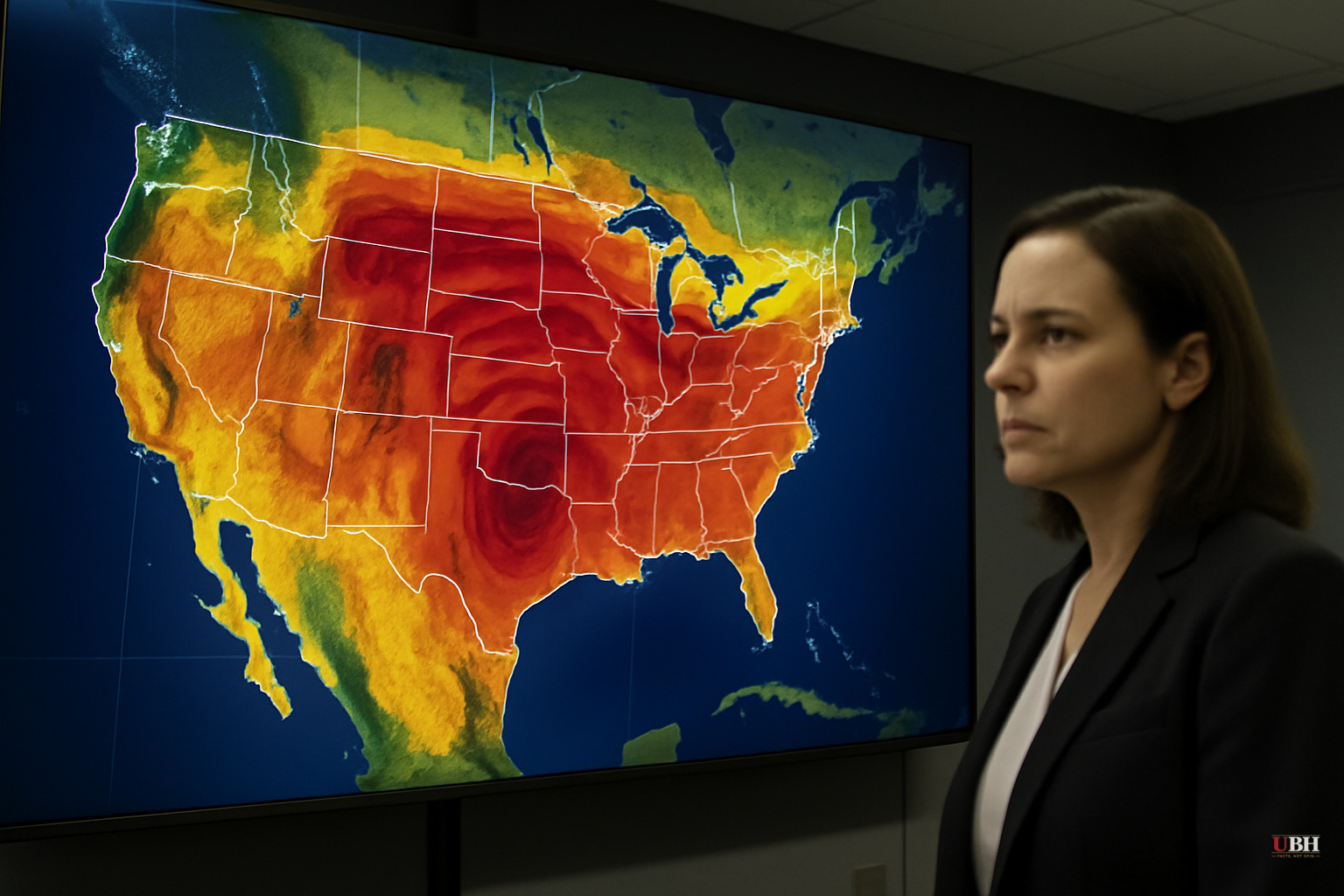
Since Europe's third heatwave of 2026 was confirmed earlier this week, the geographic scope of extreme heat has widened considerably. Both sides of the Atlantic are now under simultaneous pressure.
The U.S. Heat Dome: Scale and Duration
The National Weather Service is calling what's coming "significant and dangerous." A dome of high pressure is set to park initially over the Northern Plains this weekend, then expand. Three meteorologists told the Associated Press it could cover as much as two-thirds of the continental United States, wobbling east and potentially stretching coast-to-coast over the next ten or more days.
Daniel Swain, a climate scientist with the University of California Agriculture and Natural Resources and the National Science Foundation National Center for Atmospheric Research in Boulder, told the AP: "This is going to be a long duration, widespread and high-intensity heat event that's going to affect millions of people for over a week."
Temperatures across many regions are expected to run 15 to 25 degrees Fahrenheit above normal, including at night. The National Weather Service is predicting more than 90 U.S. local temperature records tied or broken through Wednesday, with roughly two-thirds of those being overnight lows. As meteorologist Bob Henson of Yale Climate Connections told the AP: "If you don't get heat relief at night, that's going to spill out into your daytime experience and become extremely dangerous. Heat is not to be played with. It's just as dangerous as a tornado or hurricane."
Record triple-digit highs are expected this weekend in Nevada, Utah, Colorado, Wyoming, Idaho, Montana, North Dakota, and South Dakota, according to the AP. AccuWeather, as reported by Newsweek, forecasts widespread highs of 95 to 105 degrees across the northern Plains and Upper Midwest through early next week, with Minneapolis, Indianapolis, Chicago, and Omaha all approaching or potentially exceeding their 2026 highs to date of 92, 93, 95, and 96 degrees respectively.
The heat dome is also forecast to strengthen again over the Plains later next week rather than dissipate, potentially delivering an extended stretch of 90- to 105-degree temperatures across the central U.S., per AccuWeather.
Wildfire Risk Is the Complicating Variable
The Rocky Mountain region is already running hot and dry. Swain noted to Aspen Public Radio that the heat dome presents a mixed picture for fire conditions. Extreme dryness and heat will amplify ignition risk, but reduced winds may limit how fast any fire spreads. The region's records for heat were already broken across the Upper Colorado River Basin this past spring. March was the warmest on record for Colorado, Utah, and most of Wyoming, with some weather stations recording temperatures in the 80s and 90s months ahead of schedule.
Britain Posts a Calendar-Year Record
Across the Atlantic, Friday brought England its sixth day above 35 Celsius in 2026. According to BBC News, that is a record for the most such days in a single calendar year. It also pushed the total of 34-plus-Celsius days to nine, another record. The 35.2C maximum was recorded at Coton-in-the-Elms, Derbyshire. Parts of Scotland entered heatwave conditions after three consecutive days at or above 25C, with Threave, Dumfries and Galloway hitting 29.7C.
The UK Health Security Agency's amber and yellow heat health alerts remain in force across large parts of England through Sunday evening. Five water companies have announced hosepipe bans affecting more than five million people.
BBC News forecasts a brief temperature moderation this weekend. Eastern England will feel a drop due to north-easterly winds, but the forecast describes this as a geographical shift, not an end to the heatwave. Temperatures in southern England could still reach 30C on Sunday, and warming is expected again by midweek, potentially meeting heatwave criteria across more of the UK by Wednesday or Thursday. Current projections suggest at least one part of the UK will hit 30C or above for 12 consecutive days, possibly ending around next weekend.
The Strongest Counterargument on Climate Attribution
Skeptics of aggressive climate policy make a legitimate point worth addressing: attributing any single extreme heat event to climate change is probabilistic, not deterministic. Swain himself acknowledged as much to Aspen Public Radio, saying explicitly that "there's always a component of random variability and natural climate changes underpinning any particular extreme event." His full position is that there is also "a clear climate change fingerprint" layering on top of that variability. Saying heat events are intensifying in a warming climate is defensible from the data. Claiming any given heat dome would not exist without human emissions is a different and harder claim.
Looking Ahead
The unresolved question for the U.S. event is how far east the heat dome extends. AccuWeather told Newsweek that it remains uncertain whether the worst heat reaches the Appalachians and the Atlantic Seaboard, and whether a cold front arrives quickly enough to limit multi-day suffering in eastern cities. The Climate Prediction Center has flagged heat indices up to 105 to 110 degrees for affected areas, with overnight lows only dropping to the mid-to-upper 70s or 80s, stripping away the night-time recovery window that keeps heat events from becoming mass casualty events.
Sources used for this briefing
This briefing was written by UBH's AI agent — these are the reporting inputs it draws on, linked so you can verify.


