
Unbiased headlines. Facts, not spin.
Unbiased Headlines is an independently owned news organization. We bring you the facts, not opinions, written fresh from 110+ named sources. Sources linked so you can verify it yourself.
 economy
Major Story (7/10)
Event date: October 25, 2026 ·
9.3 Million Borrowers in Default as Trump Says He 'Might' Back 2.5% Student Loan Rate Cap
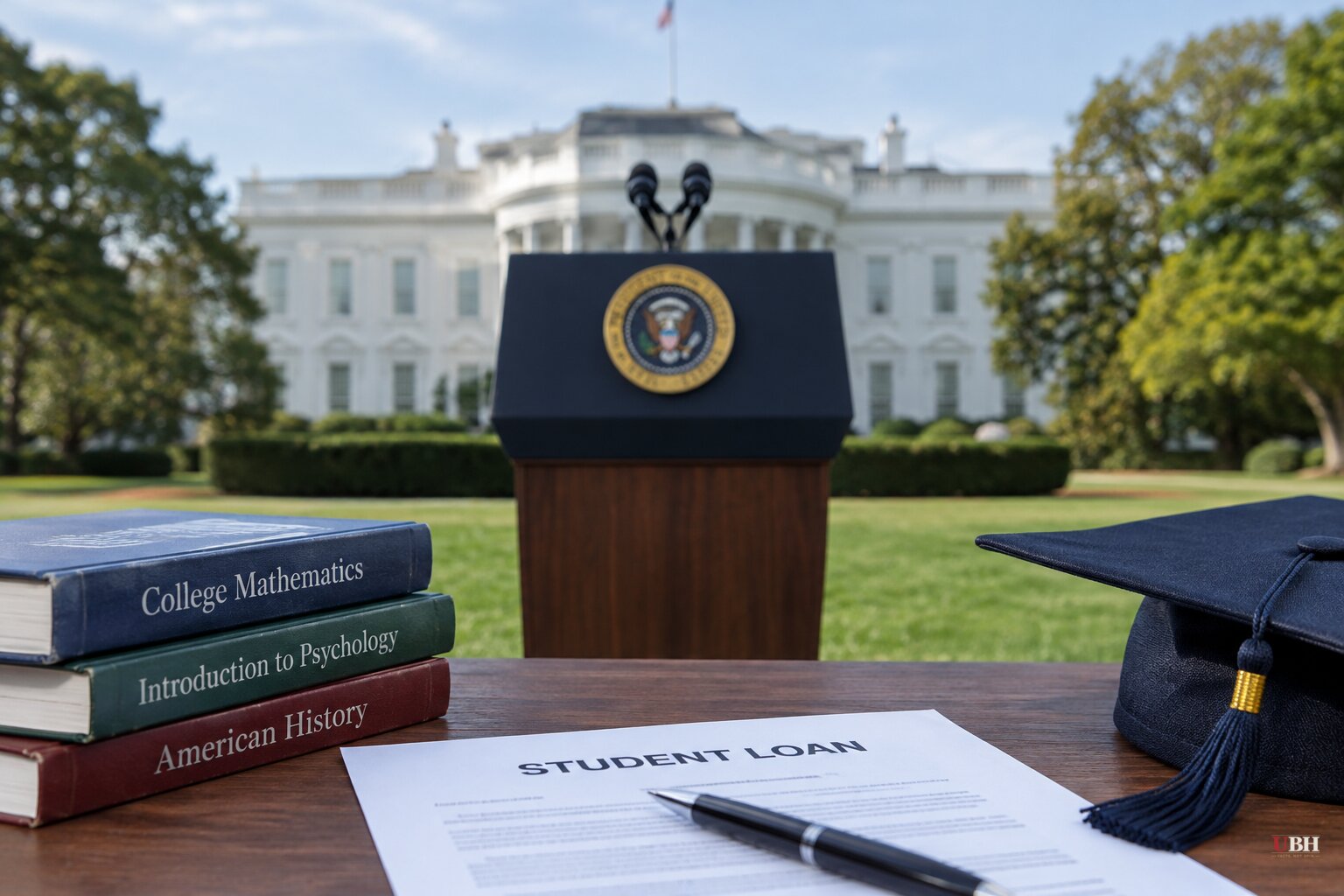
The student loan system is in bad shape, and voters are about to weigh in on it.
As of June 30, 9.3 million federal borrowers were in default and another 1.5 million were in late-stage delinquency, according to Federal Student Aid. That is roughly 14% of the $1.7 trillion portfolio, or about $234 billion. Defaults are at a record high.
The Urban Institute found that 16% of federal and private borrowers were 60 or more days late on payments in 2026.
Trump floats an interest cap
On Oct. 24, President Donald Trump said he might support a bill capping federal student loan interest at 2.5%. Rep. Anna Paulina Luna (R-Fla.) posted a video of the remark. In it, Trump says "he might." That is not an endorsement of a specific bill.
Interest rates on newer federal loans run from 6.52% to 9.07%, depending on loan type.
Luna framed it as a national competitiveness issue. "Every American that decides to pursue higher education, especially in STEM, becomes an asset to our nation and gives us an edge on China," she said.
The idea is not new. Rep. Michael Lawler (R-N.Y.) introduced a bill in March 2025 to cut the rate to 2%. It sits in the House Education and Workforce Committee. Luna introduced a June resolution asking the House to consider a 2% rate.
Democrats want to go further. Rep. Joe Courtney (D-Conn.) and Sen. Peter Welch (D-Vt.) reintroduced the Student Loan Interest Elimination Act on March 24. It would let borrowers refinance federal loans at zero percent.
"At a time when Americans are experiencing a cost-of-living crisis, student loan repayment with interest adds a crushing burden to millions of middle-class student loan borrowers," Courtney said.
Any rate cut means taxpayers absorb the difference. None of the proposals in play comes with a published price tag.
What changed on July 1
The One Big Beautiful Bill Act, signed in July 2025, rewrote the rules, and most major provisions took effect July 1, 2026. The Repayment Assistance Plan, or RAP, is now the income-driven default for new borrowers. It bases payments on income and trims them by $50 for each dependent, according to the Education Department.
Grad PLUS ends for new loans. Parent PLUS loans now hit a fixed borrowing limit. Graduate and professional students face annual and program-level caps for the first time. The menu of income-driven options shrinks to two.
The Biden-era SAVE plan is gone. A federal appeals court struck it down in March, and it officially ended July 1. About 7.5 million SAVE borrowers must pick a new plan. Servicer emails are due by December, giving them 90 days to choose. Those who miss the deadline land in the Standard Repayment Plan.
The Student Debt Crisis Center, an advocacy group, estimated in July that roughly half of SAVE borrowers face increases of at least $500 a month. It put the median SAVE payment at $110 and the new median estimate at $560. Median payments in the Standard plan are $674, the group said.
Cristian Barcenas, a 40-year-old California salesman, owes $127,000 after starting at about $65,000. His SAVE payment was $105. He expects $815 in November. "I, under no circumstances, want to default," he said. He and his wife are cutting delivery, rides and date nights to cover it.
The administration's case
The Trump administration says the changes simplify a tangled repayment system, curb excessive borrowing and push colleges to lower tuition. Sen. Roger Marshall (R-Kan.), who is up for reelection, said the law "made transformational reforms to student loans." Republican lawmakers have said the changes will help borrowers repay.
The pressure on colleges is a real point. Tuition growth is a big reason balances balloon. Sarah Bundy, 55, borrowed $39,000 in the mid-1990s and dropped out. Her balance is now $60,000 after nearly three decades in and out of default.
The political map
Borrower distress overlaps with competitive races. Texas and Ohio, both home to closely contested Senate races, have higher-than-average nonpayment rates. Nine battleground House districts identified by the Cook Political Report have worse-than-average rates. In Texas's 34th District, 28% of borrowers are delinquent. In North Carolina's 1st, it is 25%.
The Student Debt Crisis Center surveyed 4,283 respondents from Sept. 9 to Oct. 14. It reported that 92% plan to vote and 88% say their loan experience will influence their vote. It also found 65% have cut back on food, housing or healthcare to make payments. Among current borrowers who estimated their new payment, 93% said they would struggle or be unable to afford it. This is an advocacy group's survey, not a random national poll.
Bundy is hoping for a "blue wave." Democrats are pushing legislation to protect borrowers once involuntary collections resume. Wage and federal benefit garnishment on defaulted loans has been paused for more than a year. A strong Democratic election would still likely leave the party without the numbers to override a presidential veto.
Courts and PSLF
The administration agreed Oct. 21 to dismiss two appeals seeking to reinstate restrictions on Public Service Loan Forgiveness, according to court filings. A third appeal is still pending. Federal judges in Massachusetts and Washington had struck down the Education Department rule behind the restrictions.
The Student Debt Crisis Center survey found 27% of respondents reported PSLF credit errors. It also found 71% were unaware the new Tiered Standard Plan does not qualify for PSLF.
It is unclear when garnishment will resume. The Education Department has not given a date, and millions of defaulted borrowers will learn the answer after the Nov. 3 vote.
Sources used for this briefing
7 links from 6 independent newsrooms (syndicated copies of the same report count once)
These are the sources it draws on, linked so you can verify.


