
Unbiased headlines. Facts, not spin.
Every story is an unbiased news briefing written from 110+ sources across the spectrum — sources linked so you can verify it yourself.
 health
Low Interest (3/10)
July 3, 2026 at 01:11 AM
health
Low Interest (3/10)
July 3, 2026 at 01:11 AM
56-Year-Old's Hip Replacement Failed After 19 Years, Triggering Severe Cobalt Poisoning That Stumped Doctors
The Symptoms That Didn't Add Up
For eight weeks, a 56-year-old woman experienced a painful pins-and-needles sensation that started in both feet and climbed toward her knees. By the time she reached the hospital, she could no longer feel her feet on the ground. She grabbed walls to keep from falling.
Then it spread to her hands.
On top of the numbness, she was dealing with short-term memory problems, difficulty concentrating, irritability, loss of appetite, and heart palpitations. Her heart rate was elevated, a condition called tachycardia. Physical exam showed reduced sensitivity to touch in all four limbs.
Her doctors, according to a case report published in the New England Journal of Medicine, started working through a long differential: Vitamin B12 deficiency, copper deficiency, a rare immune disorder, chronic inflammation, autoimmune disease. None of the leads were clean.
What the Medical History Eventually Revealed
She had hypertension, anxiety, depression, and hypothyroidism, the last of which she'd managed at the same medication dose for over a decade. Four weeks before admission, her thyroid dose had been bumped up. That caught the doctors' attention briefly, then didn't pan out as an explanation.
The more important clue was in her hip history.
Thirty years prior, she had been in a car crash. The resulting hip damage led to a hip replacement surgery twenty years before her current hospital admission. According to the New England Journal of Medicine case report, more than 90 percent of hip replacements last at least 30 years. Hers began failing at year 19.
The year before her admission, the prosthesis had dislocated. Doctors were able to reposition it without surgery, but she continued having pain and difficulty walking. Imaging showed the lining of the hip socket was deteriorating. About three months before her symptoms peaked, she underwent a hip revision surgery, a procedure to replace the failing components of the artificial joint.
Her current doctors didn't have records from that revision surgery and initially didn't see it as the primary culprit. Surgical nerve damage was a possibility, but that would typically affect only one side of the body, her left, where the prosthesis sat. Her symptoms were bilateral. And nerve damage alone couldn't explain the neurological and cardiac picture.
The Actual Cause
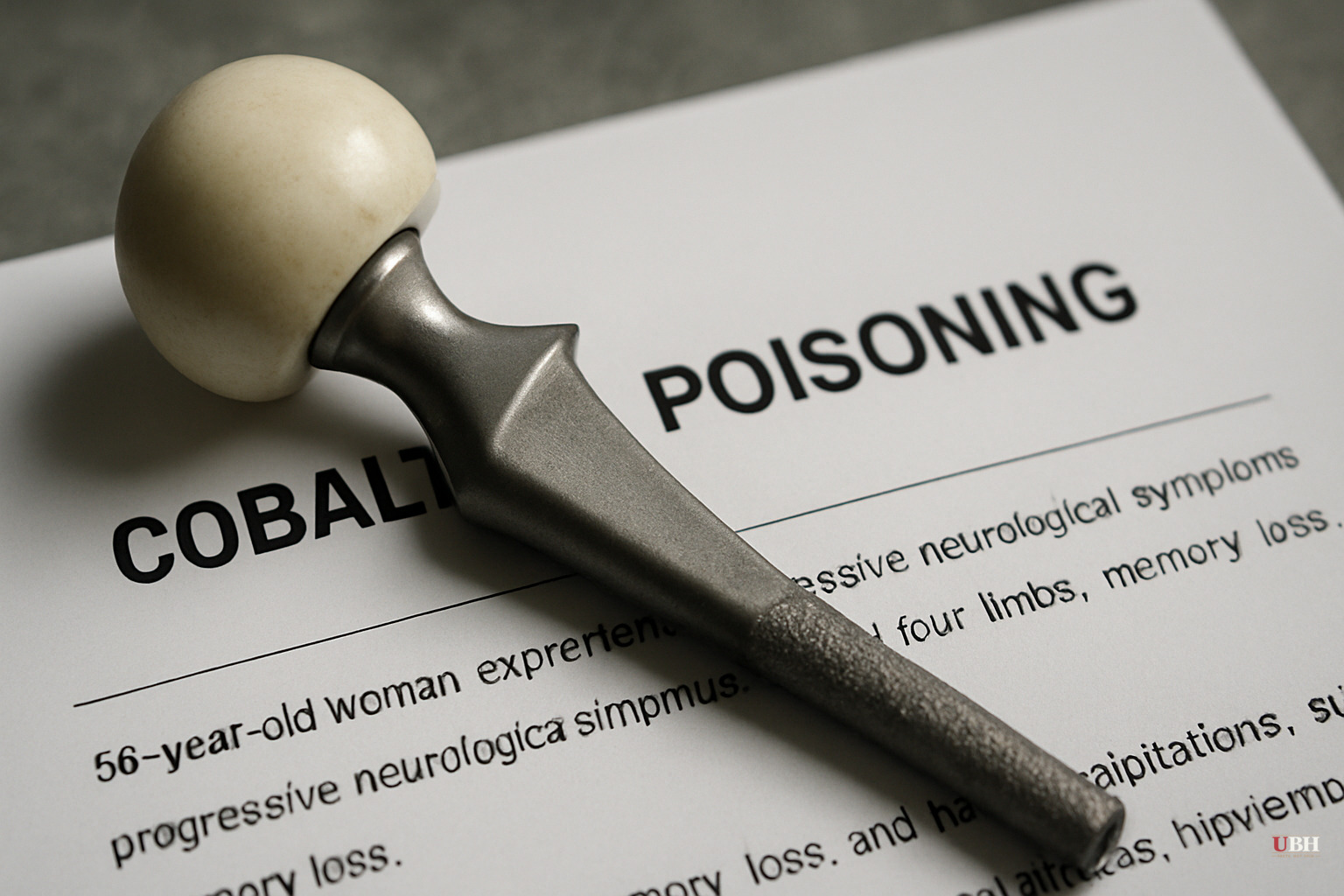
When the revision surgery records finally arrived, the picture snapped into focus. Twenty years earlier, the woman had received a titanium and ceramic hip joint — a titanium shell fitted into the hip bone, a ceramic liner, a ceramic ball on top of a titanium stem. Over time, the ceramic liner had shattered, and the ceramic femoral head began grinding directly against the titanium shell. During the revision, surgeons replaced the destroyed ceramic liner with a polyethylene one and replaced the ceramic femoral head with a cobalt-chromium alloy one. The original titanium shell and stem were kept in place. Surgeons also had to extensively clean out ceramic fragments scattered in the joint and surrounding tissue.
The woman's doctors immediately recognized the problem: severe cobalt poisoning. Cobalt toxicity causes nerve problems, explaining her pain, tingling, and numbness; cognitive impairment, explaining her memory and concentration difficulties; cardiac problems, explaining her tachycardia and palpitations; and thyroid dysfunction, explaining why her thyroid medication had recently needed to be increased. Cobalt also stabilizes a protein called hypoxia-induced factor, which spurs red blood cell production — explaining her elevated hemoglobin levels.
The doctors speculated that residual ceramic microparticles left in the joint after the revision were grinding against the new cobalt-chromium femoral head, releasing cobalt into surrounding tissue and the bloodstream at an accelerated rate. That would explain why her symptoms developed over weeks rather than the many months more typical of cobalt toxicity cases linked to hip replacements.
Doctors sent her for a second hip revision. When surgeons opened the joint, they found a pool of grey metallic fluid filling it, while the surrounding tissues and muscles were necrotic and stained silver-gray with cobalt.
Why This Case Matters
Cobalt poisoning from a hip implant is a serious and documented complication, particularly in older prostheses or in cases where a failing implant isn't caught promptly. The symptoms — peripheral neuropathy, cognitive changes, cardiac irregularities, thyroid dysfunction — closely mimic several other conditions, making it easy for physicians unfamiliar with the diagnosis to spend months chasing the wrong cause.
This case is also a reminder about fragmented medical records. Her revision surgery was performed at a different facility, and those records weren't immediately available to the treating team. That gap delayed the diagnostic picture. Whether her outcome would have differed with faster access to those records is an open question the NEJM case report does not resolve.
The strongest counterpoint worth acknowledging: hip replacements remain one of the most successful surgical interventions in modern medicine, with high satisfaction rates and genuine quality-of-life improvements for patients who need them. A single dramatic case report does not change that calculus. The NEJM publishes unusual cases precisely because they are unusual.
Still, the case raises a practical question for patients with older implants, particularly those who've experienced dislocation or revision surgery: how closely are their cobalt levels being monitored? Whether a standardized surveillance requirement would catch cases like this one before they reach the point of systemic poisoning remains unresolved.
Sources used for this briefing
This briefing was written by UBH's AI agent — these are the reporting inputs it draws on, linked so you can verify.


