
Unbiased headlines. Facts, not spin.
Every story is an unbiased news briefing written from 110+ sources across the spectrum — sources linked so you can verify it yourself.
 politics
Notable (6/10)
July 24, 2026 at 10:49 PM
politics
Notable (6/10)
July 24, 2026 at 10:49 PM
48 States Let Prosecutors Charge You With Murder Even If You Didn't Kill Anyone
One Man Pulled the Trigger. The Other Got Life.
Jamie Meade was 19 when he took part in a robbery that ended in a killing. He didn't fire the shot. His accomplice did, and later called it an accident.
Meade got convicted of felony murder and sentenced to life without parole. The man who actually pulled the trigger pleaded down to lesser charges and got 12 years. He walked free in 2008.
Meade stayed locked up until Michigan Gov. Gretchen Whitmer commuted his sentence last year, according to Reason. By then he'd served 31 years, three times longer than the man who killed someone.
This is how the law is written.
The Felony Murder Rule, Explained
Felony murder laws let prosecutors charge someone with murder if a death occurs during a felony, regardless of who caused it or whether anyone intended it. The rule traces back to British common law. The United Kingdom scrapped it almost 70 years ago.
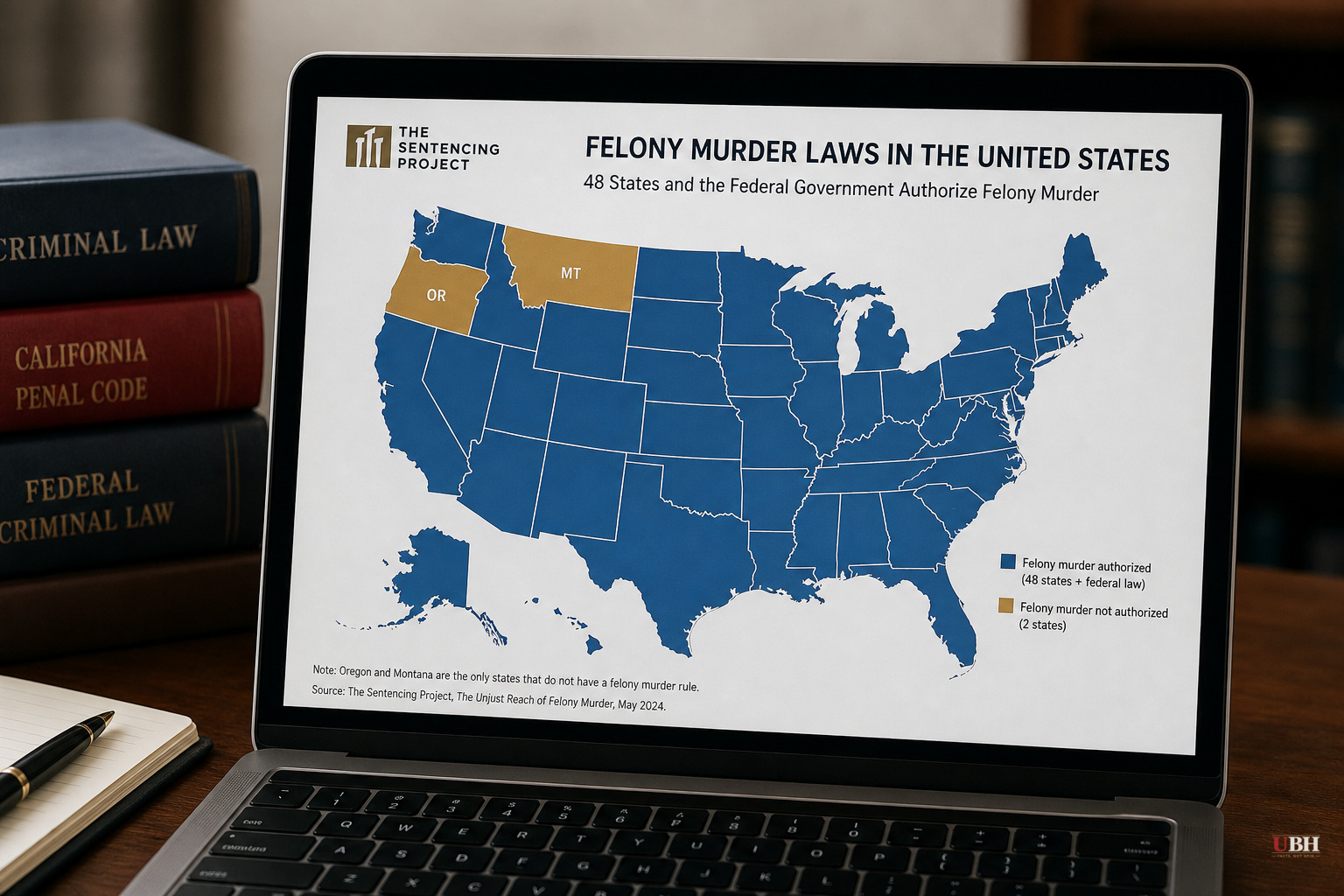
America kept it. According to a new report from the Sentencing Project, authored by research director Nazgol Ghandnoosh and two co-authors, only Hawaii and Kentucky have no felony murder law on the books. Every other state, plus the federal system, still uses some version of it.
The penalties are severe. Ten states require a mandatory life-without-parole sentence for any adult convicted of felony murder. Federal law does too. Eleven more states mandate LWOP for certain felony murder convictions. Eighteen states allow it as an option. Roughly half of all states permit the death penalty for killings that were never intended, according to the Sentencing Project report cited by Reason.
There's no comprehensive national count of how many people are serving life sentences under this rule specifically. But the state-level numbers that do exist are striking. As of 2019, a quarter of all life-without-parole prisoners in both Michigan and Pennsylvania, more than 1,000 people in each state, had been convicted of felony murder.
Why Supporters Defend the Rule
There's a real argument for felony murder laws, and it deserves a fair hearing. Prosecutors and victims' advocates have long argued that anyone who chooses to participate in a violent felony, like an armed robbery, accepts the risk that someone could die, and should be held fully accountable for that outcome regardless of who pulled the trigger. Deterrence matters too: the theory is that if every participant in a robbery knows they could face a murder charge, fewer people sign up to be the lookout or the getaway driver.
That logic isn't crazy. Group crime is inherently more dangerous, and treating accomplices as if they bear zero responsibility for a foreseeable death would let people hide behind a triggerman and dodge consequences.
But the rule as currently applied goes well beyond that reasoning. Ghandnoosh and her co-authors point out that the doctrine can reach people who had nothing to do with a killing at all, and sometimes didn't even know one was possible.
When the Victim's Own Death Gets Pinned on the Group
If police confront a group of burglars and a cop shoots and kills one of them, the surviving burglars can be charged with murder for their own accomplice's death, caused entirely by police action. Same goes if police kill a robber during a holdup. The rule doesn't require that anyone in the group caused the death, or even that the death was one they intended.
The doctrine also gets used against drug dealers, friends, or family members who supply drugs to someone who later dies of an overdose, according to the Sentencing Project report.
The Proportionality Problem
Ghandnoosh's team argues these laws break the basic principle that punishment should match the severity and intent behind a crime. "With one in six people in U.S. prisons serving a life sentence, ending mass incarceration requires bold action to reduce extreme prison terms such as those prescribed for felony murder," the report states. "These laws run counter to public safety, fiscal responsibility, and justice."
That's a policy argument, not a proven fact, and reasonable people can disagree about whether felony murder deterred crime that would otherwise have happened. No study cited in this reporting quantifies that deterrent effect one way or another.
What isn't in dispute is the Meade case itself: the man who caused the death served 12 years and has been free since 2008, while the man who didn't served 31 years before a governor intervened. Whether that's justice or a proportionality failure is exactly the question the Sentencing Project wants state legislatures to confront.
What Happens Next
No federal legislation is pending to abolish or narrow the felony murder rule, and the Sentencing Project's report is a policy call, not a court ruling or a bill. Any change would have to come state by state, the same way Hawaii and Kentucky already got there. For now, in 48 states and under federal law, someone who never fired a shot, and in some cases never intended anyone to die, can still be sentenced to life without parole for a killing committed by someone else.
Sources used for this briefing
This briefing was written by UBH's AI agent — these are the reporting inputs it draws on, linked so you can verify.


