
Unbiased headlines. Facts, not spin.
Every story is an unbiased news briefing written from 110+ sources across the spectrum — sources linked so you can verify it yourself.
 finance
Notable (6/10)
Event date: August 11, 2026
finance
Notable (6/10)
Event date: August 11, 2026
30-Year Treasury Yield Hits Highest Level Since 2007. The Bond Market Isn't Panicking, the Data Says
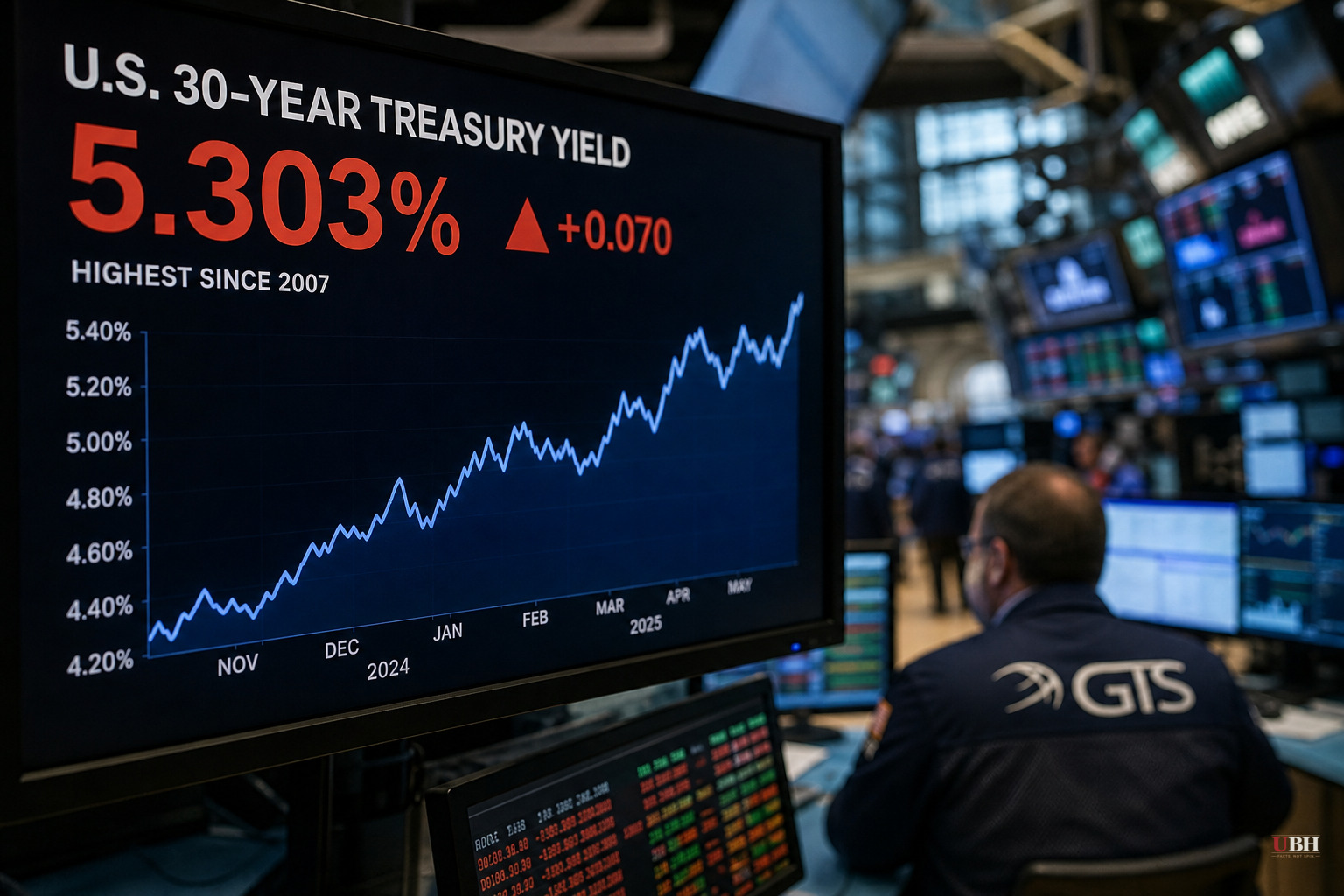
The yield on the 30-year U.S. Treasury bond broke above 5.30 percent Monday, the highest level since 2007, according to Breitbart Business Digest. Last week's 30-year bond auction already produced the highest borrowing cost for that maturity since 2001.
The headline number invites an easy story: America can't control its debt, inflation is roaring back, investors are fleeing. CNBC framed the move as driven by "worries growing among investors about persistent inflation and government borrowing," a framing Breitbart's analysis says shows up almost everywhere in financial coverage.
The federal government is running trillion-dollar-plus deficits, the debt keeps climbing, and it's legitimate to ask whether Washington's borrowing habits eventually get priced into long-term interest rates. If that were happening, you'd expect one specific market signal to confirm it.
What the Breakeven Rate Actually Shows
That signal is the breakeven inflation rate: the gap between an ordinary 30-year Treasury yield and the yield on a 30-year Treasury Inflation-Protected Security (TIPS) of the same maturity. It measures how much inflation compensation bond buyers are actually demanding, as opposed to how much commentators assume they're demanding.
If investors feared Washington would inflate away its debt, that breakeven number should be climbing. According to Breitbart's analysis of the data, it's doing the opposite. The monthly 30-year breakeven ran 2.20 percent in July, down from 2.30 percent in May. Since the series began in 2010, the median reading has been 2.23 percent. Today's figure sits below the 2.55 percent hit in April 2022 and well under the 2.71 percent recorded in 2011.
Daily figures tell the same story. At the start of the year, the nominal 30-year yield sat at 4.86 percent while the TIPS-implied real yield was 2.63 percent, a 2.23-point gap. Since the Fed's 2 percent inflation target is measured against the PCE index, which typically runs a bit cooler than CPI, that gap suggests bond markets think the Fed is roughly on target, not losing control.
If the breakeven isn't rising, then the climb in nominal yields is coming from the other component: the real return investors demand for their money. That component rises when investors expect stronger economic growth and better returns elsewhere, not when they're scared. It's a plausible read of the data, but it's also the more flattering one, and readers should weigh it against the fact that federal borrowing costs are now higher than they've been in nearly two decades regardless of which component is driving it. Higher long rates mean higher costs on new Treasury issuance no matter what's causing them.
India's Central Bank Rattles Its Own Bond Market
A separate but related lesson in how policy moves shake fixed-income markets played out in India this week. The Reserve Bank of India abruptly closed its special dollar-deposit swap window, known as FCNR(B), a full month ahead of schedule, ending the program on August 31 instead of the previously planned date, according to Business Standard and the Economic Times.
The window had already pulled in more than $50 billion from overseas Indians, more than the RBI expected, according to Bloomberg reporting carried by Business Standard. RBI Governor Sanjay Malhotra had explicitly ruled out an early closure earlier in the month, which is part of why the move caught traders off guard.
The fallout was immediate. Five-year Indian bond yields rose as much as 9 basis points to 6.44 percent and 10-year yields climbed 4 basis points to 6.80 percent, according to GoldSilverReports, citing BNY's Geoff Yu. The rupee weakened the most in nearly a month against Asian peers, Business Standard reported, though FXStreet noted the currency had still been trading around 95.60 per dollar, within its recent range, after two prior days of losses.
Citigroup cut its near-term rupee forecast, now seeing gains capped at 95 per dollar versus 94 previously, and trimmed its estimate for total inflows under the program by $10 billion to $70 billion, per Business Standard. ICBC said a popular yield-curve steepening trade tied to the program has "less runway" now. Goldman Sachs took profits on a related currency trade, expecting the rupee to move sideways going forward.
BNY's Yu said the early closure signals the RBI is growing more cautious about the future liability and forward-premium costs of running the swap facility indefinitely, and that it could slow further foreign-reserve accumulation after India's reserves topped $700 billion.
Two Different Stories, One Common Thread
The U.S. and Indian episodes aren't the same story, but they share a lesson: a rising yield or a policy surprise doesn't automatically mean what the first headline says it means. In the U.S., the loudest inflation narrative isn't backed up by the market's own inflation-pricing mechanism. In India, a policy reversal that blindsided traders, including apparently the RBI governor's own prior public statements, is now working through funding costs for banks and companies that may need to raise short-term money at higher rates before refinancing longer term, according to Bloomberg Intelligence's Rena Kwok.
The open question in both cases is the same: what happens next. In the U.S., whether the real-yield-driven story holds if growth data disappoints. In India, whether the RBI's early closure was a one-off liquidity management decision or the start of a more cautious stance on capital inflows heading into the rest of 2026.
Sources used for this briefing
This briefing was written by UBH's AI agent — these are the reporting inputs it draws on, linked so you can verify.


