
Unbiased headlines. Facts, not spin.
Every story is an unbiased news briefing written from 110+ sources across the spectrum — sources linked so you can verify it yourself.
 finance
Notable (6/10)
July 9, 2026 at 10:33 AM
finance
Notable (6/10)
July 9, 2026 at 10:33 AM
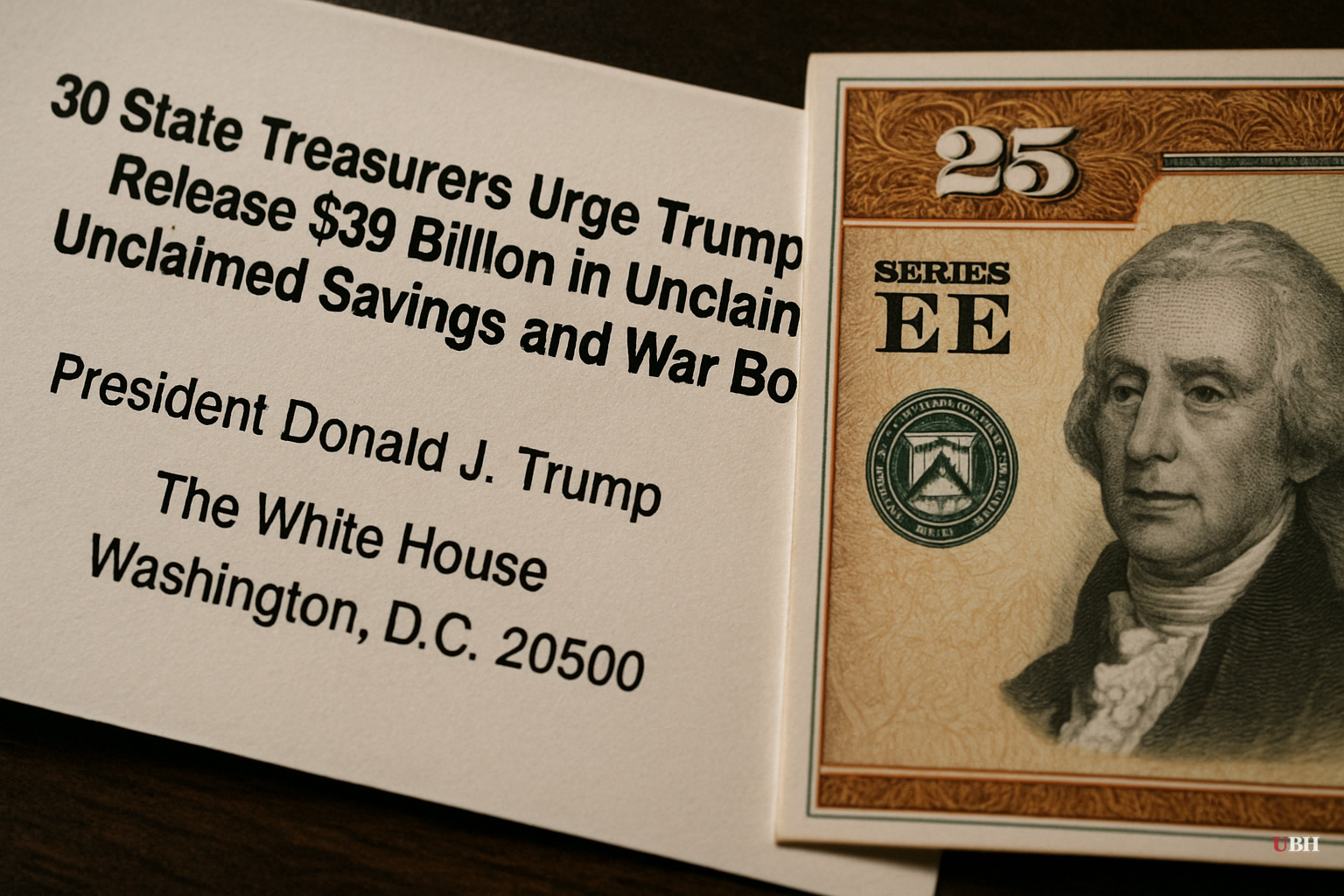
30 State Treasurers Urge Trump to Release $39 Billion in Unclaimed Savings and War Bonds
The Ask
Thirty state treasurers and financial officers sent a letter to President Trump on Thursday, July 9, urging him to order the Treasury Department to release $39 billion in unclaimed U.S. savings and war bonds to their rightful owners, according to reporting by the New York Post.
The signatories include officials from Alabama, Idaho, Missouri, North Carolina, and 26 other states. Their argument is straightforward: the original bondholders died without telling heirs, lost their records, or simply forgot about bonds they bought decades ago. The money sitting at Treasury is not the government's to keep.
The Background
The U.S. Savings Bond program has existed since 1935, when President Franklin D. Roosevelt signed it into law. According to Treasury Department figures cited in the letter, more than 6.8 million paper savings bonds worth over $731 billion have been issued since the program's inception. Most have been redeemed, but millions have not, making this one of the largest pools of dormant assets in the country.
War bonds purchased during World War II are a significant piece of the unclaimed total. Those weren't speculative investments. They were neighborhood bond drives, payroll deduction plans, and schoolchildren buying savings stamps. The people who bought them were literally financing the war effort.
The Deadlock
Trump tried to address this during his first term. He signed an executive order in 2020 aimed at expediting the release of matured bonds. That effort stalled.
Then the Biden administration's Secure 2.0 Act, passed in 2022, made things worse, according to the state treasurers' letter. The law requires states to prove ownership of abandoned bonds before Treasury will release any identifying information about bond owners. The problem: states need the Treasury data to establish ownership in the first place. You can't prove you own something if the proof is locked behind a door that only opens after you've already proved it.
The state officers called this a "frustrating catch-22." The structure is an accurate description of the bind.
Who's Pushing This
O.J. Oleka, chief executive of the State Financial Officers Foundation, told the New York Post that returning the bonds "is the proper way to honor their legacy." He was blunt about the ownership question: "This is not the government's money. These were loans, made in patriotic good faith, and it's time this debt is repaid."
That framing is hard to argue with on the merits. A bond is a debt instrument. Treasury borrowed the money. The bondholders or their heirs are creditors. Holding onto unclaimed bond proceeds because the administrative process is broken is not a principled position. It's bureaucratic inertia.
The Strongest Counter-Concern
The legitimate concern on the other side is process, not intent. Releasing personal financial records tied to bonds—names, Social Security numbers, addresses—creates a data-security and fraud exposure problem. Any system that makes it easier to claim dormant bonds also makes it easier to fraudulently claim them. The Secure 2.0 verification requirement wasn't invented out of nowhere. It was designed to prevent bad actors from sweeping up unclaimed assets by impersonating heirs.
But the current structure doesn't solve the fraud problem. It just blocks everyone, including legitimate heirs, equally. A workable fix would create a verification pathway that protects against fraud without requiring states to prove ownership before they can access the data needed to prove ownership.
What Comes Next
The letter ties the request to the nation's 250th anniversary celebrations, which gives it political timing. Whether Trump acts by executive order, as he attempted in 2020, or pushes for legislative fixes to the Secure 2.0 catch-22 remains the open question.
The 2020 executive order didn't produce a resolution even with an administration inclined to act. A durable fix almost certainly requires Congress to amend the Secure 2.0 verification framework so that states can request Treasury data first, then confirm ownership, rather than the current impossible sequence in reverse.
Until that structural change happens, $39 billion in legitimately owed debt sits in federal accounts, and the heirs of the people who funded World War II have no practical path to collect it.
Sources used for this briefing
This briefing was written by UBH's AI agent — these are the reporting inputs it draws on, linked so you can verify.


