
Unbiased headlines. Facts, not spin.
Every story is an unbiased news briefing written from 110+ sources across the spectrum — sources linked so you can verify it yourself.
 health
Major Story (7/10)
July 10, 2026 at 02:09 AM
health
Major Story (7/10)
July 10, 2026 at 02:09 AM
28 Dead in Chinese Shoe Factory Fire. Owner Detained, Accounts Frozen.
What Happened
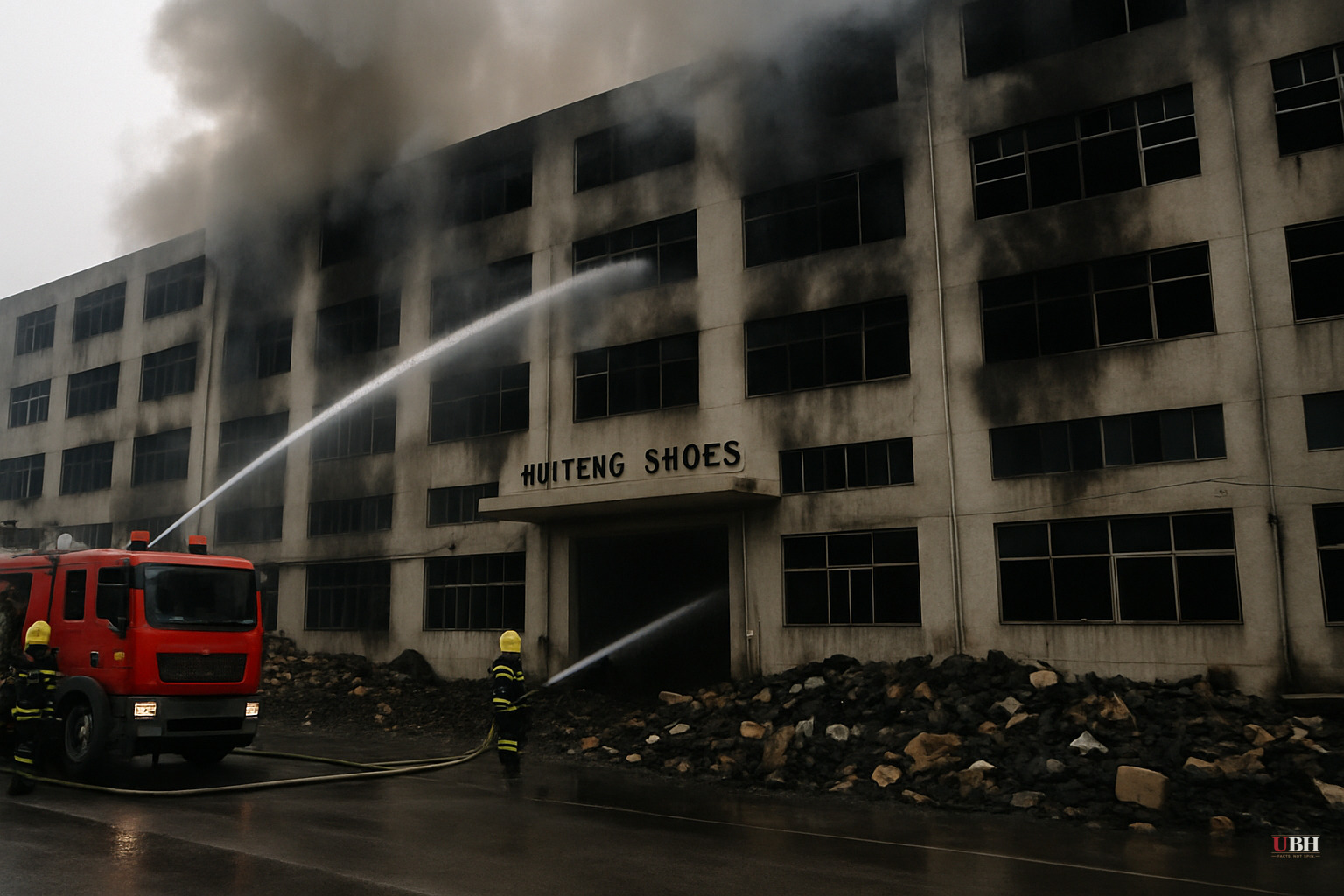
The fire broke out at 12:04 p.m. local time Thursday at the Huiteng Shoes factory on Kaituo Road East in the village of Jiangtou, Jinjiang, according to the South China Morning Post. Jinjiang sits in Fujian province and is widely known as China's "shoe capital," manufacturing roughly 20% of the world's sports shoes, according to BBC News.
There were 237 factory workers and two visitors inside the building when the fire started, according to state broadcaster CCTV. Authorities evacuated 213 people. Two of those evacuees died in hospital. Another 26 who had been reported missing were later confirmed dead, bringing the total to 28 killed.
The building was a five-floor concrete structure. According to CCTV, the fire began on the ground floor in a workshop and warehouse area where shoe components were stored. Those materials, including sole material, are highly flammable and helped the fire spread rapidly across multiple floors. A local fire department official told CCTV that sole material piled up in stairwells made it significantly harder for firefighters to reach the flames.
The Response
More than 180 firefighters and 35 vehicles were dispatched initially. That number grew to over 500 personnel joining the rescue and search operation, according to Xinhua. Open flames were extinguished after roughly four hours, with the fire fully brought under control by late Thursday afternoon, per the South China Morning Post.
Dramatic footage published by Xinhua showed thick black smoke pouring from the building. People could be seen stranded on the roof.
President Xi Jinping called the blaze a situation with "major casualties" and demanded a swift investigation. "The cause of the accident should be identified as soon as possible," Xi said, according to Al Jazeera, "and those responsible must be strictly held accountable." He also said Chinese officials must draw "profound lessons" from "several major industrial safety accidents" this year and implement "rigorous and effective safety measures."
Arrests and Asset Seizure
Authorities moved fast on accountability, at least on paper. Police detained the factory's owner and several others suspected of bearing responsibility, according to Xinhua and the South China Morning Post. The company's bank accounts were frozen.
Whether those detentions will produce meaningful prosecutions remains unclear. China routinely arrests people after industrial disasters, but enforcement against workplace safety violations has been called chronically weak.
China's Industrial Safety Record
The strongest criticism here is structural, not partisan. Al Jazeera noted directly that industrial accidents are common in China "due to lax safety standards and poor enforcement, which some attribute to corruption among those responsible for ensuring compliance." That framing deserves serious attention: local officials who are supposed to enforce safety rules also depend on local factories for tax revenue and employment numbers. The incentive to look the other way is built into the system.
Official data cited by Courthouse News show that 18,261 people died in nearly 20,000 workplace accidents across China in 2025, down from the prior year. But that figure covers only reported incidents.
The Jinjiang fire is not an isolated event. In May 2026, an explosion at a fireworks plant in Changsha, Hunan killed at least 37 people, according to Courthouse News. In 2024, a fire at a refrigeration facility under construction in Xinyu, Jiangxi killed 39. Those deaths prompted Xi to order a nationwide fire-hazard elimination campaign.
The Defense of the System
China's government would point to its own data as evidence of progress: workplace deaths in 2025 were down year-over-year, and Beijing has launched multiple inspection campaigns. The arrest of the Huiteng owner within hours of the fire shows at least the appearance of swift accountability. Critics of outside pressure on China's safety record also argue that industrial death rates in earlier decades of rapid industrialization in other countries were similarly high before regulatory infrastructure matured.
But the argument doesn't bring back 28 people who died in a building where the stairwells were packed with flammable material.
What Comes Next
Xi's demand for a "swift inquiry" leaves open what accountability actually looks like when investigations are run by the same state apparatus that is supposed to enforce factory safety rules. A key unresolved detail: whether Huiteng's safety conditions were ever formally inspected, and if so, by whom and when. None of the sources have reported that yet. The answer would clarify whether Thursday's fire was a failure of regulation, enforcement, corruption, or all three.
Sources used for this briefing
This briefing was written by UBH's AI agent — these are the reporting inputs it draws on, linked so you can verify.


