
Unbiased headlines. Facts, not spin.
Every story is an unbiased news briefing written from 110+ sources across the spectrum — sources linked so you can verify it yourself.
 finance
Notable (5/10)
June 15, 2026 at 02:05 AM
finance
Notable (5/10)
June 15, 2026 at 02:05 AM
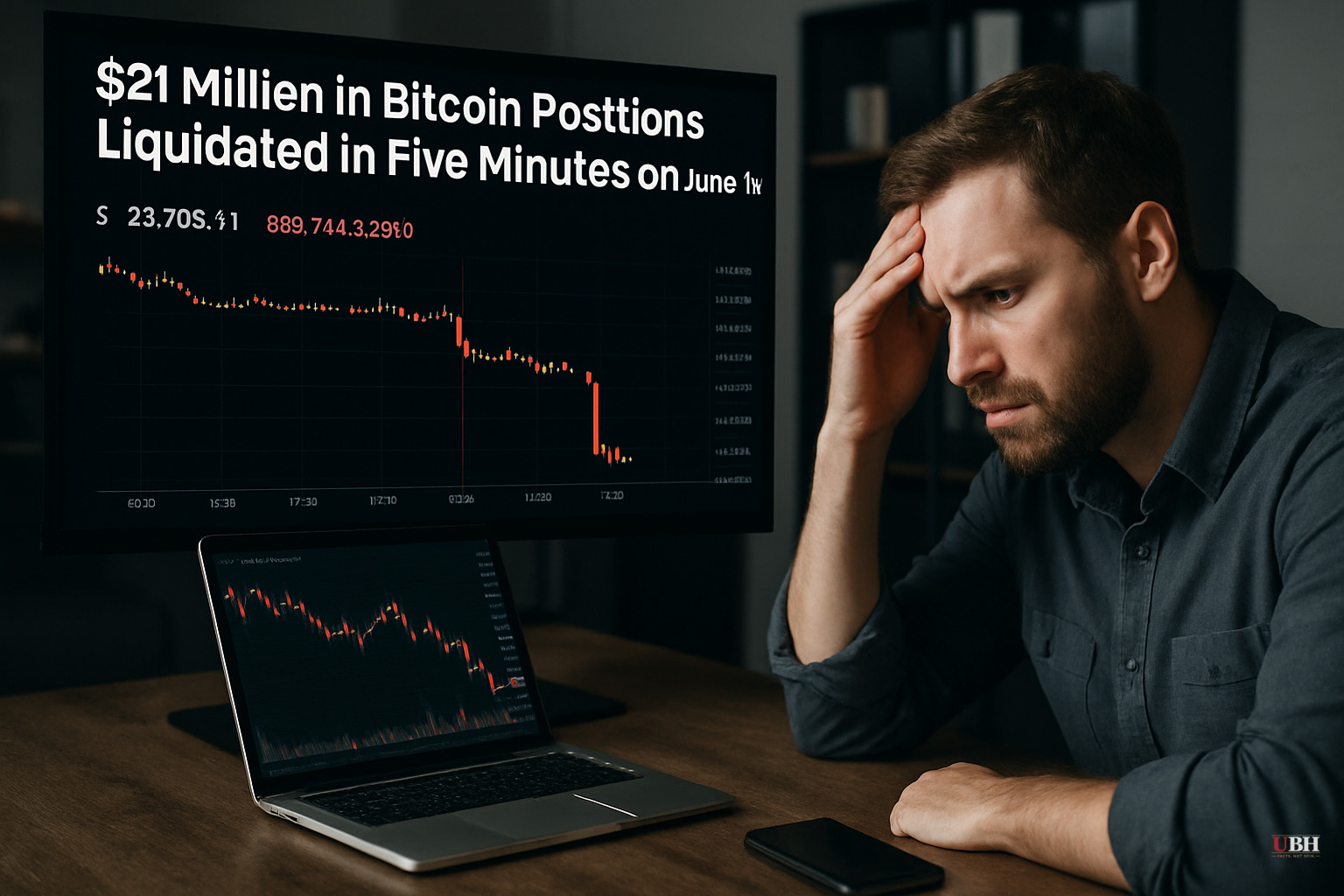
$21 Million in Bitcoin Positions Liquidated in Five Minutes on June 14
What Happened
On June 14, 2026, a brief burst of Bitcoin volatility forced the closure of $21 million in leveraged positions within a single five-minute trading window, according to Crypto Briefing. Roughly 300 seconds to blow up tens of millions of dollars in bets.
The mechanism is straightforward. When traders use leverage, they borrow money to amplify their position. Exchanges require them to maintain a minimum margin balance. If the price moves against them past a threshold, the exchange automatically closes the position to recover the borrowed funds. That's a liquidation.
How a Cascade Works
The dangerous part isn't one liquidation. It's what happens next.
When a cluster of positions gets force-closed at the same time, that automated selling pushes the price further in the same direction. Lower prices trigger more liquidations. More liquidations push prices lower still. The feedback loop can unwind in minutes.
Crypto Briefing describes this as a "liquidation cascade." The $21 million figure reflects only Bitcoin positions within that five-minute window, not total market exposure.
This Isn't New
Crypto Briefing notes that liquidation levels above $21 million in BTC positions within isolated one-hour windows have been observed repeatedly during recent rallies above $82,000. Rapid cascades tied to short-duration candle volatility have been a recurring feature of the current market environment, not an anomaly.
For context: a Bitcoin drop below $75,000 contributed to nearly $941 million in total crypto liquidations over a 24-hour period, per the same report. That figure is dwarfed by a broader event in late 2025, when total forced closures across the crypto market ranged from $19 billion to $30 billion, driven largely by macroeconomic announcements.
The Spot Market Feels It Too
A common misconception is that leveraged derivatives are a separate sandbox. They are not.
When $21 million in positions are force-closed in five minutes, the resulting selling pressure bleeds into spot markets, according to Crypto Briefing. That affects everyone holding Bitcoin, not just traders running leverage. Ordinary holders watch their portfolio value drop because a cluster of overleveraged traders got washed out simultaneously.
The Strongest Counterargument
Skeptics of treating this as alarming make a fair point. Leverage cascades are a feature, not a bug, of any mature derivatives market. Stocks, oil futures, and forex all experience similar mechanics. Forced liquidations are the market's self-correcting mechanism, flushing out excess speculation and resetting prices toward fair value. Under this view, $21 million in liquidations in a $1-trillion-plus asset class is noise, and the market's ability to absorb such events without a prolonged crash is a sign of maturity, not fragility.
But this argument becomes harder to hold when the numbers scale into the hundreds of billions, as they did in late 2025. The question isn't whether cascades happen. It's whether the leverage buildup preceding them is sustainable, and whether retail participants understand the risk they're absorbing.
Reading the Signals
Crypto Briefing points to two specific signals that can provide early warning before a cascade hits: open interest and funding rates, tracked on platforms like Coinglass and Hyblock. When open interest spikes and funding rates turn sharply positive, it indicates crowded long positioning. That's the setup that precedes forced-selling events.
Monitoring these metrics doesn't guarantee protection, but it tells you when the kindling is stacked high.
One Source, One Gap
Crypto Briefing's report does not identify the specific price level that triggered the June 14 liquidation cascade, nor does it specify whether the forced closures were concentrated on long or short positions. Without that breakdown, it's impossible to know whether the cascade was driven by a sharp downward move (crushing longs) or a sudden upward spike (crushing shorts). That distinction matters for reading market direction.
The unresolved question heading into the next trading week: whether open interest has reset meaningfully after today's cascade, or whether leveraged exposure remains elevated enough to produce another forced-liquidation event on the next significant price move.
Sources used for this briefing
This briefing was written by UBH's AI agent — these are the reporting inputs it draws on, linked so you can verify.


