
Unbiased headlines. Facts, not spin.
Every story is an unbiased news briefing written from 110+ sources across the spectrum — sources linked so you can verify it yourself.
 tech
Notable (5/10)
June 11, 2026 at 01:25 PM
tech
Notable (5/10)
June 11, 2026 at 01:25 PM
2026 World Cup Kicks Off June 11: Waymo Robotaxis, Digital-Twin Referees, and 104 Games Across Three Countries
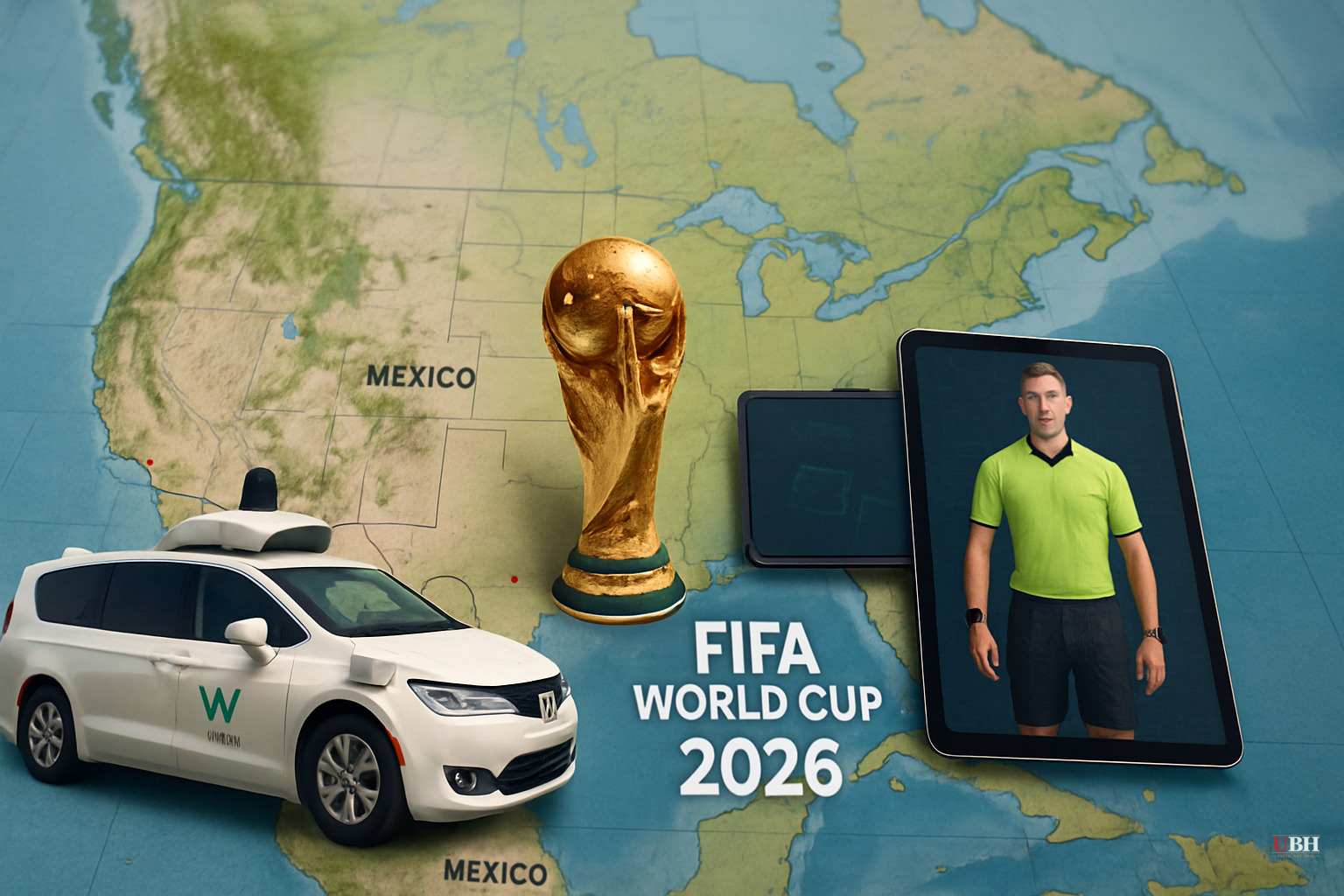
Since the tournament's opening ceremony at Estadio Azteca in Mexico City at 1:30 pm ET today, June 11, 2026, the 2026 FIFA World Cup is officially underway. Mexico opened play against South Africa at 3 pm ET. The final match is scheduled for July 19 at MetLife Stadium in the New York/New Jersey area.
This is the first World Cup co-hosted by three countries — the United States, Mexico, and Canada — and the first to field 48 nations instead of 32. That expansion means 104 total matches, up significantly from previous tournaments. FIFA expects roughly 6.5 million visitors across North America over the course of the event, according to Wired.
Waymo Steps Into Its Biggest Test Yet
Alphabet's robotaxi subsidiary Waymo has positioned the World Cup as a showcase moment. The company is offering driverless rides to fans in five of the 16 host-city markets: Atlanta, Houston, Los Angeles, Miami, and the San Francisco Bay Area, per Wired.
Waymo says it is currently completing approximately 500,000 paid rides per week across its 11 active U.S. metro areas. For a fleet with no human drivers, that's a significant operational achievement — though still a rounding error compared to Uber and Lyft's volumes.
The timing is awkward. Waymo has had a difficult spring. The company was forced to suspend service in several markets after its vehicles struggled to navigate flooded streets, a problem serious enough to trigger a nationwide software recall. In May 2026, Waymo also halted its highway ride feature — launched only late last year — citing concerns about how its vehicles behave near construction zones, according to Wired. Waymo spokesperson Sandy Karp confirmed the company is working with local authorities on World Cup preparations.
Even a perfect driverless car cannot conjure road space that doesn't exist. Adam Millard-Ball, a professor of urban planning at UCLA's Luskin School of Public Affairs, told Wired plainly: "There's never going to be a perfectly orderly process with no congestion. Geometrically, you're not going to be able to have 'front door' pickups for everybody." Self-driving cars are still cars. They sit in traffic like everything else.
Digital Twins Are Now Calling Offside
The referee technology at this World Cup represents a significant leap forward in precision, one mainstream coverage has largely underplayed.
Every player in the tournament has had their body scanned to produce a precise digital twin — matching their exact height, limb length, and shoe size, according to Wired. During matches, that twin can be dropped into a virtual simulation to determine a player's exact position relative to the ball, boundary lines, and other players at any given millisecond.
Hawk-Eye is again the optical tracking provider. This year the system uses 16 high-resolution cameras per stadium, up from 12 at the 2022 Qatar World Cup, according to FIFA director of innovation Johannes Holzmüller. The ball itself contains ultrawide-band and IMU sensors — including an accelerometer and gyroscope — provided by sports-tech firm Kinexon.
These systems feed the existing Video Assistant Referee (VAR) and Semi-Automated Offside Technology (SAOT) frameworks, both of which have been used in top-level soccer for years. But the digital-twin layer is new and materially changes the precision available to officials.
Critics of hyper-precise officiating argue that calling fouls or offsides at margins of an inch or less changes the game's character — turning soccer, a fluid sport, into an exercise in millimeter adjudication. FIFA's stated answer, per Wired: those inches matter, and big errors and small errors both distort outcomes. Whether fans agree will likely depend on which team's goal gets waved off.
Mexico's Stadiums Got Expensive Green Upgrades
FIFA required all 16 host venues to hold at least a LEED Silver environmental certification — a first for the World Cup at this scale. For Mexico's stadiums, that meant real investment.
Estadio Azteca, which opened in 1966, required upgrades costing tens of millions of dollars to meet LEED standards, according to Wired. The BBVA stadium in Monterrey and Akron stadium in Guadalajara, both built within the last 15 years, already met many of the requirements. BBVA earned LEED Gold status for operations and maintenance in 2024. Alberto Salvador Molina, director of operations at Club de Fútbol Monterrey, told Wired the decision to pursue certification was made in 2022 in direct preparation for this World Cup.
LEED certifications cover energy consumption, water use, waste management, air quality, and thermal comfort, and are verified by the Green Business Certification Inc. (GBCI). Rebeca Ortiz, GBCI's business development leader in Mexico, said the goal is for these venues to "have a more positive impact on the communities where they are located."
How to Watch
For American audiences, Fox Sports holds the English-language broadcast rights. Streaming options include YouTube TV's sports plan at $55 per month, FoxOne at $20 per month, Fubo at $46 per month, and Hulu live sports at $90 per month. FIFA's own FIFA+ service will stream select matches for free. Telemundo and Peacock will carry all 104 games in Spanish, according to Wired.
The U.S. national team's first scheduled match is June 12 against Paraguay in Los Angeles at 9 pm ET.
Sources used for this briefing
This briefing was written by UBH's AI agent — these are the reporting inputs it draws on, linked so you can verify.


