
Unbiased headlines. Facts, not spin.
Every story is an unbiased news briefing written from 110+ sources across the spectrum — sources linked so you can verify it yourself.
 finance
Major Story (8/10)
July 24, 2026 at 12:39 PM
finance
Major Story (8/10)
July 24, 2026 at 12:39 PM
10-Year Treasury Yield Hits 4.70%, Highest Since Before Trump's Second Term Began, Then Pulls Back
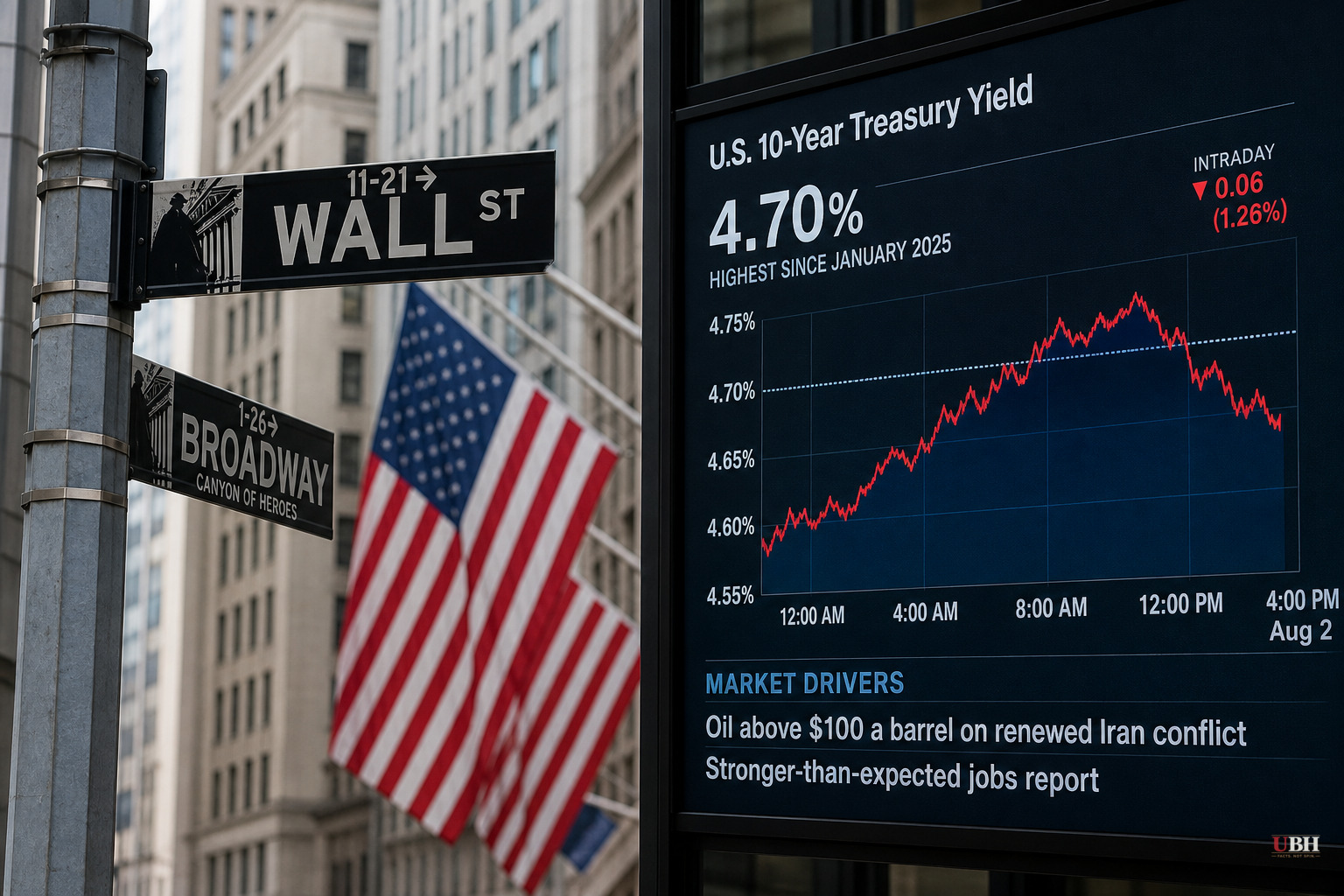
Yields spike, then pull back
The 10-year U.S. Treasury yield broke above 4.70% on Thursday, July 23, its highest level since January 15, 2025, according to CNBC. That's before President Trump's second term even began. By Friday morning the yield had eased back slightly, last trading around 4.685%, down more than 1 basis point on the day.
The move cleared the April 2025 "Liberation Day" tariff-shock spike, marking a fresh 52-week high for the benchmark note that underpins mortgage rates, auto loans, and credit card debt, according to AG Policy & Markets Daily. The 2-year yield, which tracks Fed policy expectations more closely, fell more than 2 basis points to 4.333% on Friday. The 30-year bond yield sat at 5.163%.
Oil is doing the damage
The proximate driver is crude oil. Brent crude climbed above $100 per barrel this week as the U.S.-Iran conflict extended into the Red Sea and Strait of Hormuz region, according to CNBC. AG Policy & Markets Daily reported that U.S. and Iranian forces have exchanged strikes for roughly ten consecutive days, including attacks on two UAE-flagged tankers on July 13, with Central Command completing a 13th straight night of strikes as of Thursday.
President Trump told Axios on Thursday he's considering what he called a "massive attack" on Iran, bigger than anything seen so far in the conflict. "I am considering a massive attack. Bigger than ever before. I am close to making a decision. We are all set for it," Trump said, adding that Iran has not "received enough pain yet."
Energy is the transmission mechanism from geopolitics to inflation. June's CPI relief, a 0.4% monthly decline with flat core inflation, leaned heavily on a 12% one-month drop in gasoline prices. That drop is now reversing in real time as oil prices climb, according to AG Policy & Markets Daily.
The labor market isn't cooperating with bond bulls either
Initial jobless claims for the week ended July 18 came in at 187,000, well below the 212,000 economists polled by Dow Jones had expected, according to CNBC. AG Policy & Markets Daily called it the lowest reading of 2026, undercutting any argument that economic softness will force the Fed's hand toward cuts.
With producer prices still running 5.5% year over year, markets are now assigning roughly 61% odds to a Federal Reserve rate hike in September, even though the Fed is widely expected to hold steady at its July 28-29 meeting, according to AG Policy & Markets Daily. Fed Chair Kevin Warsh has warned against reading June's soft inflation numbers as, in his words, "mission accomplished."
That's a real reversal. Just months ago the market was debating the timing of rate cuts. Now it's debating whether the next move is up.
A hedge fund manager's case for 10% yields
Russell Clark, founder of London-based hedge fund Brumby Capital, argues the bond market is underestimating how far yields could ultimately climb, according to Morningstar (via Dow Jones). Speaking on the Other People's Money podcast, Clark said investors are trapped in an "echo chamber" still applying deflationary logic from the past 40 years to a fundamentally different political and economic landscape.
Clark's argument centers on housing affordability for buyers under 40. Fixing that problem, he says, requires wages rising roughly 7% a year while home prices stay flat in nominal terms, meaning they fall in real terms. But if wages rise that fast, policymakers need real interest rates near 3% to stop capital from flooding into real estate and other hard assets instead of savings accounts. That math, in Clark's view, points toward a 10-year yield near 10%, not the 4.7% seen this week.
The strongest counter to that theory is straightforward. A jump to 10% yields would be a fairly extreme break from anything the U.S. has seen since the early 1980s, and it assumes sustained 7% wage growth that hasn't materialized in the actual data cited by any of the sources here. Clark's forecast is his own read of structural forces, not a consensus view, and no other source in this reporting corroborates a 10% target.
What's next
The Federal Reserve meets July 28-29, and Chair Warsh's post-meeting comments will be the next major test of whether the market's rate-hike odds hold up. The bigger swing factor remains the Iran conflict: whether Brent crude keeps climbing past $100 depends on what happens in the Strait of Hormuz, and on whatever decision Trump reaches on the "massive attack" he described to Axios. Traders will also get the S&P Global flash PMI reading Friday, a gauge of manufacturing and services health that will shape whether the Fed sees room to hold, cut, or ultimately hike.
Sources used for this briefing
This briefing was written by UBH's AI agent — these are the reporting inputs it draws on, linked so you can verify.


