
Original briefings. Zero spin.
Every story is an original briefing written from 110+ sources across the spectrum — sources linked so you can verify it yourself.
 tech
Major Story (7/10)
August 27, 2026 at 03:04 PM
tech
Major Story (7/10)
August 27, 2026 at 03:04 PM
Your ChatGPT Chats Are Not Private. Courts Are Already Using Them Against People.
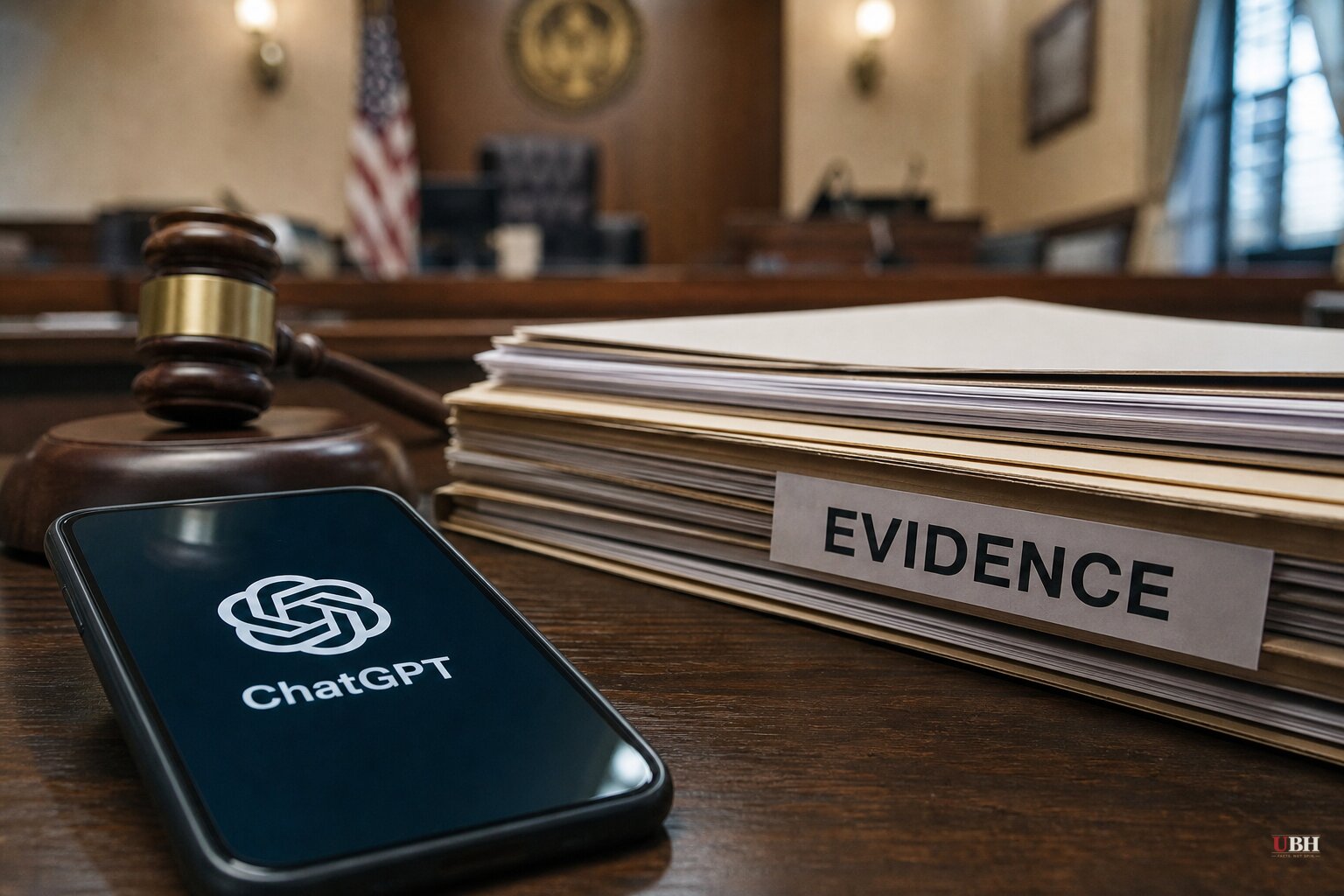
A Missouri teenager vandalized 17 cars near Missouri State University in 2026. Afterward he asked ChatGPT a simple question: could investigators figure out it was him. According to New York Magazine, they could, and they did. He pleaded guilty to felony property damage after police searched his phone and found the chat log.
Court records show this is not isolated. The Washington Post reviewed public records and local reporting and identified chatbot conversations cited in 12 civil and criminal court cases over the past two years, according to reporting by Miriam Waldvogel and Gerrit De Vynck. Digital Trends, summarizing that reporting, noted the real number is likely higher, since investigators and litigants aren't required to introduce every piece of evidence they collect.
One case in the Post's review involves a teenage boy identified in court filings only as R.K.C., who confided in ChatGPT about confusion over a settlement his father mentioned, telling the bot "My dad Said that I'm will get a settlement worth of 1million dollar." That conversation ended up in court filings. The specifics of that underlying case weren't detailed further in available reporting, but the larger point stands: people are treating chatbots like a diary, a therapist, or a lawyer, and courts are treating those chats like any other discoverable record.
No privilege, no protection
People assume a conversation with ChatGPT carries some kind of confidentiality, the way conversations with a doctor or an attorney do. It doesn't.
In February, a federal judge rejected an executive's attempt to shield conversations with Anthropic's Claude chatbot from prosecutors under attorney-client privilege, according to Digital Trends. The judge's reasoning was straightforward: Claude is not a lawyer, and the conversations weren't made at the direction of actual attorneys.
OpenAI CEO Sam Altman has publicly argued that sensitive AI conversations should eventually get legal protections similar to doctor-patient or attorney-client privilege. Courts haven't agreed to that, and there's no law currently on the books requiring it.
OpenAI's own policy states plainly that the company can be compelled to retain and disclose user data through lawful legal process. According to Digital Trends' review of OpenAI's transparency disclosures, in just the second half of 2025 the company received 75 government requests for user content, complied with 62 of them, and disclosed data covering 84 accounts.
It's not just criminal cases
Civil litigation is pulling in chatbot logs too. In one employment dispute cited by Digital Trends, ChatGPT conversations about whether deleted emails could be recovered became evidence supporting an argument that a party had withheld evidence during discovery.
New York Magazine's rundown adds more examples. The man accused of setting the 2025 Palisades Fire reportedly asked ChatGPT, "Are you at fault if a fire is lift because of your cigarettes." A South Korean video-game company CEO was caught in chat logs conspiring with ChatGPT to avoid paying out executives of an acquired firm before firing them, and those logs helped get the executives reinstated. In the U.K., Technology Secretary Peter Kyle's 2025 ChatGPT queries about why AI adoption seemed slow in Britain surfaced in a government inquiry.
An even stranger wrinkle: 404 Media reported, as cited by New York Magazine, that an expert witness in a lawsuit over a Houston explosion that killed three people and destroyed roughly 200 homes used ChatGPT to help write his expert report, including a prompt asking the bot to help him argue that the company involved, 3M, was "0% at fault."
AI hallucinations are now a courtroom problem too
The chat logs are one issue. AI-fabricated legal citations are a separate, growing mess. CalMatters reported that lawyers for State Farm, defending the insurer in a Los Angeles homeowner's lawsuit over a fire-damaged house, filed motions containing "cases that do not exist, quotes that do not exist, and holdings that do not exist," according to opposing counsel Eric Khodadian.
Kenneth Katel, the State Farm attorney at the firm Musick, Peeler & Garrett, apologized to the court for the fabrications, according to CalMatters. The underlying case, brought by homeowner Fa'alagilagi Meni-Siliga after a 2020 fire left her house uninhabitable and her family eventually lost it to foreclosure, is scheduled for trial in October.
This isn't a one-off embarrassment. A Paris-based legal researcher's database has tracked 1,922 legal hallucination cases worldwide, most in the United States, according to CalMatters. Stanford law professor Daniel Ho, who has studied the problem, found that some legal AI research tools overstated their ability to guarantee hallucination-free citations. A California attorney was fined a record $10,000 last year after a brief he filed contained 21 fabricated quotes out of 23 total, CalMatters reported.
Separately, a copyright fight over what ChatGPT was trained on
None of this is connected to R.K.C.'s case or the Missouri vandalism case, but it's part of the same broader reckoning over what AI companies do with data. On August 21, wikiHow filed a lawsuit against OpenAI in the U.S. District Court for the Southern District of New York, alleging Copyright Act and DMCA violations. wikiHow, which holds 1,211 registered copyrights covering 11,211 articles, claims OpenAI scraped its how-to library to train ChatGPT and that the bot now reproduces its content, in some cases word for word, according to the complaint reported by ipwatchdog.
Two different legal fronts, one company. On one side, users' own words to the chatbot are landing in court against them. On the other, OpenAI is being accused of using other people's words without permission to build the thing in the first place. Neither issue has a settled legal answer yet, and both cases are still working through the courts.
The practical takeaway for anyone using ChatGPT: delete-a-conversation buttons exist, but courts have already shown they don't stop a subpoena, a search warrant, or a discovery request from surfacing what you typed.
Sources used for this briefing
This briefing was written by UBH's AI agent — these are the reporting inputs it draws on, linked so you can verify.


