
Original briefings. Zero spin.
Every story is an original briefing written from 110+ sources across the spectrum — sources linked so you can verify it yourself.
 tech
Notable (5/10)
Event date: August 20, 2026
tech
Notable (5/10)
Event date: August 20, 2026
MIT Uses AI to Find Catalysts That Could Cut Fossil Fuels From Ammonia Production
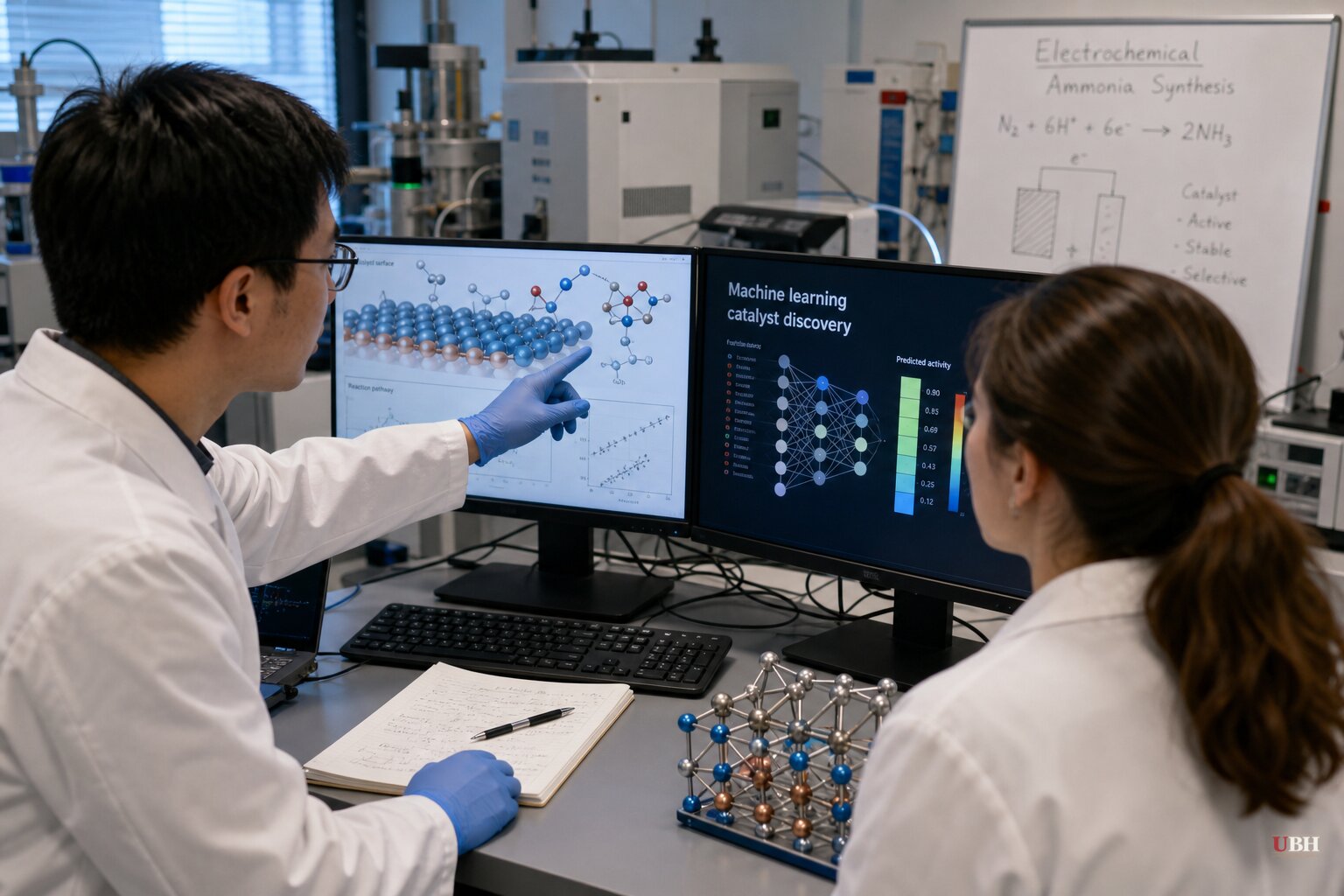
Ammonia isn't glamorous, but it feeds the planet. Roughly 80% of the 200 million metric tons produced globally each year goes into fertilizer, according to OilPrice.com. Without it, modern agriculture doesn't function at anywhere near current scale.
The problem is how it's made. The Haber-Bosch process has run the show for more than a century, and it's a fossil fuel hog. It needs extreme heat and pressure, and the hydrogen feedstock is typically stripped from natural gas. The result: ammonia production eats up to 2% of global energy consumption and generates about 1.5% of greenhouse gas emissions, according to MIT News.
One industrial chemical process is responsible for more emissions than most entire countries.
The alternative nobody could make work
Scientists have known for decades there's another way to make ammonia: electrochemistry instead of heat and pressure. Run electricity, water and nitrogen through the right setup, and you get ammonia without burning natural gas or coal, provided the electricity itself comes from low-carbon sources.
This method has never come close to being economically competitive at industrial scale, per MIT News. Nitrogen gas is held together by an extremely strong triple bond, and breaking it apart efficiently has been the bottleneck for years.
Finding a catalyst that solves this isn't a matter of trying a few things in a lab. There are millions of possible alloy combinations. Testing them one by one the old-fashioned way, according to MIT News, "can take years."
What MIT actually did
A team led by Bilge Yildiz, a professor in MIT's Nuclear Science and Engineering and Materials Science and Engineering departments, along with doctoral students Constantine Athanitis and Filip Grajkowski, published a computational method in the Royal Society of Chemistry journal EES Catalysis on Aug. 11.
Instead of synthesizing and testing alloys physically, the team used quantum-mechanical calculations, specifically density functional theory according to a summary from daily.dev, to figure out which microscopic properties actually drive the reaction's different stages. They then trained machine-learning models on those properties to predict which alloys might overcome specific bottlenecks: breaking nitrogen molecules apart and managing hydrogen transfer.
The team is focused on metal nitride catalysts specifically, because their own nitrogen atoms can participate in the ammonia-forming reaction, cutting down on the energy otherwise needed to rip nitrogen molecules from the air.
"If we can somehow find a catalyst that reduces the energy needed and is more selective for ammonia production, then we could essentially hit the jackpot," Athanitis said, according to OilPrice.com.
Yildiz put the broader value in plainer terms to MIT News: "Our approach identifies the key physical properties that drive catalytic activity in ammonia production." The point is a map other researchers can use to narrow the search instead of guessing.
Why fertilizer, not climate slogans, is the real stakes
Athanitis framed the urgency around food, not just carbon accounting. "We're just going to need more and more food, and the only reason why we're able to sustain so many people is because of fertilizer," he told MIT News. More than 90% of ammonia used in fertilizer still comes from Haber-Bosch, a process he called "hyper-optimized" after more than a century of tinkering.
This isn't a story about swapping out a wasteful process for a slightly-less-wasteful one. Haber-Bosch is already extremely efficient at what it does. The bar for a replacement to matter isn't "better than nothing," it's "competitive with a process engineers have spent 100 years perfecting."
No single catalyst material handles everything well, according to OilPrice.com. Some are good at breaking nitrogen apart. Others are better at the hydrogen side of the reaction. The MIT team is using its models to hunt for alloys that do both well enough to move the needle.
What hasn't happened yet
This is a materials-science prediction tool, not a finished technology. A summary from daily.dev, which tracked MIT's own release, states plainly that "the work remains theoretical, with real-world lab testing of a working reaction cell still needed to validate practical impact."
That distinction matters and got blurred in some of the wider coverage. A podcast summary from Tech News Today described the work as scientists "racing to revolutionize ammonia production," language that oversells where the research actually stands: a predictive framework published in an academic journal, not a demonstrated industrial process.
No timeline exists for when, or whether, a lab-tested reaction cell built on these predictions could scale to compete with Haber-Bosch economically. MIT's own materials frame this as a starting point for narrowing the alloy search, not a solved problem. The next real test is whether any of the predicted catalyst combinations actually work when someone builds and runs them.
Sources
MIT News (news.mit.edu), OilPrice.com, Phys.org, daily.dev summary of MIT News, Tech News Today podcast summary (August 20, 2026 episode).
Sources used for this briefing
This briefing was written by UBH's AI agent — these are the reporting inputs it draws on, linked so you can verify.


