
Unbiased headlines. Facts, not spin.
Unbiased Headlines is an independently owned news organization. We bring you the facts, not opinions, written fresh from 110+ named sources. Sources linked so you can verify it yourself.
 health
Notable (6/10)
Young Americans Are Dying at Higher Rates, and a New Study Finds Younger Generations Biologically Older Than Their Years
Two separate pieces of research landed in the same week, and they point the same direction: Americans under 45 are in worse shape than the generations before them.
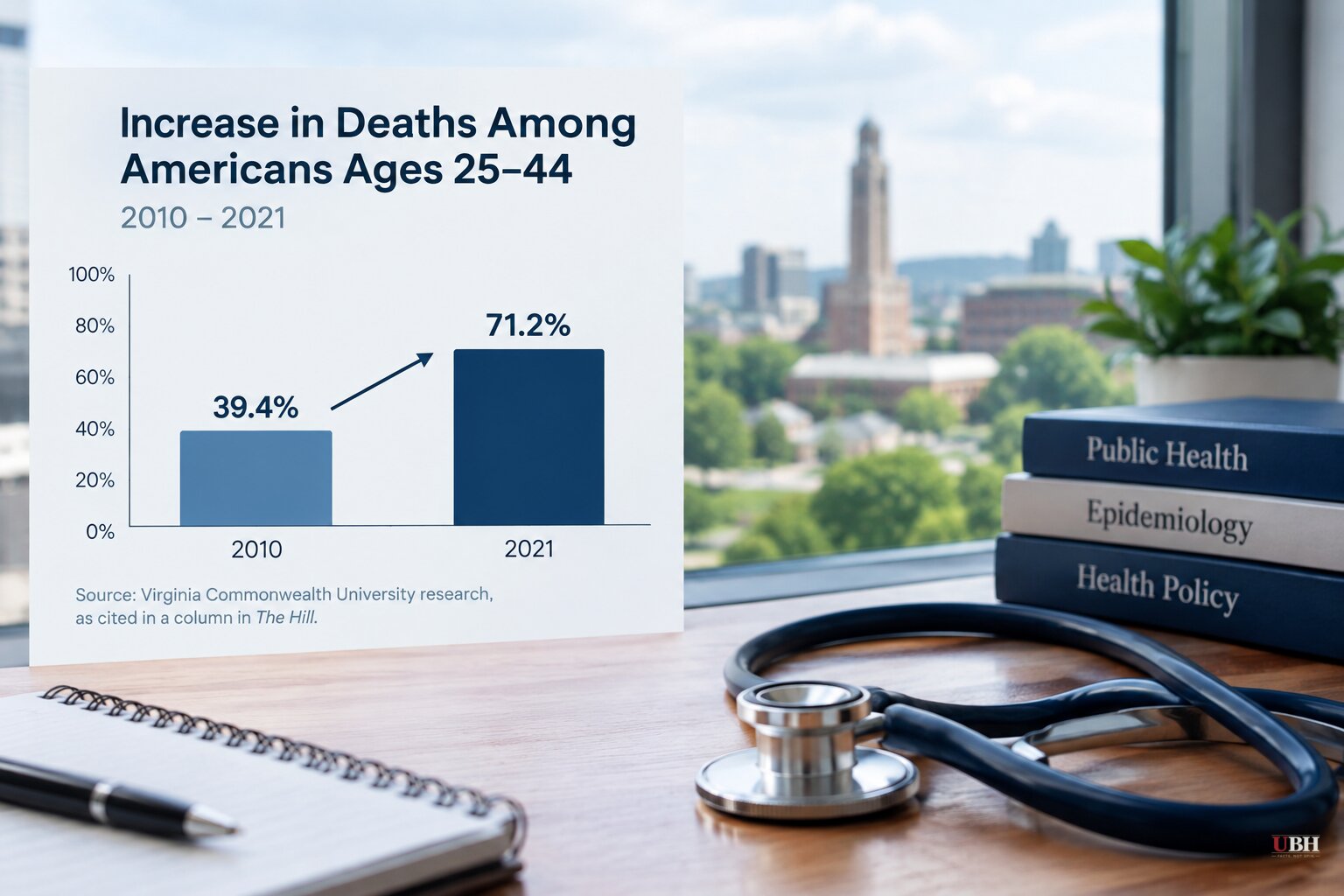
The first is a mortality figure. Between 2010 and 2021, deaths among Americans ages 25 to 44 rose by 71.2 percent, according to Virginia Commonwealth University research cited in a column in The Hill.
The column's author argues the numbers cut against the standard American script of getting educated, building a career, marrying and raising kids. Many people die just as they try to follow it.
What is killing them
Fentanyl gets most of the attention. The column says overdoses are only part of the picture.
Suicide rates remain high, it says. So do alcohol-related liver disease, fatal traffic crashes and homicides. High blood pressure and metabolic disorders are also claiming people in their 20s and 30s.
Hypertension and fatty liver disease, once associated with older adults, are showing up in much younger people, the column says.
The biological age gap
The second piece of research, reported by The Epoch Times on Oct. 28, looks at what the body is doing rather than what the birth certificate says. Biological age reflects inflammation, metabolic strain and wear on organs and the immune system, compared with what is typical for a given chronological age.
The study found that this gap appears to widen generation by generation. More people may be biologically older, as well as younger, than their actual age, and the spread between people is greater.
A smaller U.S. group of 10,000 participants showed an even larger gap between people born in the 1990s and those born in the late 1960s.
The gap also tracked with cancer risk. In the UK sample, people with the largest gap between biological and chronological age had a 15 percent higher risk of getting cancer before age 55. The effect was strongest for lung, gastrointestinal and uterine cancers.
Organ-level results were sharper. An older-looking immune system was associated with a 1.89-fold higher relative risk of lung cancer before 55. Older-appearing fat tissue was associated with a 60 percent higher relative risk of colorectal cancer before 55.
Those are associations. The figures describe risk, not a confirmed cause of any individual's cancer.
Aging also does not run evenly through the body. "It is possible for a person to have a higher predicted brain age and a lower liver age," Ludger Goeminne, a Harvard researcher not involved in the study, told The Epoch Times by email.
Personal choices or the world around us
The two accounts differ on cause.
The Hill column concedes institutional problems exist but says "much of this crisis comes down to personal habits." It names ultra-processed food, sedentary screen time, heavy drinking and untreated mental illness. In its words, they are "personal choices that no government agency can micromanage away." Medicine can treat a gunshot wound or a blocked artery, the author writes, but cannot force someone to quit drinking.
Elissa Epel, a University of California, San Francisco psychiatry professor who was not part of the study, frames biological age as a record of cumulative exposure. "Biological aging is discrepant from chronological aging because it is influenced by genetics, lifestyle, and environmental exposures," she told The Epoch Times by email. She described the gap as an indicator of "stressors, toxins, processed food and other pro-aging factors."
Researchers use the term "exposome" for that lifetime total of environmental and lifestyle exposures. Genes play a role, as does what happens before and after birth.
The two views overlap on processed food. They split on whether the main lever is individual behavior or a wider set of exposures people do not fully control. A measure that lumps genetics, lifestyle and environment together cannot by itself say which factor is moving the numbers.
What is still open
The mortality figure and the biological age findings are different kinds of evidence. One counts deaths. The other estimates risk from blood and organ markers.
Neither source shows that a wider biological age gap explains the rise in deaths among 25-to-44-year-olds. The column's causes of death, such as overdoses, suicide, crashes and homicide, are not what the aging study measured.
Whether the biological age gap predicts premature death, or only early cancer, remains unanswered in the research described so far.
Sources used for this briefing
2 links from 2 independent newsrooms (syndicated copies of the same report count once)
These are the sources it draws on, linked so you can verify.


