
Unbiased headlines. Facts, not spin.
Unbiased Headlines is an independently owned news organization. We bring you the facts, not opinions, written fresh from 110+ named sources. Sources linked so you can verify it yourself.
 finance
Notable (5/10)
Event date: October 23, 2026 ·
xStocks Tokenized Stocks Reach $1 Billion in Onchain Market Cap, Token Terminal Data Shows
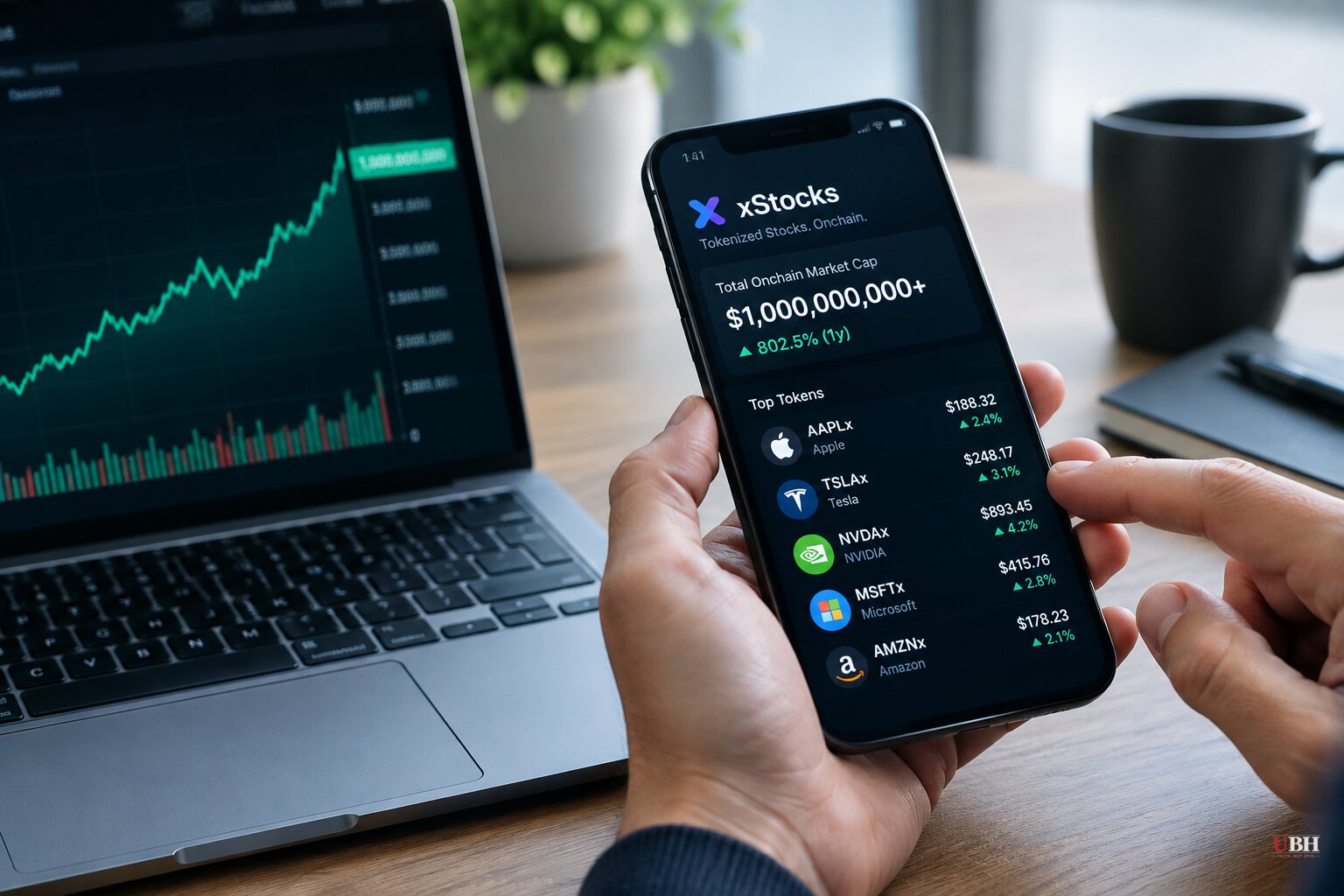
Since xStocks launched on June 30, 2025 with roughly 60 tokenized U.S. stocks and ETFs, the platform has grown into the second-largest issuer in a fast-expanding category. It has now reached $1 billion in onchain market cap, up 802.5% over the past year, according to figures from the data firm Token Terminal.
The number depends on who is counting. Crypto Briefing's tally put xStocks at about $685 million in early September and about $886 million as of Oct. 25. DWF Labs, a crypto market maker, counted $954 million in the week of Oct. 5, up from $187 million in early January.
The gap is a methodology problem, not a rounding error. Anyone quoting a single figure for tokenized equities should say whose data it is.
What xStocks is
xStocks was launched by Backed Assets (JE) Limited, which has since been acquired by Payward, the parent company of Kraken. Each token is meant to mirror one share of a stock or ETF, backed 1:1 by shares held in regulated custody.
Legally, the tokens are structured as tracker certificates, not direct share ownership. Kraken says the tokens give holders exposure to share prices without shareholder rights or a legal claim to the underlying shares.
The lineup has grown past 1,000 instruments, Kraken says. By October the catalog covered more than 1,300 assets across over 11 blockchains, according to Crypto Briefing. It started primarily on Solana. Cumulative trading volume has passed $40 billion, and onchain decentralized exchange activity alone topped $1 billion in September.
There is a hard restriction. xStocks tokens are not available to U.S. persons, even though they track U.S. securities.
Weekly momentum
Token Terminal's weekly data, as of Oct. 12, showed xStocks adding $76.8 million in market cap over seven days. Binance's bStocks added $68.1 million and Securitize added $19.7 million. The top two issuers together added $144.9 million.
The largest single xStocks token is STRCx at $144.7 million, followed by MSTRx and CRCLx. xStocks' combined common and preferred stock tokens total $269.1 million, according to Token Terminal figures.
A crowded field
xStocks is no longer the only story. DWF Labs counts total tokenized equities at $3.8 billion in the week of Oct. 5, up from $654 million in the week of Jan. 5. Crypto Briefing, using a different count, puts the category at about $2.67 billion.
Ondo Finance still leads at about $1 billion, but its share of the market fell from 56% to 26%, DWF Labs says. Binance launched bStocks in June 2026 and it now sits at $905 million, or 24% of the market. Robinhood launched in July and grew from $20 million to $170 million. Securitize launched its own stock token in July and holds $290 million, about 8%.
xStocks held its ground at about 25%, according to DWF Labs.
The network map is shifting too. Ethereum held 50% of tokenized equities at the start of the year and holds 22% now. BNB Chain rose from 9% to 32%, and Avalanche went from zero to 9%, DWF Labs says.
Usage, not just market cap
DWF Labs is blunt about what the market cap figure does and does not prove. "Tokenization for tokenization's sake won't work in the long run," the firm wrote, arguing that demand depends on added utility beyond off-chain shares. Market cap growth matters less, it says, than whether the assets are used on-chain rather than sitting idle in wallets.
Its own numbers point toward use. Weekly transfer volume in tokenized equities rose 41.8 times between the weeks of Jan. 5 and Oct. 5, from $420 million to $17.5 billion, while market cap rose 5.8 times. Weekly turnover climbed from 0.64x to 4.6x. Weekly spot DEX volume grew from $45.8 million to $2.54 billion.
Transfer volume counts any token movement between addresses, including moves between lending protocols, so it is a broad measure of activity rather than pure trading.
Risks that come with the structure
Holders depend on the issuer and custodian doing their jobs. The 1:1 backing is only as good as the custody arrangement behind it, Crypto Briefing notes.
Price is a separate issue. The Defiant has published a closed-market buy-and-exit example showing how spreads and trade size affect execution, and that minting and redemption follow a separate clock from onchain trading. A token can trade away from the underlying share price, especially when U.S. markets are shut, as they are this weekend.
Regulation is the other variable. The exclusion of U.S. persons shows how carefully issuers handle securities rules. Any shift in how regulators treat tokenized equities could change who can buy these products and how they are built. No such change has been announced in the material behind these figures.
The next test is whether turnover keeps rising as issuers from Binance to Robinhood compete for the same market. xStocks needs the usage numbers to hold up, not just the market cap.
Sources used for this briefing
6 links from 6 independent newsrooms (syndicated copies of the same report count once)
These are the sources it draws on, linked so you can verify.


