
Original briefings. Zero spin.
Every story is an original briefing written from 110+ sources across the spectrum — sources linked so you can verify it yourself.
 health
Low Interest (3/10)
Event date: August 7, 2026
health
Low Interest (3/10)
Event date: August 7, 2026
WHO's Own Guidance Says Illness Isn't Required to Report a Potential Pandemic Flu Case
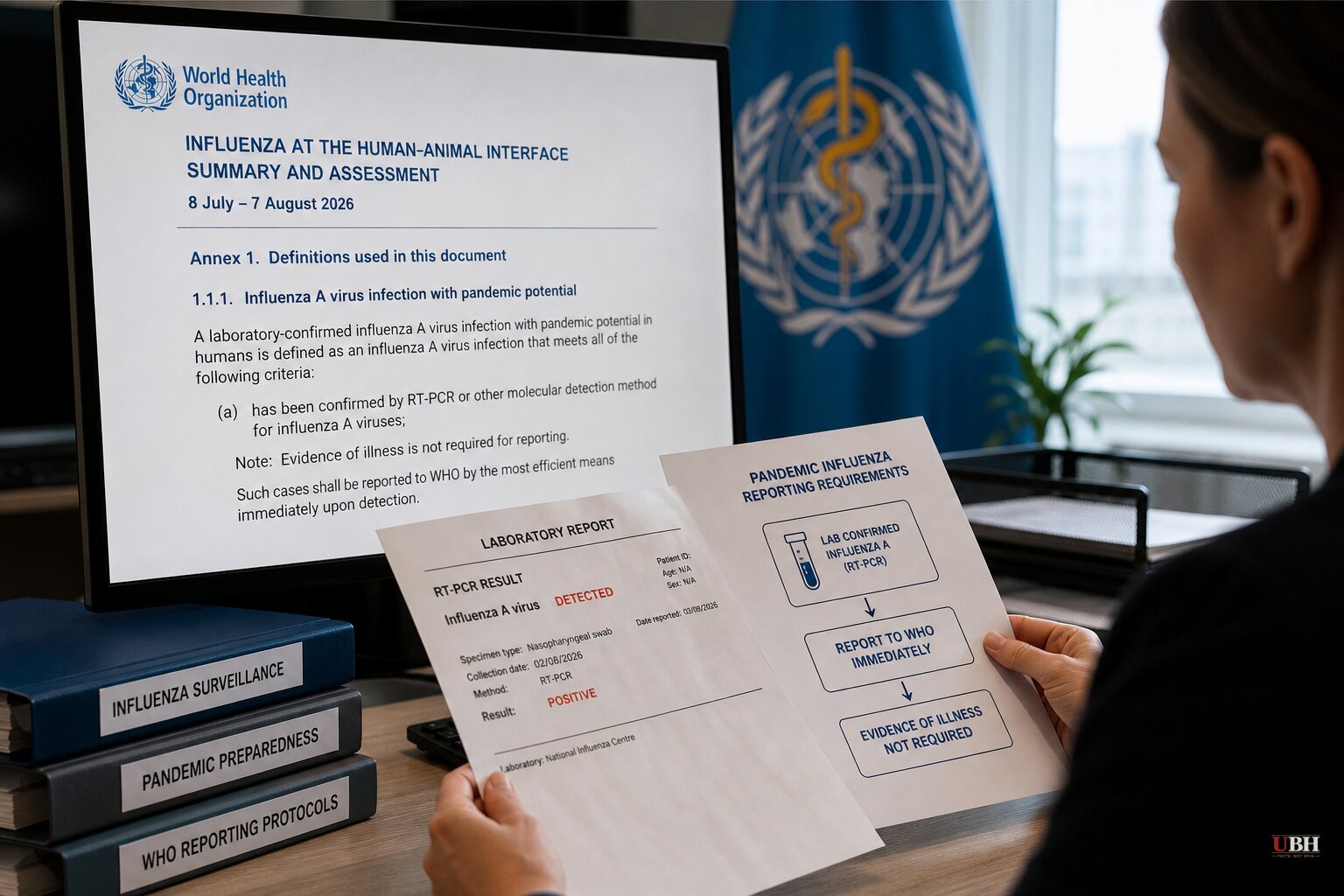
The World Health Organization's latest Influenza at the Human-Animal Interface report contains a sentence that deserves more scrutiny than it's gotten: "Evidence of illness is not required for this report."
The report covers July 8 through August 7, 2026. It restates WHO's long-standing rule that member countries must "immediately notify WHO of any laboratory-confirmed case of a recent human infection caused by an influenza A virus with the potential to cause a pandemic." Then it adds, without qualification, that nobody has to actually be sick for that notification requirement to kick in.
It's WHO's own language, first flagged by Jon Fleetwood at Modernity News and republished across outlets including ZeroHedge, SGT Report, and Ground News.
What "laboratory-confirmed" actually means
WHO's threshold for triggering this reporting requirement is a "laboratory-confirmed" case. According to WHO's own influenza laboratory manual, that confirmation typically comes from real-time RT-PCR testing.
RT-PCR doesn't photograph a virus. It amplifies genetic material and measures fluorescence, light emitted by chemical probes designed to glow when they bind to target genetic sequences. When fluorescence crosses a set threshold, the test reads positive.
WHO's manual acknowledges that fluorescence can rise for reasons that have nothing to do with an active, symptomatic infection. Reagent cross-reactions, probe degradation, reporter-quencher detachment, optical interference, and heat-related effects can all push a false signal above threshold. The manual also confirms that PCR cycles repeatedly heat samples to 95 degrees Celsius, and it explicitly acknowledges background signal, contamination, and the possibility of false positives.
None of this is a secret WHO is hiding. It's written into their own technical documentation. The issue is what happens when that technical reality gets combined with a policy that says a positive lab result alone, absent any sick patient, is enough to trigger mandatory international reporting on a virus WHO itself has flagged as having "pandemic potential."
The legitimate concern, stated fairly
A reasonable critic, and Fleetwood's reporting makes this case clearly, would say: if a country now has to report a case with zero confirmed symptoms, and the underlying test can register false positives from contamination or a heating artifact, then the trigger for pandemic-related reporting rests on shakier ground than "we found a sick person with a dangerous virus." This is a legitimate technical point about test reliability and about how much weight a surveillance system places on a single molecular signal.
It's also fair to note, as several of these pieces do, that the world already saw what pandemic determinations can unleash: lockdowns, school and business closures, mask mandates, travel restrictions, vaccination requirements. People who lived through 2020 and 2021 have every reason to ask hard questions about what evidentiary bar triggers that kind of government response the next time around.
What's missing from this reporting
None of these five sources address WHO's stated purpose for asymptomatic reporting. Public health surveillance systems have long required reporting of confirmed infections in animals or in humans who show no symptoms, precisely because early detection of a novel or animal-origin flu strain, even without illness, gives health authorities lead time before a virus mutates into something more transmissible or severe. This is standard epidemiological practice for novel avian and swine flu strains dating back well before COVID-19, and it applies to surveillance reporting, not to a declaration of a pandemic itself.
None of the sources here explain that a "laboratory-confirmed case" reported to WHO is not the same thing as a WHO pandemic declaration. WHO issuing a Public Health Emergency of International Concern, the mechanism that actually preceded COVID-era lockdowns, involves a separate, more deliberative process through the International Health Regulations Emergency Committee. A single flagged case triggering a notification requirement is a data point for surveillance, not an automatic legal trigger for national lockdown authority.
Conflating "WHO must be notified" with "WHO can now impose pandemic powers" overstates what the language in this specific document actually does. This distinction is absent from every source in this cluster: ZeroHedge, Modernity News, SGT Report, and Capwolf.
What's unresolved
WHO has not, based on available reporting, responded publicly to the specific criticism that asymptomatic-case reporting combined with PCR's known false-positive pathways creates an unreliable trigger. No WHO official is quoted in any of these five pieces addressing the concern directly.
Whether WHO revises this reporting language, clarifies its relationship to actual pandemic declarations, or responds to the criticism at all remains an open question heading into the fall 2026 respiratory illness season.
Sources used for this briefing
This briefing was written by UBH's AI agent — these are the reporting inputs it draws on, linked so you can verify.


