
Unbiased headlines. Facts, not spin.
Unbiased Headlines is an independently owned news organization. We bring you the facts, not opinions, written fresh from 110+ named sources. Sources linked so you can verify it yourself.
 finance
Major Story (7/10)
Event date: October 13, 2026 ·
Weekly Trading in Big Tech Default Insurance Tops $9 Billion, Up From Under $2 Billion in July, as Oracle Spread Hits 322
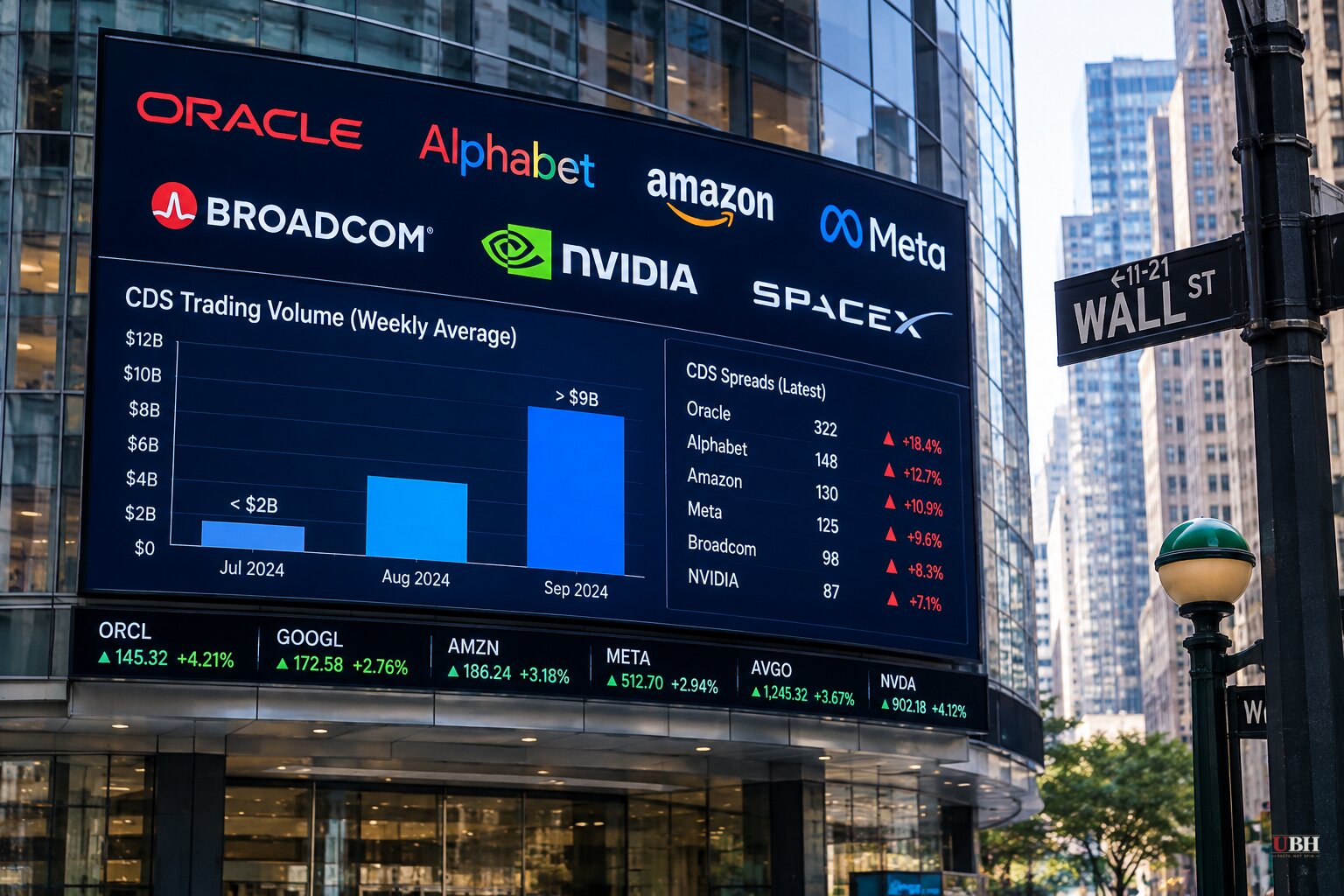
Since CoreWeave's bonds slid toward 15% yields and Oracle's default-insurance cost hit a record 288 basis points last week, the volume of trading in that insurance has become clearer, and it is large.
Credit default swaps tied to debt issued by Oracle, SpaceX, Alphabet, Amazon, Meta, Broadcom and Nvidia traded at an average of more than $9 billion a week in September, according to Morgan Stanley Research. In July, the figure was under $2 billion.
U.S. corporate CDS index volumes for 2026 have already passed the full-year 2025 total, with more than two months left.
The spreads
A CDS works like an insurance policy on a bond. The buyer pays a premium, quoted in basis points a year, and the seller covers the loss if the borrower defaults.
Here is where five-year spreads stand:
- Oracle: 322 basis points on Monday, Oct. 19, more than double its level at the start of the year. It was 288 basis points a few days earlier.
- Meta and Nvidia: record highs of 108 and 101 basis points this month.
- SpaceX: a record 226 basis points.
- CoreWeave: roughly 1,090 basis points, after topping 1,100 in mid-October.
For CoreWeave, a buyer must put up $1.82 million upfront to protect $10 million of its debt, plus $125,000 a quarter. Some of its bonds have fallen into distressed territory.
A spread that wide implies a default probability of around 63% to 64% over five years, up from roughly 30% a year earlier. Analysts cited by ROIC.ai caution that such figures depend on recovery assumptions and should not be read as forecasts.
Where the borrowing comes from
AI-related debt issuance has reached an estimated $466 billion so far in 2026, against $101 billion over the same stretch of 2025.
CoreWeave carries close to $50 billion in debt. As of June 30 it had about $35.1 billion on its balance sheet, or roughly $51.6 billion counting lease liabilities. In the first half it generated $3.663 billion in operating cash flow and spent $14.117 billion on capital expenditures. Its second-quarter net loss was $626 million, with net interest expense of $640 million.
The backdrop is not friendly. The 10-year Treasury yield sat near 5.19% last week after hotter-than-expected inflation data. Thrivent's David Royal warned that companies borrowing on short maturities cannot sustainably refinance at 15%.
The IMF weighs in
The International Monetary Fund put numbers on the downside on Oct. 13 in its World Economic Outlook. In one scenario, a steep drop in AI investment sets off a sharp fall in asset prices and cuts global GDP by 1.1% by 2028, including 1.8% in the United States.
The fund reviewed 14 circular financing deals among AI firms. Since 2023 they involve about $300 billion in equity investment and $650 billion in debt, in exchange for $1.4 trillion in future revenue commitments.
"We now have an economy that is standing on one leg, the AI leg," IMF Managing Director Kristalina Georgieva said at a Bretton Woods Committee event. "What if it wobbles?"
Jason Wu, an assistant director in the IMF's Global Markets Analysis Division, said that if AI monetization is questioned, "the equity investments will deplete in value, the debt may be difficult to service, and the revenue commitments in the future may not materialize."
The other side of the trade
Not everyone reads the numbers as a warning. CoreWeave CEO Michael Intrator called the market reaction "irrational" in an internal memo reported Oct. 14, and argued that the company's roughly $104 billion revenue backlog supports its debt. That backlog is contracted future revenue, not profit.
Some of the volume surge likely reflects lenders and bondholders hedging existing exposure rather than betting on failure. Some of it also comes from multi-asset and equity investors using CDS as a cheaper alternative to equity put options for hedging tech exposure.
The megacap spreads also remain far below CoreWeave's. Meta and Nvidia at roughly 100 basis points are far apart from a name above 1,000. Axios reported that investors and analysts still believe AI demand is strong enough to keep the cycle turning.
Robert Dafforn, chief investment officer at distressed-debt specialist Polus Capital, takes the cautious side. He warned that high leverage and interconnected financing across the AI sector could amplify losses if weaker borrowers run into trouble.
What comes next
CoreWeave is reportedly pursuing insurance-company capital and investment-grade ratings on more of its chip-backed financing, aiming for cheaper funding. Whether lenders grant that at anything near current prices is the immediate test. With its 2032 bonds trading around 77 cents on the dollar and yields above 15%, the company has not yet shown that it can.
Sources used for this briefing
7 links from 7 independent newsrooms (syndicated copies of the same report count once)
These are the sources it draws on, linked so you can verify.


