
Unbiased headlines. Facts, not spin.
Unbiased Headlines is an independently owned news organization. We bring you the facts, not opinions, written fresh from 110+ named sources. Sources linked so you can verify it yourself.
 finance
Notable (6/10)
Mastercard Launches Stablecoin Security, a Risk-Scoring Tool for Banks, at Money20/20
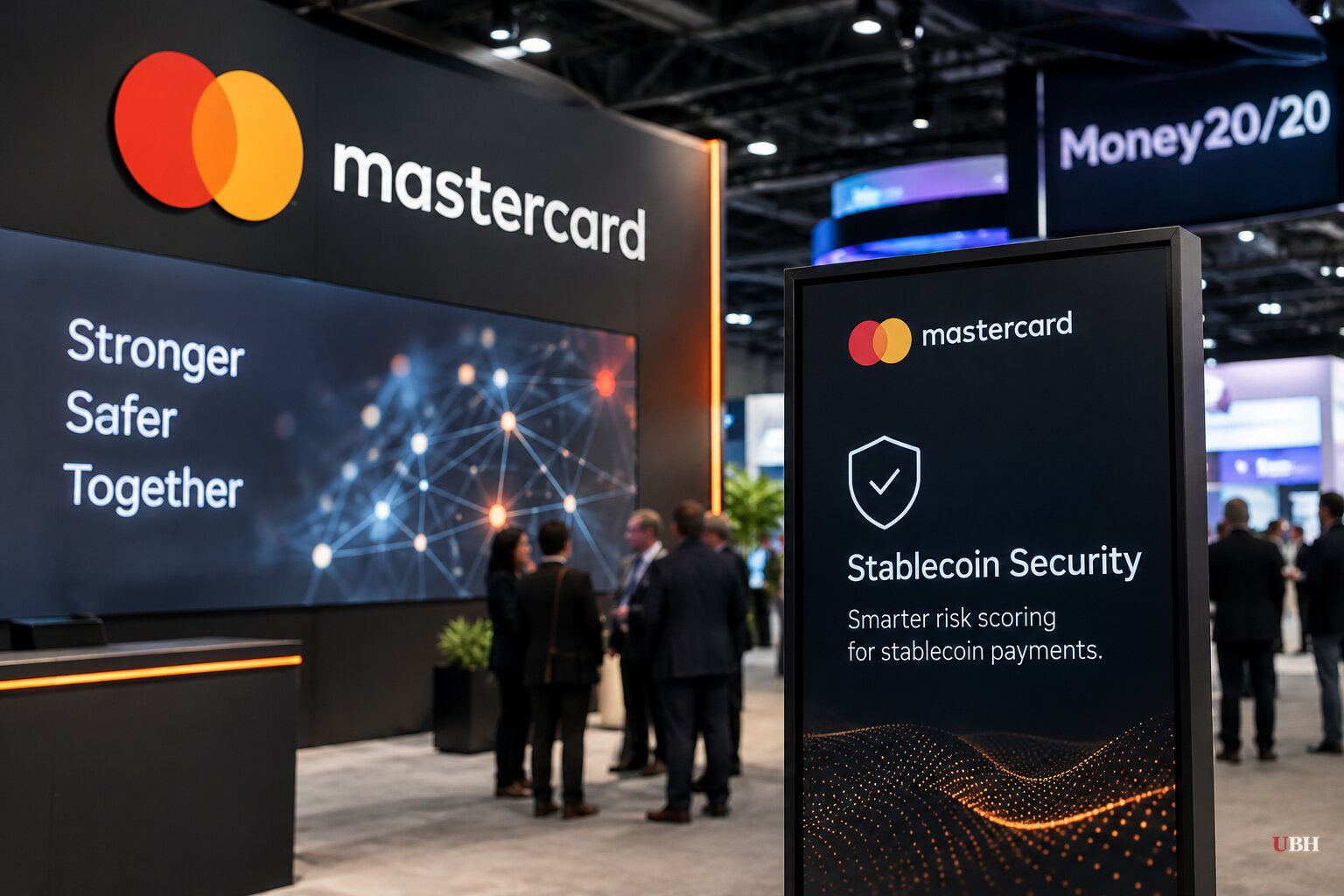
Mastercard is putting its fraud-screening business to work on stablecoins.
The company unveiled Stablecoin Security on Monday, Oct. 19, at the Money20/20 USA conference in Las Vegas. The service gives banks and payment providers a risk score on a stablecoin payment before it settles, so a suspect transfer can be held for review before the money moves.
What the product does
Stablecoin Security screens for fraud, scams, sanctions exposure and other financial-crime signals. It combines Mastercard's payment intelligence with blockchain analytics and covers a payment from initiation through its movement on a public ledger.
It is delivered through a platform-agnostic API. Banks can plug it into the fraud and compliance systems they already run rather than replace them.
Mastercard's own example: a Boston coffee shop pays a coffee bean supplier in Brazil. The shop starts the payment at its bank, and the bank uses stablecoins for the cross-border leg. Before anything is sent, the bank's service provider runs the payment through Stablecoin Security to decide whether it proceeds or goes to review.
The pitch is simple. Once funds land onchain, getting them back is hard. Catching a bad payment beforehand is the whole point.
Launch details
The first two program participants are Borderless.xyz and Keyrails. Both are alumni of Mastercard's Start Path blockchain accelerator.
The service launches first in North America. Worldwide commercial availability is expected in 2027, and Mastercard said it plans to widen the product's reach that year, including through BVNK.
Ann Johnson, Mastercard's executive vice president of Security Solutions, framed it as an extension of the company's fraud work into digital assets. "Stablecoins are creating new possibilities for value exchange, but financial institutions need the right intelligence and controls to participate with confidence," she said.
Mastercard said the product builds on its existing Crypto Credential and Crypto Secure tools. In a companion Q&A, Johnson pointed to the roughly 175 billion transactions a year Mastercard sees and to its Recorded Future threat intelligence. Mastercard's release does not say whether Recorded Future data feeds the new service.
Why Mastercard says it is needed
Mastercard cited a Bank for International Settlements study of stablecoin activity in 2025. The BIS paper, Working Paper 1359, "The anatomy of stablecoin transactions," counted 593 million transfer events across 141 million Ethereum transactions involving USDT, USDC and PYUSD.
Nearly 60% of those transfer events occurred inside complex, multi-step transactions rather than simple one-to-one payments. A single stablecoin payment can be bundled with swaps, lending or routing through other contracts. That makes it harder for an institution to judge risk across the full path of the money.
The stablecoin push
Stablecoin Security is the latest piece of a broader build-out. Mastercard acquired the stablecoin infrastructure firm BVNK in August for $1.8 billion. It has since rolled out a Global Money Platform with BVNK that lets businesses hold and move fiat and stablecoins through one connection.
The company has also secured a New York BitLicense covering stablecoins and tokenized deposits. It is working with Coinbase and Ripple on AI-agent payments and has expanded stablecoin settlement to include Circle's USDC and Ripple's RLUSD.
The market backdrop is mixed. Growth in the supply of digital dollars has slowed significantly this year, even as transaction volumes have accelerated, driven in part by remittances and cross-border payments. A recent Standard Chartered report suggests the stablecoin market could reach $2 trillion by 2030, two years later than the bank's initial forecast.
What Mastercard has not shown
Mastercard has published no API reference and no description of how scores are calculated. It lists the signals the tool looks at: where funds originated, exposure to restricted parties and scam indicators. It has not disclosed pricing, accuracy rates, or how many payments the tool has screened.
A risk score that holds up a legitimate payment costs a bank and its customer money, and one that waves through a bad payment defeats the purpose. Borderless.xyz and Keyrails are the first live tests. Their cross-border and trade payment flows in North America will show whether banks adopt it before the 2027 global rollout.
Sources used for this briefing
7 links from 7 independent newsrooms (syndicated copies of the same report count once)
These are the sources it draws on, linked so you can verify.


