
Unbiased headlines. Facts, not spin.
Unbiased Headlines is an independently owned news organization. We bring you the facts, not opinions, written fresh from 110+ named sources. Sources linked so you can verify it yourself.
 finance
Major Story (7/10)
Kospi Falls 2.8% to 3.5% Tuesday as Samsung and SK Hynix Slide Despite Wall Street AI Rebound
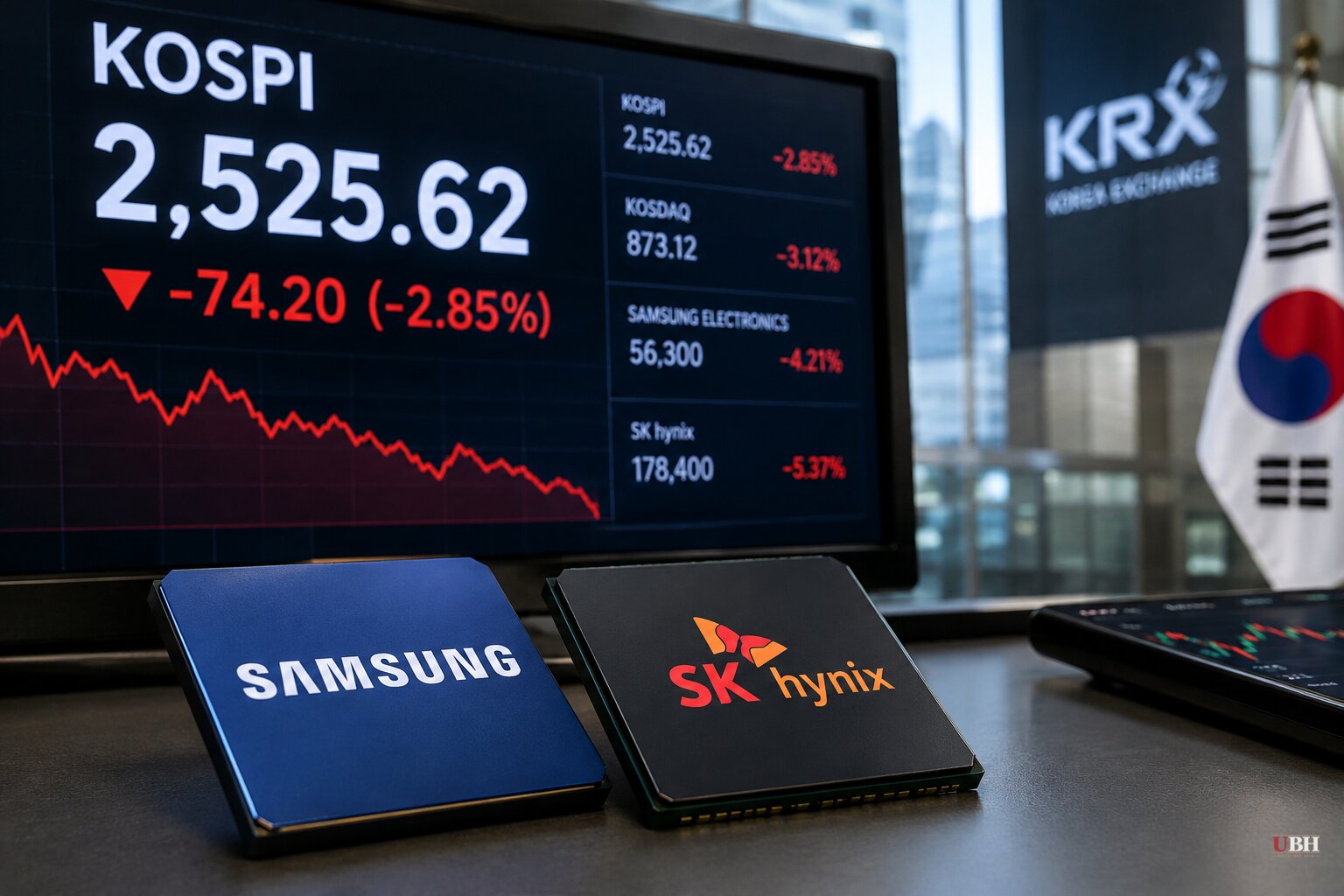
Since the Kospi's plunge of almost 8% on Oct. 15, part of an 18% slide over five sessions, South Korea's benchmark has kept sinking. On Tuesday, Oct. 20, it dropped again, even though U.S. tech stocks had rebounded overnight.
The Associated Press had the Kospi down 2.8% in early trading at 5,605.31. BeInCrypto put the drop at 3.5% at the open. Coin Bureau, a crypto media outlet, said about ₩170 trillion in market value was erased. That figure is Coin Bureau's own and is not confirmed by an exchange or official source.
Memory names lead the drop
SK Hynix fell as much as 5.6% and Samsung Electronics dropped 2.6%, according to Coin Bureau. Both are memory chipmakers, and memory is where the Kospi is most concentrated.
BeInCrypto reported that the index is now about 39% below its June record. Its 2026 gain has shrunk from 116% to 31%. BeInCrypto also pointed to foreign selling and liquidations of leveraged investors as added pressure.
The rest of Asia was weaker but calmer. Japan's Nikkei 225 slipped 0.6% to 64,512.35. Australia's S&P/ASX 200 lost 0.8% to 8,772.10. Hong Kong's Hang Seng fell nearly 1.0% to 23,947.37. The Shanghai Composite was little changed at 3,732.29.
Wall Street's rebound was narrow
Monday's U.S. bounce was concentrated in AI and tech. The S&P 500 rose 0.4% to 7,690.73, coming off its worst week since June. The Nasdaq composite gained 1.1% to 26,430.89. The Dow Jones Industrial Average slipped 0.1% to 51,966.03, and most stocks outside AI and tech fell.
Nvidia added 1.4%. As the largest U.S. stock by market value, it was one of the biggest forces lifting the S&P 500. Chip stocks snapped an eight-day losing streak that Fox Business described as the longest in 18 years.
The rebound did not carry into Seoul. It is unclear whether the rebound will carry through the rest of the week.
Debt and rates are the worry
Much of the money going into AI chips and data centers has been borrowed. The 10-year Treasury yield climbed to 5.14% from 5.09% late Friday, after yields hit their highest levels in years. Higher rates make that debt more expensive to carry.
Fox Business singled out CoreWeave, which rents out computing power for AI, because of its $50 billion debt load.
Oil adds to the pressure. U.S. crude rose to $103.50 a barrel and Brent to $109.47. The Associated Press said uncertainty about when the war with Iran will allow the energy industry to return to normal makes it unlikely prices ease soon.
The case that the AI buildout is intact
Not everyone reads the selloff as a sign of weak demand. Hendi Susanto, a portfolio manager at Gabelli Funds, told The Epoch Times that "the biggest challenge in AI investing right now isn't the fundamentals. It is the expectations that are fragile."
Susanto said the AI infrastructure buildout will continue into the new year, with demand still high for accelerators, chipmaking equipment, memory chips and networking. "Companies don't commit billions to new fabs unless they see the orders coming," he said.
Adam Turnquist, chief cross-asset strategist at LPL Financial, framed Korea's problem as specific to its market. "While enthusiasm around the broader AI investment cycle remains intact, Korea's concentrated exposure to memory leaves it more vulnerable to competitive threats, positioning unwinds, and shifts in the memory cycle," he said in a note. Turnquist said the Kospi has diverged from the Nasdaq 100.
On Oct. 15, the Philadelphia Semiconductor Index fell about 2% and was down almost 10% over the week, though still up 61% for the year.
Investors are watching for proof that AI spending pays off. Meta and Tesla report results Wednesday, Oct. 21. Chip equipment maker Lam Research and data storage company Western Digital also report this week.
Western Digital's numbers bear directly on the memory demand that Samsung and SK Hynix depend on. U.S. markets reopen at 9:30 a.m. ET today, Oct. 20.
Sources used for this briefing
6 links from 4 independent newsrooms (syndicated copies of the same report count once)
These are the sources it draws on, linked so you can verify.


