
Unbiased headlines. Facts, not spin.
Unbiased Headlines is an independently owned news organization. We bring you the facts, not opinions, written fresh from 110+ named sources. Sources linked so you can verify it yourself.
 finance
Major Story (7/10)
Event date: October 15, 2026 ·
Kospi Drops About 5% Tuesday to 5,493 as Elice Debut Sinks and Margin-Call Worries Build
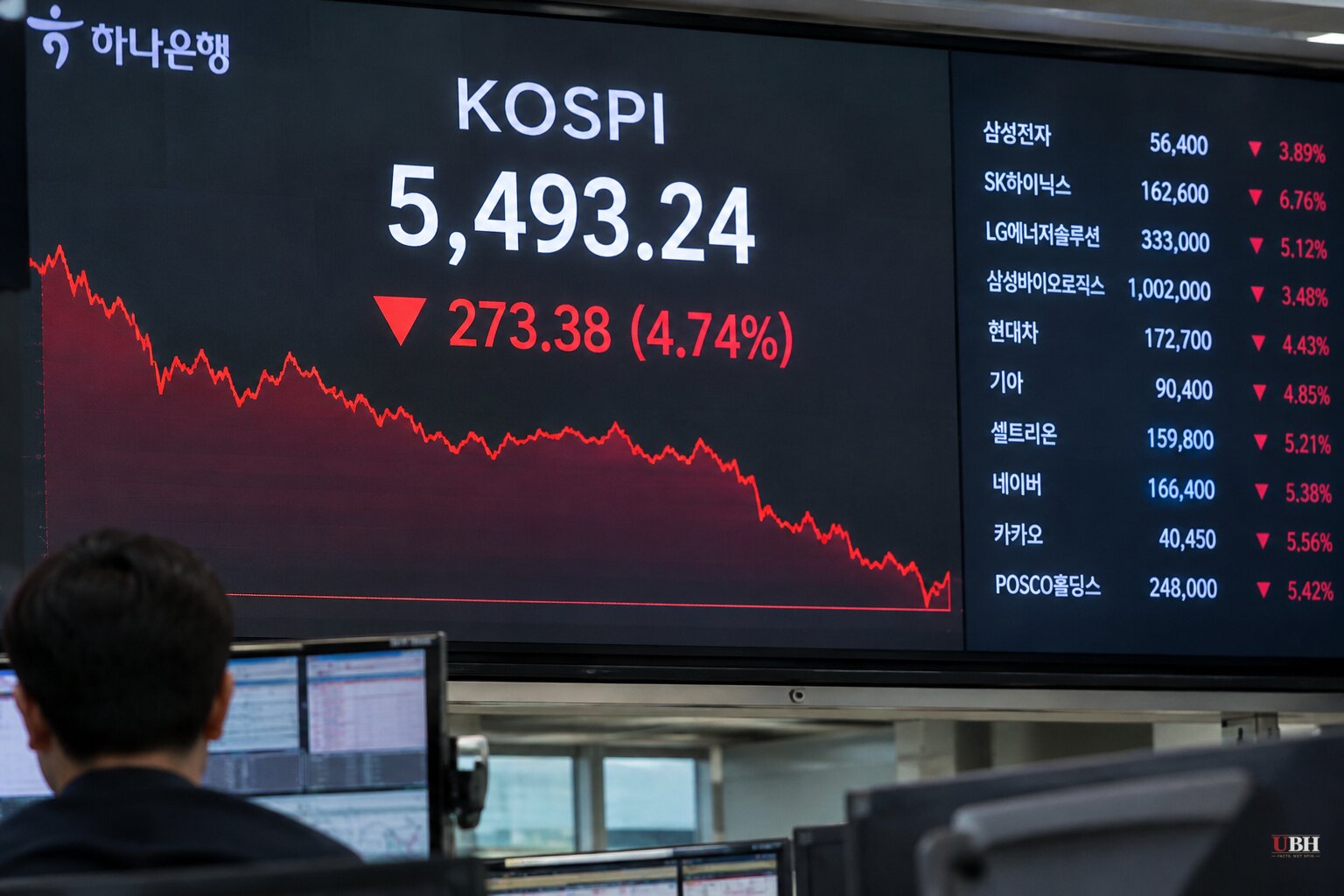
Since the Kospi hit its record 9,386 in June, the index has lost roughly 40% of its value, and Tuesday, Oct. 20, added to that: the benchmark fell about 5% to 5,493.24, a steeper loss than the 2.8% to 3.5% decline in early trading.
The index is still up about 30% for 2026. It surged 116% at its June record close before the reversal began.
Elice's debut and the Oct. 15 crash
The AI-linked data-center firm Elice Inc. made its Seoul market debut Tuesday and dropped as much as 32%. A debut that sours that fast is a direct read on how little appetite remains for new AI listings.
The backdrop is Thursday, Oct. 15. The Kospi fell 7.57% that day to 5,554.22, according to Korea Exchange data. It was down more than 9% at one point. It was the index's biggest single-day drop in recent years and its lowest close since April.
The Korea Exchange triggered sell-side sidecars and Stage 1 circuit breakers on both the Kospi and Kosdaq. Trading halted for 20 minutes in each market. Of 917 Kospi-listed stocks traded that day, 789 fell and 113 rose. The Kosdaq closed at 760.82, down 7.65%.
The Kospi 200 Volatility Index jumped 23.31% to 55.38, its highest since Aug. 26, according to Dong-A Ilbo. The won weakened to 1,344.6 per dollar.
Samsung Electronics fell 9.5% on Oct. 15 and SK Hynix fell 11.1%. SK Hynix now sits about 35% below its peak and Samsung about 22%. The two companies made up 44% of the Kospi in May, according to Mint.
What set it off
Three things hit at once, according to Daishin Securities analyst Lee Kyung-min: higher short-term rate expectations after U.S. inflation data, doubts over AI infrastructure profitability, and worries about memory-chip competition.
The U.S. producer price index posted its sharpest monthly gain since 2022. Core producer inflation, which strips out food and energy, rose 0.7%, above estimates, according to the Epoch Times.
Seoul-based coverage also points to a sharp drop in CoreWeave's corporate bond prices. That sharpened scrutiny of how much debt AI companies are carrying.
Reuters reported that OpenAI told investors last week its annualized revenue for September was nearly $50 billion. That is below a figure the company had indicated earlier. At a separate event, OpenAI had said its September run rate was approaching $70 billion.
Foreign investors did most of the selling. The Korea Exchange recorded net foreign sales of about 3.62 trillion won (roughly $2.70 billion) in the Kospi market on Oct. 15. Dong-A Ilbo put the figure above 5 trillion won. Foreigners had been net sellers for eight straight sessions since Oct. 2, according to MoneyToday.
Retail and institutional buyers took in 1.29 trillion won and 1.69 trillion won respectively that day. It wasn't enough to offset the foreign selling.
The leverage risk
The more immediate worry in Seoul is borrowed money. Korean financial-industry data cited by Maeil Business show forced liquidations of unpaid margin purchases, known as "counter-trading," reached about 80.5 billion won on Oct. 15. They totaled 256.3 billion won from Oct. 12 through Oct. 15.
The Oct. 15 drop had not yet fully fed through those figures. Forced sales usually come the next trading day after the settlement deadline. Maeil said the Oct. 15 crash could trigger more liquidations early this week.
The Kospi rebounded only 2.05% on Oct. 16. That ended a seven-session losing streak, but it left the index more than 20% below where it stood on Oct. 6.
Customer deposits, the cash retail investors keep on hand to buy stocks, fell below 100 trillion won to 96.91 trillion won as of Oct. 15. That is a thinner cushion than a month ago.
Not everyone sees broken fundamentals
Some investment professionals say the AI buildout itself is intact. Hendi Susanto, a portfolio manager at Gabelli Funds, said "the biggest challenge in AI investing right now isn't the fundamentals. It is the expectations that are fragile."
Susanto said demand remains high for accelerators, chipmaking equipment, memory chips and networking. He said suppliers are expanding capacity because "companies don't commit billions to new fabs unless they see the orders coming."
Adam Turnquist, chief cross-asset strategist at LPL Financial, said Korea's weakness stems from its structure rather than from the broader AI cycle. He wrote that Korea's "concentrated exposure to memory leaves it more vulnerable to competitive threats, positioning unwinds, and shifts in the memory cycle."
That helps explain the split with Wall Street. On Oct. 15 the Dow rose more than 400 points while the Philadelphia Semiconductor Index fell about 2%, though that index is still up 61% this year.
The next checkpoint is Wednesday's earnings from Meta and Tesla. Korean regulators and brokers will also be watching whether margin-loan liquidations jump in the sessions ahead, given how far retail buying power has shrunk.
Sources used for this briefing
7 links from 5 independent newsrooms (syndicated copies of the same report count once)
These are the sources it draws on, linked so you can verify.


