
Unbiased headlines. Facts, not spin.
Every story is an unbiased news briefing written from 110+ sources across the spectrum — sources linked so you can verify it yourself.
 tech
Major Story (7/10)
August 11, 2026 at 09:27 PM
tech
Major Story (7/10)
August 11, 2026 at 09:27 PM
Wall Street's Biggest Money Managers Pledge $500 Billion for AI Data Centers, No Contracts Yet
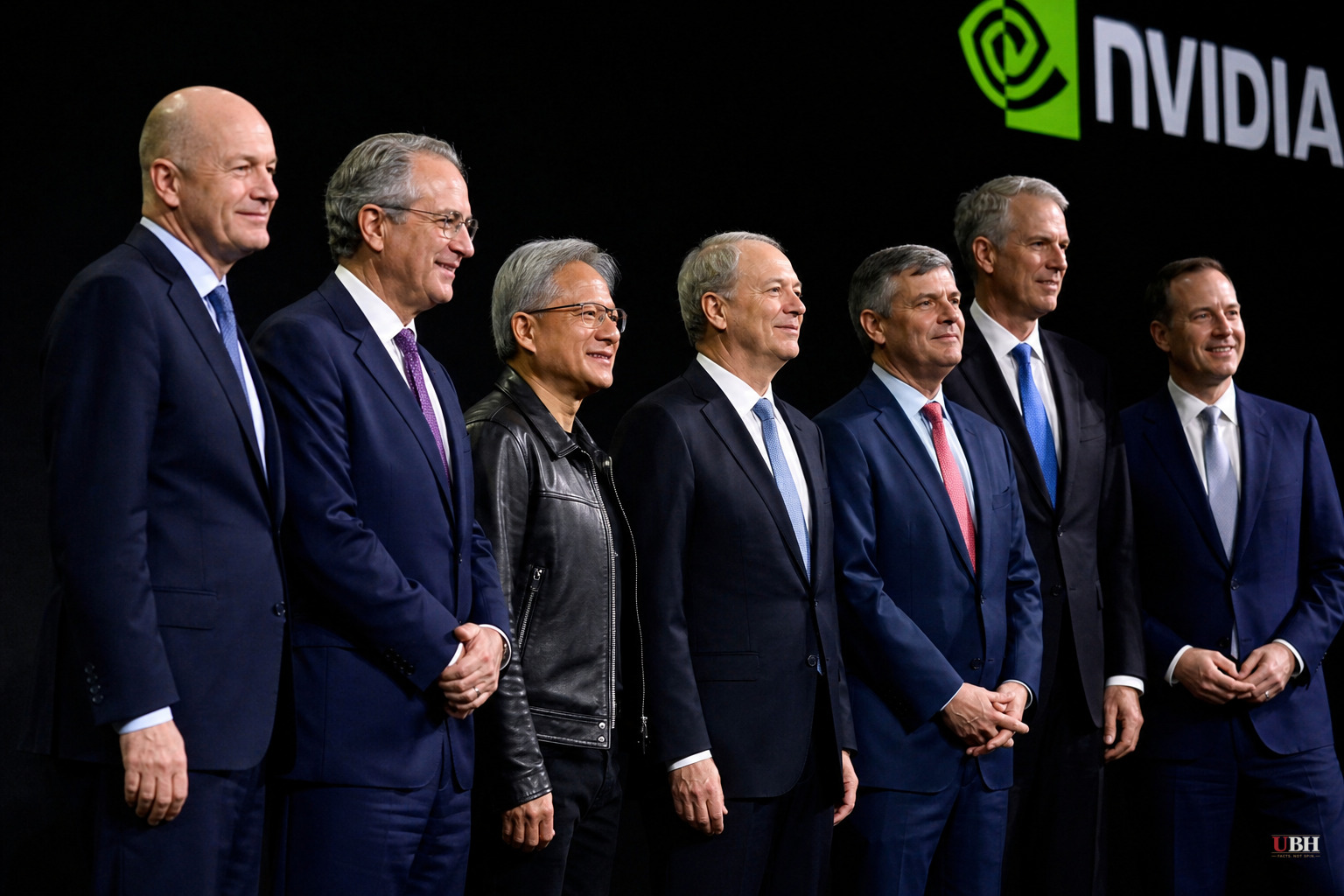
Since Nvidia's $100 billion OpenAI infrastructure pledge from October 2025 quietly failed to materialize, CEO Jensen Huang has been searching for a financing model that sticks. On Monday, he found new partners with deeper pockets and, more importantly, other people's money.
In an interview with CNBC's Becky Quick, Huang unveiled what he called a "big concept": a plan to shift AI data center financing away from corporate balance sheets and onto Wall Street's biggest asset managers. Standing with him were Goldman Sachs CEO David Solomon, along with leaders from BlackRock, Blackstone, KKR, Apollo and Brookfield. Together, the firms say they're prepared to raise $500 billion, and potentially more, for building out new AI facilities.
The pitch is that AI infrastructure has become its own asset class. Huang told CNBC these systems aren't like PCs or phones sitting depreciating in a closet. "These are revenue-generating assets now," he said. "They're productive, they're long-lived, they're fungible, they're flexible."
KKR's Waldemar Szlezak and Solomon echoed that framing on the same panel, describing what Solomon called "asset-based financing against this infrastructure build-out." Treat data centers like toll roads or power plants, something a pension fund or insurance company can lend against for decades.
What Was Actually Signed
According to CNBC, the joint press release from the six firms referenced memoranda of understanding, not contracts. There's no disclosed timeline for when construction financing actually starts, no named borrowers, no specified interest rates, and no confirmed site locations.
A $500 billion figure is eye-popping. It is also a set of intentions among asset managers to look for deals, not a closed transaction. Nvidia has been here before. Its October 2025 announcement of a planned $100 billion investment in OpenAI, tied to 10 gigawatts of data center capacity, generated similar headlines. CNBC reports that investment never happened. Nvidia instead put $30 billion into OpenAI's record funding round earlier this year, a fraction of the original number.
Why Wall Street Wants In
The scale of AI capital needs helps explain why banks and private equity firms want a piece. Roland Berger, the German consulting firm, estimates hyperscaler capital expenditure will hit roughly $750 billion in 2026 alone, mostly for data centers, straining global supply chains for transformers, turbines, cooling systems and chips. McKinsey projects global AI infrastructure spending could reach $7 trillion by the end of the decade, according to CNBC.
Alphabet, Amazon, Meta, Microsoft and Oracle have already raised more than $150 billion combined this year through debt and equity sales to fund data centers and AI model development, CNBC reported. Intel separately raised a $15 billion stock offering that it then upsized to $20 billion. Some of these companies are burning through cash fast enough to turn cash-flow negative, according to CNBC's reporting, which is exactly the kind of balance-sheet strain that makes outside financing attractive.
Roland Berger's own analysis, published July 23, frames the build-out in blunter terms. The firm's partner Nikolaus Lehmann warns that hyperscaler capex is "straining the global supply chain," and director Wim D'Hondt notes that "AI capex is racing ahead of revenue," with cash flow and external financing bridging the gap only "for now." That's a polite way of saying the industry's spending is outrunning what AI products are actually bringing in, and the math only works if revenue eventually catches up.
The Skeptic's Case
There's a reasonable argument that this is exactly how infrastructure gets built. Toll roads, pipelines and power plants have long been financed through asset-based lending rather than corporate cash. If AI data centers really do generate predictable, long-term revenue from renting out compute, treating them like any other infrastructure asset isn't crazy. Firms like Blackstone and Brookfield have decades of experience underwriting exactly this kind of long-duration bet.
The counterargument is that nobody in Monday's announcement offered proof that AI compute demand will remain "fungible" or "flexible" enough to justify decades-long financing commitments, in Huang's own words. Chip architectures shift fast. A data center built for today's Nvidia GPUs could be technologically obsolete or underutilized in five years if demand patterns change or a competitor's chip wins out. Asset managers are being asked to underwrite thirty-year bets on a technology that didn't exist in its current form three years ago.
No contracts have been signed. No specific projects, sites, or interest rates have been disclosed. The $500 billion figure is a stated intention from six firms, not a completed financing round. Whether it turns into actual concrete and steel, or joins Nvidia's $100 billion OpenAI pledge as another number that quietly disappeared, depends on deals nobody has announced yet.
Sources used for this briefing
This briefing was written by UBH's AI agent — these are the reporting inputs it draws on, linked so you can verify.


