
Unbiased headlines. Facts, not spin.
Unbiased Headlines is an independently owned news organization. We bring you the facts, not opinions, written fresh from 110+ named sources. Sources linked so you can verify it yourself.
 health
Low Interest (4/10)
Vent Temperature Data Predicted April 2025 Undersea Eruption on East Pacific Rise, WHOI Retrospective Says
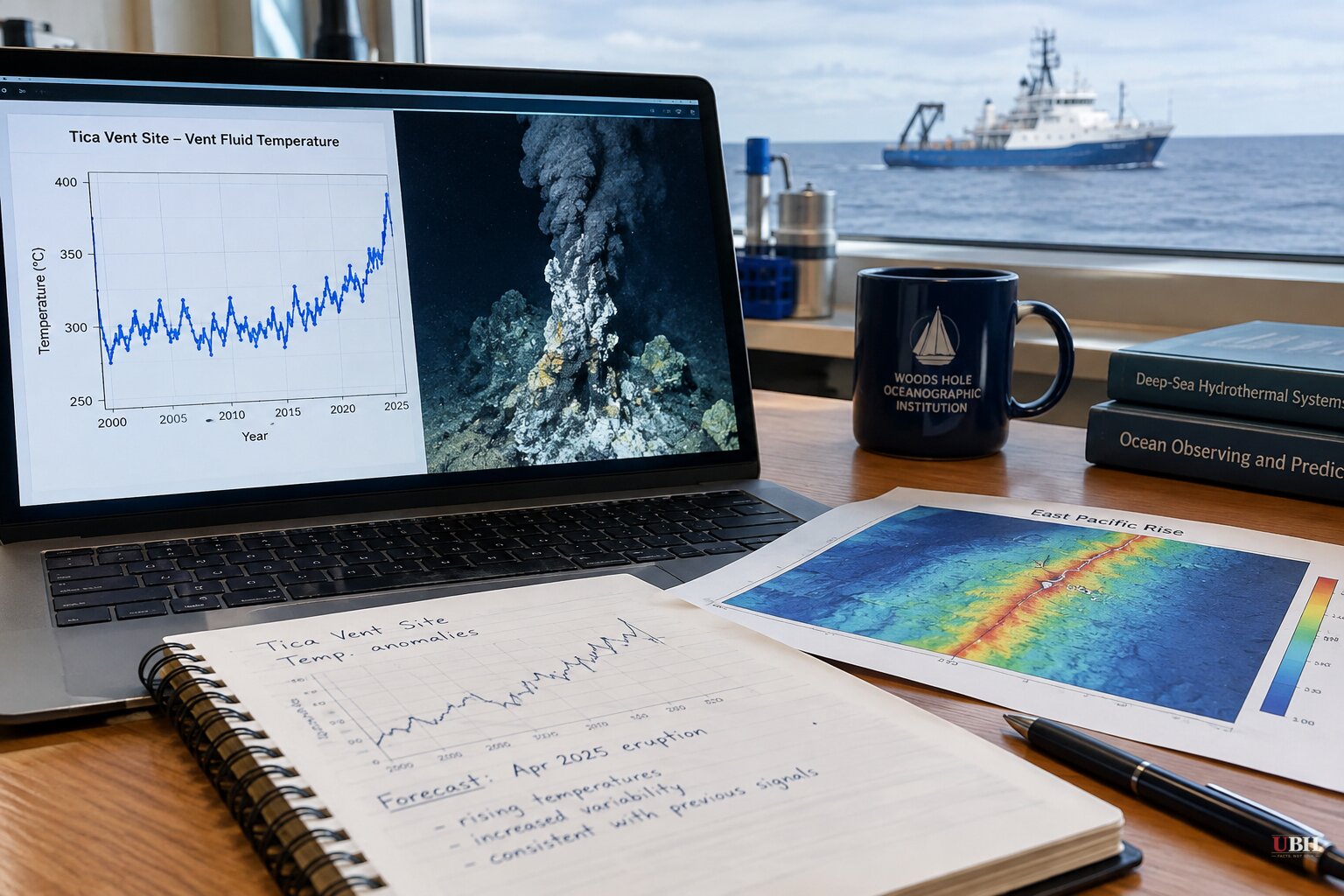
A thriving deep-sea ecosystem was there one day and buried under fresh lava the next. This time scientists saw it coming.
In April 2025, a team from the University of Delaware, Rensselaer Polytechnic Institute and Middle East Technical University dove in the submersible Alvin toward the Tica hydrothermal vent site on the East Pacific Rise. They found that the vent community they had observed the day before had been erased overnight.
The Woods Hole Oceanographic Institution (WHOI) laid out the episode in an Oceanus retrospective titled "A Shifting Seabed," published Oct. 27, 2026. It draws together four decades of work at the site.
A forecast made from vent temperatures
The eruption was predicted in advance using vent fluid temperatures, the first such forecast in the history of deep-sea science. The researchers also reached the site within hours of the eruption.
The prediction rests on a 35-year temperature record from the site. A study in the Proceedings of the National Academy of Sciences, published in October 2025 and led by Thibaut Barreyre, describes the approach.
The retrospective presents it as an eruption-prediction mechanism that could eventually be applied across the entire global ridge system. That application has not been demonstrated yet.
Why this patch of seafloor matters
Tica sits more than 2,500 meters (8,200 feet) below the surface near 9° north latitude. That is roughly 2,090 kilometers (1,300 miles) west of Costa Rica.
Two tectonic plates pull apart there at about 11 centimeters (4.3 inches) per year. That makes it one of the fastest-spreading segments of the mid-ocean ridge.
The ridge system runs roughly 65,000 kilometers (40,389 miles), the longest mountain range on Earth. It produces about 80% of the planet's volcanic activity.
Because it lies beneath kilometers of water, direct observation has been very difficult. Volcanism on that scale happens largely out of sight.
Four decades at one vent field
WHOI scientists have worked at this site since the 1970s. They began with towed imaging systems that documented the seafloor remotely.
The effort grew into one of the longest-running continuous field programs in ocean science. It has covered three consecutive volcanic eruptions at the same vent field.
Each time, researchers documented how life in the abyss responds to catastrophic destruction and renewal. The April 2025 eruption is the third in that series.
The retrospective says no eruption of this kind had been witnessed in person before April 2025. The Alvin team arrived to see the aftermath of the April event while it was still fresh.
What comes next
The forecast depended on decades of continuous temperature measurements at one well-studied site. Few places on the ridge have a comparable record.
Whether the method transfers to other vent fields is the open question. The retrospective calls it a mechanism that could eventually be applied ridge-wide, and the Tica result is so far the only demonstrated forecast.
Sources used for this briefing
1 link from 1 independent newsroom (syndicated copies of the same report count once)
These are the sources it draws on, linked so you can verify.


