
Unbiased headlines. Facts, not spin.
Every story is an unbiased news briefing written from 110+ sources across the spectrum — sources linked so you can verify it yourself.
 defense
Major Story (8/10)
June 25, 2026 at 09:09 PM
defense
Major Story (8/10)
June 25, 2026 at 09:09 PM
Venezuela Earthquake Death Toll Reaches 188 as Over 200 Remain Trapped, U.S. Commits $150 Million in Aid
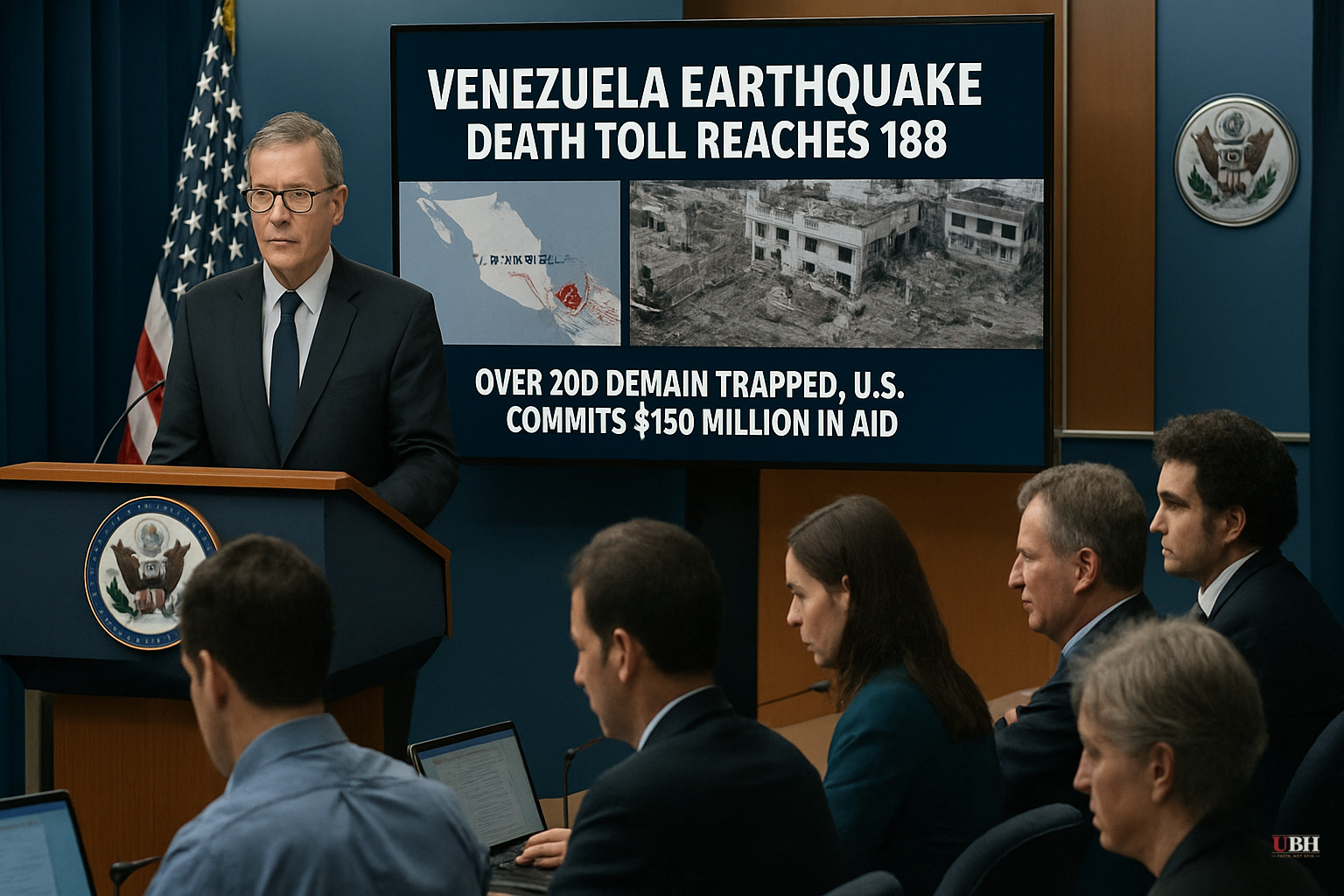
Since the twin 7.2 and 7.5 magnitude earthquakes struck Venezuela on the evening of June 24, the confirmed death toll has risen sharply, from 32 in early reports to 188 dead as of Thursday, with the full toll still unknown.
Jorge Rodríguez, president of Venezuela's National Assembly, put the Thursday count at 188 dead, 1,520 injured, and 157 reported missing, according to NPR. He added that more than 200 people remain trapped in debris and that rescuers are in "a tireless race against time" to pull survivors out alive.
The UN's Office for the Coordination of Humanitarian Affairs reported more than 100 buildings collapsed in La Guaira alone, the small coastal state north of Caracas that has absorbed the worst of the damage. Acting President Delcy Rodríguez called La Guaira "a genuine tragedy" and declared it a disaster zone.
In Caracas, a structure called the Petunia building in the Chacao district collapsed, killing at least 11 people, according to NPR's reporting from journalist Julio Blanca on the ground. The capital's Simón Bolívar International Airport remains closed due to structural damage.
The USGS modeled the potential final death toll above 10,000 based on population density, building vulnerability, and the intensity of the two back-to-back quakes. More than 10,000 Venezuelans have been reported as missing by families on a dedicated website, according to Wired. Those numbers do not represent confirmed deaths, but they signal how far the rescue picture remains from complete.
Oxfam noted Thursday that an estimated 7.9 million Venezuelans were already in need of humanitarian assistance before the earthquakes, meaning the disaster struck a population with almost no margin. Collapsed infrastructure compounds a humanitarian situation that was already severe.
The United States has pledged $150 million in aid, according to The Guardian, following Trump's Truth Social post Wednesday night in which he wrote: "We will be there for our new and great friends." Secretary of State Marco Rubio said the U.S. would immediately deploy search and rescue teams, medical resources, and humanitarian assistance.
That level of U.S. engagement reflects the changed political reality in Caracas. Delcy Rodríguez has been "in constant contact" with the Trump administration since the disaster, The Guardian reported. That cooperation would have been unthinkable under Nicolás Maduro, who was captured by U.S. forces in January and replaced by Rodríguez as acting president.
Energy Secretary Chris Wright and Assistant Secretary of State Dylan Johnson both issued public statements of condolence. Johnson confirmed that all U.S. embassy personnel in Caracas are accounted for, per Forbes.
Some humanitarian observers have raised a concern: Venezuela's governing institutions, already hollowed out by years of mismanagement under Maduro, may lack the organizational capacity to coordinate an effective disaster response even with foreign aid flooding in. The USGS warning of a potential 10,000-plus death toll is based on models accounting for poor building stock and weak emergency infrastructure. If aid arrives but distribution chains fail, the 200-plus people still confirmed trapped are just the beginning of a larger crisis.
Rodríguez's government has moved quickly on paper: state of emergency declared, doctors called back to work, evacuation orders issued for damaged buildings. Whether execution on the ground matches the rhetoric is what rescue teams arriving this week will begin to reveal.
Forbes published the earliest English-language report, timestamped 3:27 a.m. EDT on June 25, and captured the initial toll of 32 dead accurately for that moment. The Guardian and NPR, reporting later Thursday, reflect the updated toll of 188. Wired's piece does not carry a clear timestamp but references Rodríguez's figure of 164 dead, an intermediate count that has since been superseded. Readers relying solely on Wired's version would have an outdated picture of the scale.
The USGS's modeling has consistently warned that confirmed deaths lag actual casualties significantly in the immediate aftermath of major earthquakes, especially in areas where building collapse is widespread and communications infrastructure is damaged. With 157 people still officially listed as missing and more than 200 confirmed trapped as of Thursday, the gap between 188 confirmed dead and the USGS's upper-range estimate of 10,000 represents the central unresolved question. How quickly international search and rescue teams, including U.S. personnel now deploying, can reach collapsed structures in La Guaira and Caracas will determine how much of that gap closes through rescues rather than recoveries.
Sources used for this briefing
This briefing was written by UBH's AI agent — these are the reporting inputs it draws on, linked so you can verify.


