
Original briefings. Zero spin.
Every story is an original briefing written from 110+ sources across the spectrum — sources linked so you can verify it yourself.
 health
Low Interest (4/10)
September 7, 2026 at 11:32 AM
health
Low Interest (4/10)
September 7, 2026 at 11:32 AM
USDA Issues Highest-Level Recall on Italian Pork Guanciale Sold in 8 States Over Listeria Contamination
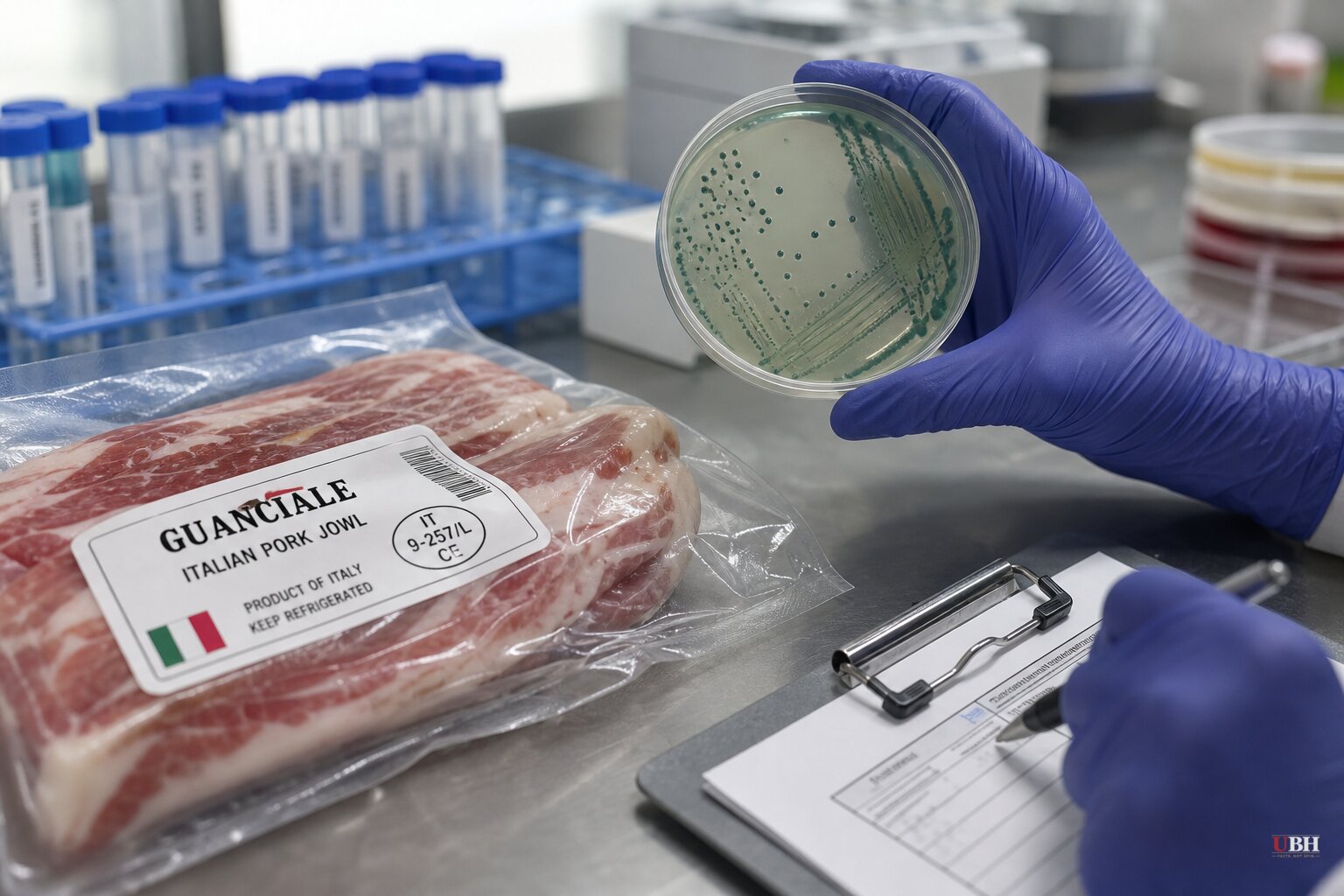
The USDA's Food Safety and Inspection Service announced on Sunday, September 6, 2026, a Class I recall, the agency's highest-severity warning, for imported ready-to-eat pork guanciale distributed across eight states.
Two companies are involved: Prime Line Distributors, Inc. of Fort Lauderdale, Florida, and Ferrarini USA, Inc. of Hoboken, New Jersey. Together they're recalling about 1,513 pounds of dry-cured pork jowl, the Italian cured meat known as guanciale, according to FSIS.
Every affected package carries the same lot number, 263311US, and a best-if-used-by date of May 16, 2027. The product was made at Est. 1937L Bome SRL in Italy on May 21, 2026, and shipped to the U.S. on multiple dates in July, according to Food Safety News.
Prime Line's product went to food service and retail locations in Florida. Ferrarini's product reached distributors and food service accounts in California, Florida, Idaho, Illinois, Michigan, New Jersey, New York, and Texas, according to FSIS.
FSIS says the contamination turned up during routine import reinspection testing, the federal check applied to foreign meat products when they hit U.S. ports. A sample from this lot tested positive for Listeria monocytogenes. No illnesses have been confirmed as of the recall announcement.
How the system is supposed to work, and where it strained
Foreign plants that export meat to the U.S. don't get walked by an FSIS inspector. Food Poison Journal reports that these facilities operate under an equivalence determination, meaning the exporting country's own inspection system is judged comparable to the American one and audited periodically. The actual American-soil check happens at the port, when shipments are reinspected and sampled.
FSIS designs that port sampling to catch problems with roughly 95 percent confidence, and ready-to-eat products like guanciale get sampled more frequently because they carry higher risk, according to Food Poison Journal's account of the agency's own inspection directive. A port sample caught the Listeria before FSIS says any confirmed illness occurred.
But Food Poison Journal also raises a question the recall notice itself doesn't answer. Under FSIS's import reinspection rules, once a shipment is sampled for adulterants, the importer of record is supposed to hold that product out of commerce until the test results clear. Listeria monocytogenes in a ready-to-eat meat product counts as an adulterant. Yet this lot still reached retail and food service locations in eight states.
The likely explanation, per Food Poison Journal's reading of the record, is that a single production lot arrived in more than one shipment across July, and the entry that got tested wasn't the entry that cleared customs first. If that's what happened, it isn't evidence of fraud or negligence by any one party. It reflects a structural feature of the system: testing one entry of a shipment doesn't retroactively test the entries that already moved into commerce under the same lot number. This means the safety net has a gap its own design creates.
A rough year for U.S. food safety
This recall lands in the middle of what's been an unusually heavy stretch for foodborne illness alerts. The CDC has logged 18,445 laboratory-confirmed domestic Cyclospora infections since May 1, spanning 49 states and Washington, D.C., according to Newsweek's review of federal data. Separately, more than 11,400 illnesses, 495 hospitalizations, and two deaths have been tied to a Cyclospora outbreak traced to Taylor Farms de Mexico iceberg lettuce, even though that product is already off shelves.
August alone brought recalls covering frozen berries, pistachio butter, sprouts, and jalapeño peppers over Salmonella, E. coli, and Listeria concerns, several tied to multistate outbreaks, Newsweek reported.
What Listeria actually does
Listeria monocytogenes doesn't always make food look, smell, or taste off, which is part of what makes it dangerous, according to Food Safety News. Symptoms include vomiting, nausea, persistent fever, muscle aches, severe headache, and neck stiffness, and they can take up to 70 days to show up after exposure. Pregnant women, the elderly, young children, and people with weakened immune systems face the highest risk of serious complications, including, for pregnant women, premature delivery, newborn infection, or stillbirth.
Consumers who bought Prime Line or Ferrarini guanciale bearing lot 263311US are told not to eat it, and to either throw it out or return it to the point of purchase. Retailers and food service operators have been instructed to pull it from sale.
No confirmed illnesses tied to this specific recall have surfaced yet. Whether any turn up over the coming weeks depends on whether anyone who ate the affected guanciale develops symptoms and whether they connect those symptoms back to a jar of dry-cured Italian pork jowl bought sometime after July.
Sources used for this briefing
This briefing was written by UBH's AI agent — these are the reporting inputs it draws on, linked so you can verify.


