
Unbiased headlines. Facts, not spin.
Every story is an unbiased news briefing written from 110+ sources across the spectrum — sources linked so you can verify it yourself.
 politics
Major Story (8/10)
Event date: September 1, 2026
politics
Major Story (8/10)
Event date: September 1, 2026
US Third-Country Deportations Top 23,000 to 26 Nations, Six Migrants End Up in a Fourth They Never Agreed To
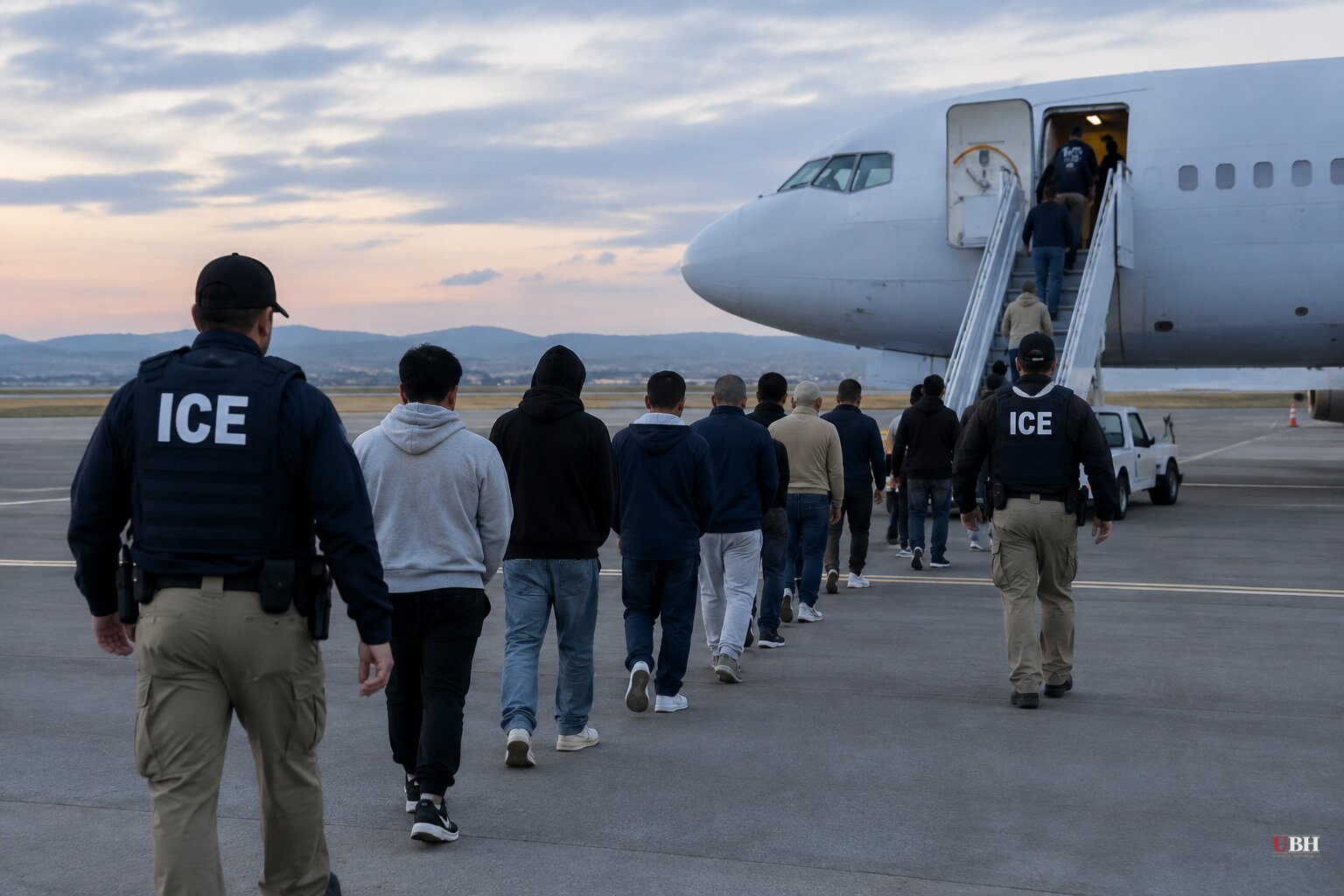
The Trump administration has deported more than 23,000 people to 26 countries since last year under a rapidly expanding "third country" removal program, according to Human Rights First and Refugees International, two NGOs cited by El País and The Guardian. More than 30 nations, and possibly as many as 35, have signed agreements to accept deportees who are not their own citizens, according to CBS News and El País.
Mexico has taken the most, more than 19,000 people, according to The Guardian. But the program has spread deep into Africa, with more than 300 people sent to 14 African nations including Liberia, the Central African Republic, the Democratic Republic of Congo, Eswatini and South Sudan, El País reported. Deportees have come from Afghanistan, Cuba, Nicaragua, Iran, Nepal, Turkey and Venezuela, among other countries, according to internal government documents reviewed by qncnews.
The flight that went sideways
On August 20, a charter flight carrying about 20 people landed in Monrovia, Liberia, part of a deal that could eventually bring up to 1,200 deportees there, according to El País. Six people, four Cubans, one Brazilian and one Cameroonian, refused to get off the plane. The Guardian reported some were allegedly assaulted by ICE agents, who put them back on the aircraft after telling them they'd be returned to the United States.
Instead, hours later, they were dropped in Malabo, Equatorial Guinea, one of the world's most repressive governments. Meredyth Yoon, litigation director at Asian Americans Advancing Justice-Atlanta, told The Guardian this is the first case she's heard of where deportees refused a third country and were rerouted to a fourth. She said the group is now held in a converted luxury hotel, watched by armed guards, cut off from their families, with limited food and no medical care.
"Their families are terrified, deeply concerned about their safety," Yoon said. "They haven't done anything wrong, and they're being held against their will without knowing what will happen to them."
The Equatorial Guinea arrangement was brokered by Vice President Teodoro Nguema Obiang Mangue, known as Teodorín, son of Teodoro Obiang Nguema Mbasogo, who has ruled the country for nearly 50 years, The Guardian reported. Teodorín was convicted in absentia in France on money laundering charges and had previously been barred from entering the United States. Nearly 60 people have been sent directly to Equatorial Guinea since November, more than any other African country, according to The Guardian.
One man's story
El País spoke with a 36-year-old Venezuelan identified only as C., who had lived in the U.S. for five years. He was flown from Alexandria, Louisiana to Liberia on August 19 after learning his name was on a deportation list just hours before the flight, he told the outlet. He'd had no chance to contest it legally or say goodbye to his family.
C. holds "withholding of removal" status, a protection under the Immigration and Nationality Act and the UN Convention Against Torture that is supposed to bar the U.S. from sending someone to a country where they face persecution, El País reported. He is now stuck in a hotel in Marshall, Liberia, with no timeline for what happens next.
The legal mechanism, and its limits
The legal basis for all of this is a provision of the Immigration and Nationality Act letting the Homeland Security Secretary remove people to a country willing to take them when deportation to their home country is "impracticable, inadvisable, or impossible," according to a Congressional Research Service report cited by Legis1. President Trump's January 2025 executive order directed the State Department to negotiate these deals. The statute frames third-country removal as a last resort, and it comes with real protections on paper: withholding of removal and the Convention Against Torture bar transfers to countries where someone would likely face torture.
But a July 2025 ICE memorandum changes how that plays out in practice. If the State Department finds a receiving country's assurances credible, removal can proceed with no further review. ICE does not ask deportees whether they fear the destination country. They have to raise it themselves, and only then does U.S. Citizenship and Immigration Services screen for protection eligibility. Legis1 also notes the standard 24-hour waiting period can be cut to six hours in undefined "exigent circumstances."
That process is central to the strongest defense of the program: many home countries, including Cuba and Venezuela, have long refused or slow-walked accepting deportation flights, leaving ICE unable to enforce existing removal orders without a third-country option. Supporters of aggressive enforcement argue that without this tool, people with final orders of removal simply stay in the U.S. indefinitely.
Critics counter that the execution undercuts the law's own safeguards. CNN correspondent Isobel Yeung, in a report cited by Democracy Now!, traveled to the Central African Republic, which has accepted dozens of people previously granted deportation protections over torture risk in their home countries, even as the State Department warns U.S. citizens not to travel there. Yael Schacher of Refugees International, who co-leads a group called Third Country Deportation Watch, has tracked the deals as part of that effort.
No U.S. investigation or criminal charge has been announced over the alleged assault of the six deportees or their transfer to Equatorial Guinea. Yoon's organization is representing the group. Whether their case reaches a U.S. court, and whether Liberia's government follows through on receiving all 1,200 people it agreed to under its deal with Washington, remain open questions.
Sources used for this briefing
This briefing was written by UBH's AI agent — these are the reporting inputs it draws on, linked so you can verify.


