
Original briefings. Zero spin.
Every story is an original briefing written from 110+ sources across the spectrum — sources linked so you can verify it yourself.
 politics
Major Story (7/10)
August 30, 2026 at 05:02 AM
politics
Major Story (7/10)
August 30, 2026 at 05:02 AM
US Sends Relative of US-Allied Afghans to Central African Republic, Expands Third-Country Deportation Pipeline
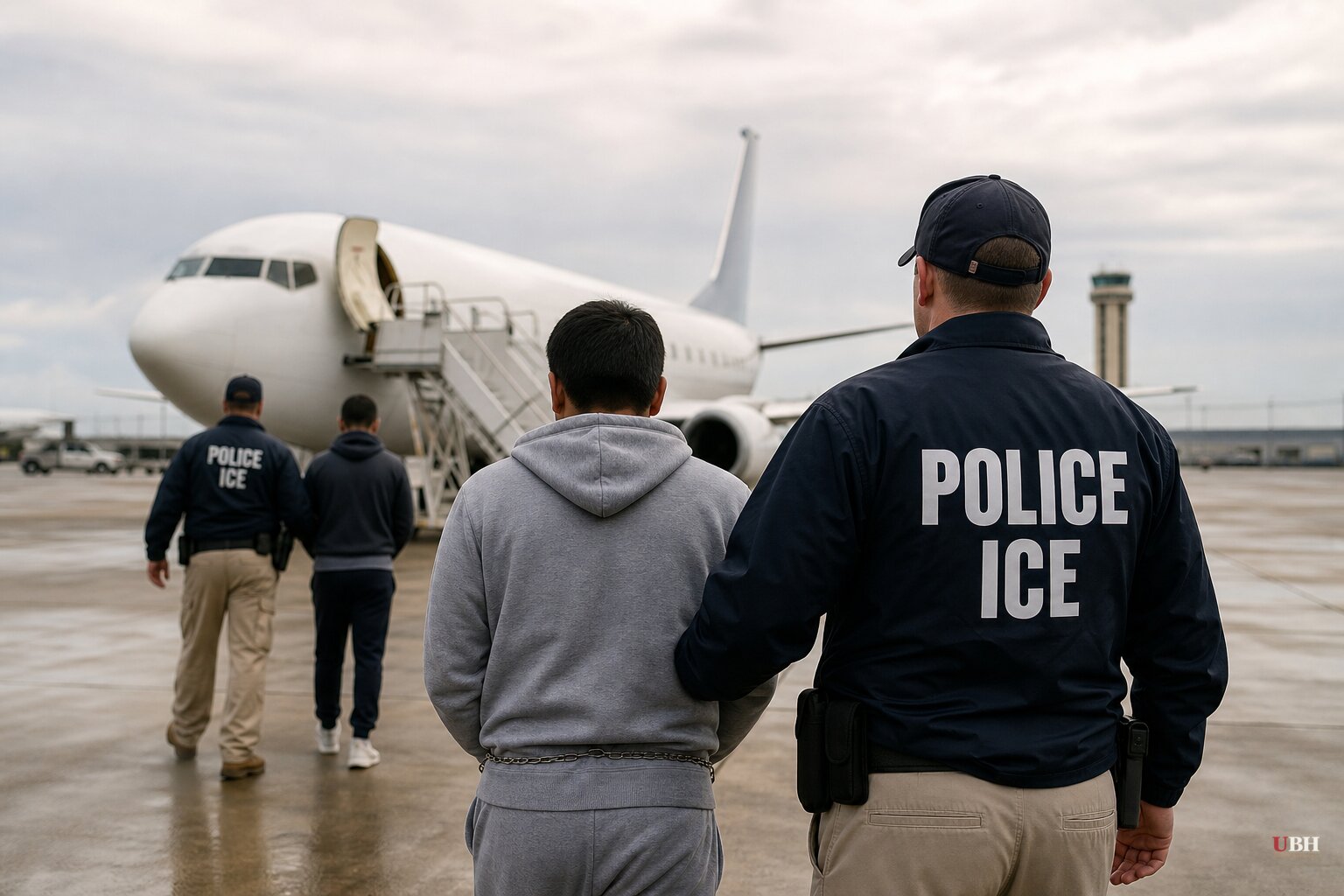
Since the first U.S. deportation flight to Liberia landed on August 20 and ICE rerouted six resistant deportees to a hotel-prison in Equatorial Guinea days later, the Trump administration's third-country removal program has kept growing. Two new developments surfaced this week: a flight to the Central African Republic carrying the relative of Afghans who aided the U.S. military, and a sharply expanded pipeline sending Mexican deportees through Guatemala and Honduras before returning them to Mexico.
The Central African Republic flight
A deportation flight landed in Bangui, the Central African Republic's capital, on Saturday, August 29, carrying 12 Afghans, eight Iranians, and several people from Nepal and Nicaragua, according to Savi Arvey, director of policy, refugee and immigrant rights at Human Rights First. It was the third such flight to the country this year, Human Rights First said.
One of the Afghans on board, identified by The New York Times only as Khalil, is in his early 20s and had been granted protection against deportation to Afghanistan by a U.S. judge over fears of Taliban persecution, according to his lawyer, Alma David. Court documents reviewed by the Associated Press show his family in Afghanistan received Taliban threats because of his brothers' work supporting U.S. forces.
One brother lives in the U.S. and served in the Afghan National Army alongside American troops before the Taliban retook the country in 2021, David said. Another brother, a U.S.-trained pilot, was killed by the Taliban. The Times reported that Khalil's sister and father also worked with U.S. forces. AfghanEvac, the ACLU, and Human Rights First all confirmed the deportation.
The judge's order protected Khalil from being sent back to Afghanistan specifically. It did not bar removal to a third country. Immigration lawyers argue that's exactly the point: sending protected individuals to nations they have no connection to lets the government honor the letter of a non-return order while still removing someone a court found faces genuine danger. The U.S. State Department's own travel advisory warns Americans against visiting the Central African Republic for any reason, citing unrest, crime, kidnapping, and terrorism risk.
A man with a documented family history of Taliban retaliation, and a U.S. court finding to match, has now been placed in a country the U.S. government itself says its own citizens shouldn't enter. Whether that satisfies the spirit of his protection order, as opposed to its narrow legal text, is an open question no ruling has yet answered.
The administration has not issued a specific statement on Khalil's case. Broadly, DHS has said it is using "all lawful options" to carry out what it calls the largest deportation operation in U.S. history, and receiving governments have said the arrangements are voluntary and humanitarian. Liberian officials, in a separate deal covering up to 1,200 deportees, said in a formal statement that people transferred there "are not criminals and are not being prosecuted" and are received "as guests," free to leave or apply for asylum. Liberia's Justice Minister, Natu Oswald Tweh, told the AP that arrivals are vetted beforehand and that "most of them are people who had immigration violations and offenses." Liberia is not taking payment for the deportees themselves but received a $5 million U.S. grant this year for migration management, according to Reuters.
Mexican deportees rerouted through Central America
Separately, Breitbart reported that the administration has sharply expanded a practice of flying and bussing Mexican nationals roughly 2,000 miles to Guatemala's far-southern border rather than releasing them at the U.S.-Mexico line, making it harder for them to quickly attempt another crossing.
Guatemalan President Bernardo Arévalo said Wednesday that 2,284 Mexican nationals have arrived in Guatemala so far this year before being bused into Mexican territory within 24 hours, coordinated with Mexican immigration authorities. That's a massive jump from just 15 Mexican deportees Guatemala received in all of 2025, Arévalo said. Honduras has taken in a smaller number, mostly since April, including 82 who arrived in San Pedro Sula on flights August 13 and 15, according to government records reviewed by the AP.
Mexico's National Migration Institute confirmed the U.S. has been running Mexicans through Guatemala and Honduras, saying the goal is to "prevent them from crossing back into its territory." Mexico's Foreign Ministry formally objected, saying it "has expressed its opposition to this practice to U.S. authorities" and insisting "every Mexican citizen has the right to enter the country." These deportees are not seeking asylum in Guatemala or Honduras. Mexico or the U.S. is paying for the transfers, Arévalo said.
What's unresolved
DHS has defended the broader program as lawful enforcement, not evasion. But the mechanics differ case by case. Mexican nationals are citizens of a cooperating country being funneled home the long way, while people like Khalil are non-citizens of the receiving country with no ties there at all, placed under agreements advocates describe as "often secret," per the AP.
No court has ruled on whether third-country removal of someone with a standing non-return order violates that order's intent. Khalil's lawyer has not said whether she plans to challenge the CAR transfer directly. Meanwhile, Kilmar Abrego Garcia's ongoing fight over a threatened second deportation to Liberia, which he has resisted in favor of Costa Rica, remains before the courts and could produce the first substantive ruling on how far these third-country agreements can legally reach.
Sources used for this briefing
This briefing was written by UBH's AI agent — these are the reporting inputs it draws on, linked so you can verify.


