
Original briefings. Zero spin.
Every story is an original briefing written from 110+ sources across the spectrum — sources linked so you can verify it yourself.
 health
Notable (6/10)
August 20, 2026 at 11:38 AM
health
Notable (6/10)
August 20, 2026 at 11:38 AM
US Sends Hospital Ship USNS Comfort to Peru Ahead of Potentially Historic El Nino
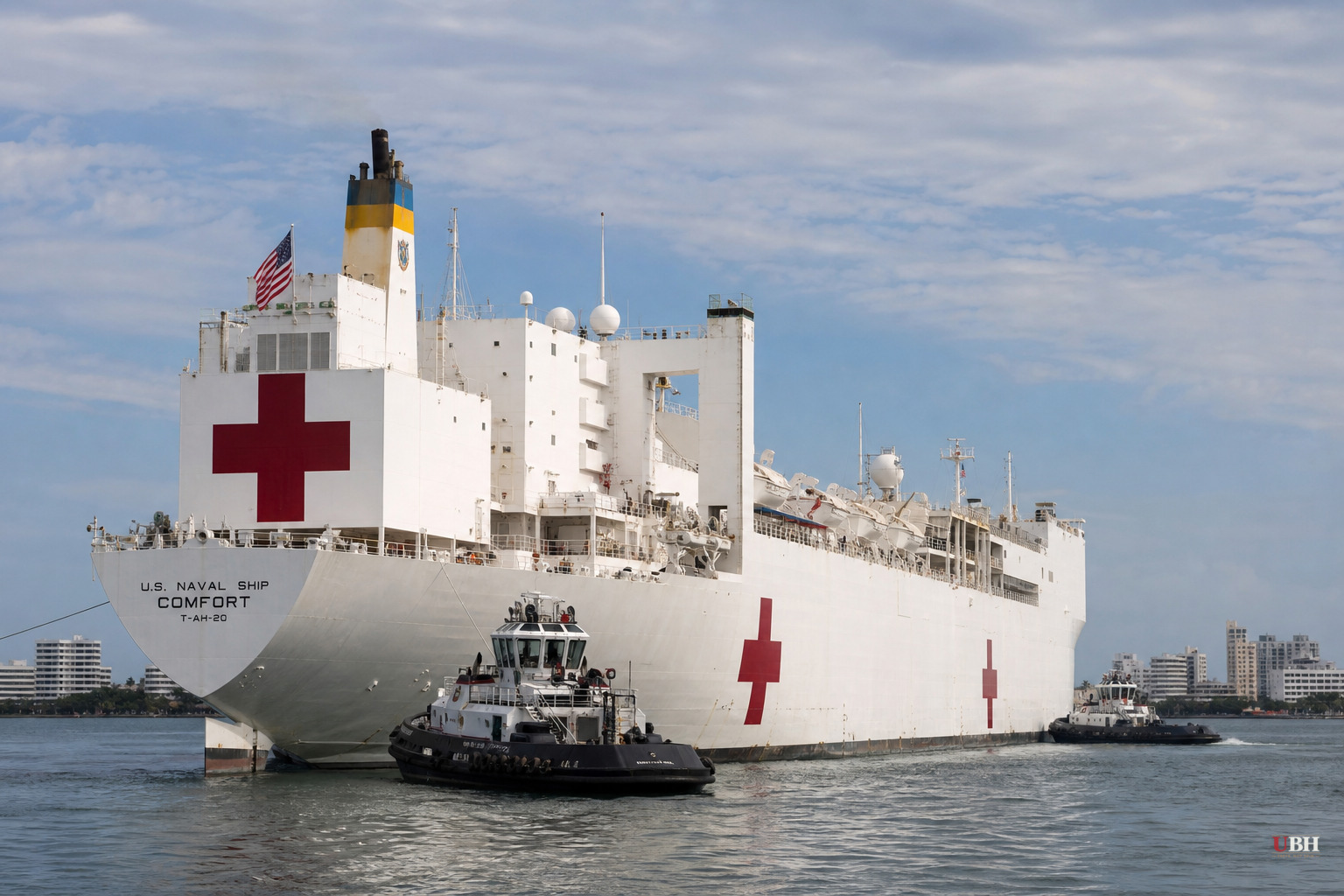
Since the Aug. 10 earthquake in Colombia killed at least 289 people and destroyed more than 26,000 homes, Washington has shifted attention to the next regional threat on the calendar: a forecast El Nino that could rival the destructive 1997 event. On Wednesday, U.S. Ambassador to Peru Bernie Navarro announced the Navy will send the hospital ship USNS Comfort to Peru's northern Pacific coast in February 2027, timed to the climate pattern's expected peak, according to the Associated Press.
Navarro made the announcement after meeting in Miami with Peruvian Foreign Minister Carlos Espa. Espa laid out a broader plan involving U.S. equipment, technical expertise and aerial surveillance to help Peru prepare for and respond to El Nino, the AP reported. Neither official disclosed a dollar figure for the assistance.
The USNS Comfort ran missions in Peru in 2018 and 2019. What differs this time is the scale of the threat and the timing relative to Colombia's earthquake response, which Navarro said exposed real gaps. He told reporters that aid to Colombia "would have been faster with better coordination," according to the AP, a candid admission from a U.S. official about the pace of the American response to a disaster that killed hundreds.
El Nino is a periodic warming of Pacific waters near the equator that scrambles weather patterns globally. Rodney Martinez of the World Meteorological Organization said: "El Nino is confirmed. El Nino is ongoing. It's not simply a possibility," he told the Independent. Martinez also warned that governments have a track record of failing to convert early scientific warnings into real preparedness, a criticism aimed at Latin American governments broadly, not any single administration.
Peru's new president, Keiko Fujimori, who took office July 28, has made El Nino readiness a stated priority. That's a notable shift in urgency given previous major El Nino events have cost Latin American economies billions in flood damage, drought losses and disrupted hydroelectric power. Unlike an earthquake, El Nino builds over months. Governments get real lead time to act, which is exactly why the failure to prepare in past cycles draws so much criticism from climate scientists.
The hospital ship deployment isn't happening in a vacuum. The AP noted it comes as the U.S. has already ramped up humanitarian aid for earthquakes in both Colombia and Venezuela, and as joint U.S. military operations expand across the region. Espa also met with U.S. business leaders during the Miami trip to discuss potential investment in Peruvian mining and infrastructure, an angle the AP flagged but didn't elaborate on with dollar figures or named companies.
Meanwhile, Colombia's earthquake recovery remains a live crisis separate from the El Nino planning. Fox News reported that the U.S. State Department still lists Colombia under a Level 3 "Reconsider Travel" advisory, citing crime, terrorism, civil unrest, kidnapping and natural disasters, with some regions carrying the more severe Level 4 designation. Nearly 1.2 million Americans visited Colombia in 2024, according to the country's Ministry of Commerce, Industry and Tourism, meaning the advisory carries real weight for U.S. travelers weighing trips to Cartagena, Medellin or Bogota even though the quake's epicenter near San Jose del Palmar in Chocó sits far from those tourist hubs.
The broader regional picture is shifting fast in other ways too. A growing number of Latin American governments, including Venezuela after the removal of Nicolas Maduro, Bolivia after twenty years of socialist rule, and Colombia under new President Abelardo de la Espriella, have moved to restore or deepen ties with Israel while cutting off Iran-linked cooperation, according to reporting from Yahoo News NZ. Peru itself has bought PULS rocket launchers from Israeli manufacturers for roughly $60 million, a deal that fits the same pattern of deepening U.S.-aligned security cooperation across the hemisphere that the hospital ship deployment represents.
None of this guarantees Peru or its neighbors are actually ready for a historic El Nino. Martinez's warning stands unanswered: scientific forecasting has improved, but political follow-through has lagged in past cycles. Whether the Comfort's February 2027 deployment, still six months away, translates into faster and better-coordinated relief than what Colombia got after its earthquake is the open question nobody can answer yet.
Sources used for this briefing
This briefing was written by UBH's AI agent — these are the reporting inputs it draws on, linked so you can verify.


