
Original briefings. Zero spin.
Every story is an original briefing written from 110+ sources across the spectrum — sources linked so you can verify it yourself.
 politics
Major Story (8/10)
Event date: August 24, 2026
politics
Major Story (8/10)
Event date: August 24, 2026
U.S. Sends First Deportees to Liberia, Preps Revocation of Up to 200,000 Asylum-Seeker Visas
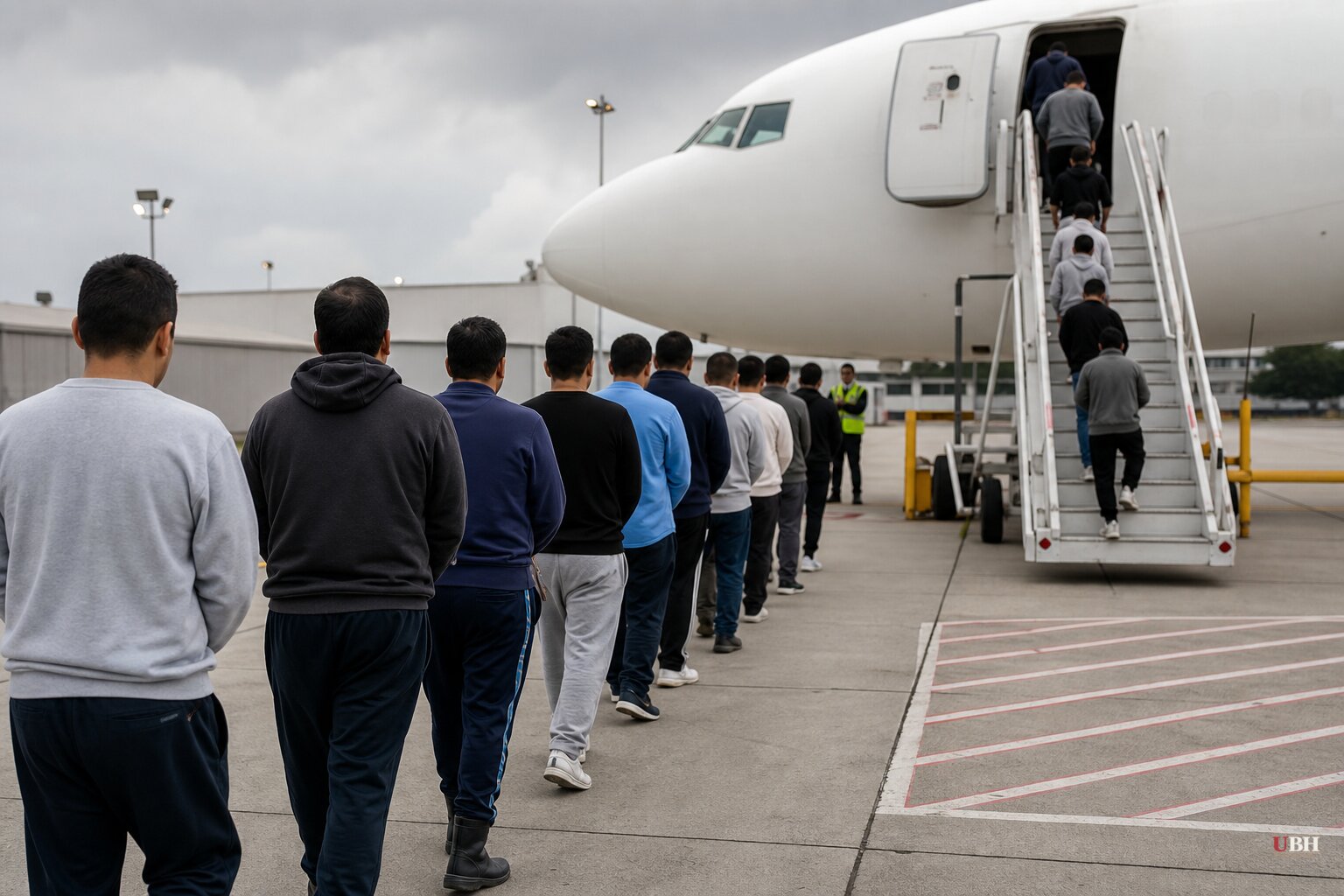
Since Mexico's National Migration Institute confirmed in April that the U.S. had started flying Mexican deportees to Guatemala and Honduras instead of straight home, the program has kept growing, and the map has now stretched to West Africa.
The Guatemala and Honduras Numbers
Guatemalan President Bernardo Arévalo said this week that 2,284 Mexican nationals have arrived in his country so far this year before being bused back into Mexico, according to Breitbart. That's up from just 15 in all of 2025. Honduras received 82 Mexican deportees on flights August 13 and 15, with 35 more scheduled to arrive, government records reviewed by the Associated Press show. Honduras had logged only six as of February 2026.
Arévalo said the transfers happen fast: deportees are moved to Mexican territory within 24 hours of landing, in coordination with Mexican immigration authorities, and are not seeking asylum in Guatemala. Either Mexico or the U.S. pays for the transfers, he said.
Mexico's Foreign Ministry says it has repeatedly told U.S. authorities it opposes the practice. "Every Mexican citizen has the right to enter the country," the ministry said in a statement, adding that Mexico "accepts the return of all its nationals" and has no agreement allowing third-country deportations. CBC and the Associated Press also reported that Mexican President Claudia Sheinbaum's government has separately protested the deaths of 17 Mexicans in U.S. immigration custody or during enforcement operations.
Adam Isacson, a migration researcher at the Washington Office on Latin America, told CBS News the rerouting "is almost entirely punitive." He argues the U.S. accomplishes two things by sending Mexicans to Honduras and Guatemala rather than home: it makes another border crossing harder, and it sends a deterrence message. DHS has not disputed that the goal is deterrence. A DHS spokesperson said the administration "is utilizing all lawful options to carry out the largest deportation operation in history, just as President Trump promised."
First Flight Lands in Liberia
The deportation map expanded further on August 20, when a plane carrying deportees from Louisiana, via a stop in Senegal, landed in Monrovia, Liberia, according to Reuters. Liberia had expected roughly 20 arrivals but instead received Venezuelan, Cuban and Colombian nationals, Liberian Information Minister Jerolinmek Piah said.
Liberia, founded by freed American slaves in the 19th century, agreed to accept up to 1,200 third-country nationals over the next year, one of the largest such deals on the African continent. Liberian officials say the arrivals are not criminals and are not being prosecuted, and many were sent because U.S. judges determined they could face torture or abuse if returned to their home countries. Liberian Justice Minister Natu Oswald Tweh told the AP that most had immigration violations, and officials say deportees can leave the country whenever they want or apply for asylum there, with support from the International Organization for Migration and the U.N. refugee agency.
Liberia says it isn't demanding compensation but will get help managing the program. Reuters reported the U.S. awarded Liberia $5 million this year for "migration management activities." Other countries in similar third-country arrangements include the Dominican Republic, Eswatini, Cameroon, South Sudan, El Salvador, Costa Rica and Panama, according to Breitbart and the Daily Wire, citing the New York Times.
The policy is also entangled with the ongoing case of Kilmar Abrego Garcia, the man the administration mistakenly deported to El Salvador before returning him to the U.S. on human smuggling charges. A federal judge dismissed those charges, ruling prosecutors' motivation was "vindictive," and the Justice Department has now filed to appeal that dismissal. Abrego Garcia is separately fighting a second deportation attempt and has said he won't go to Liberia, asking instead to be sent to Costa Rica, which has agreed to take him.
Up to 200,000 Visas Next
The State Department is preparing what would be the largest mass visa revocation in U.S. history, according to documents obtained by the Associated Press and reported by PBS. The plan targets B1 and B2 visa holders, issued between 2016 and 2026, who have applied for or are currently seeking asylum, up to roughly 200,000 people.
State Department spokesman Tommy Pigott said the department is coordinating with DHS "to identify and revoke the nonimmigrant visas of foreigners who have come to the United States claiming to be short-term visitors, but then file for asylum to stay here permanently." Deputy Secretary of State Christopher Landau argued on X that "asylum isn't supposed to be a loophole to circumvent immigration law," citing a Colombian who arrived on a tourist visa in 2015 and later applied for asylum.
Officials caution the revocations wouldn't mean automatic deportation. Most pending asylum applicants would simply lose business or tourism status while their cases proceed, the officials told the AP. The change is not yet final and is expected to be announced in the coming weeks unless challenged or revised, per PBS.
Whoever ends up covered by that revocation, and whether courts let it stand, remains an open question. Civil rights groups have not yet filed suit because the State Department hasn't formally announced the policy, but AP's own reporting notes the move would "likely face legal challenges" once it does.
Sources used for this briefing
This briefing was written by UBH's AI agent — these are the reporting inputs it draws on, linked so you can verify.


