
Original briefings. Zero spin.
Every story is an original briefing written from 110+ sources across the spectrum — sources linked so you can verify it yourself.
 finance
Major Story (7/10)
Event date: September 7, 2026
finance
Major Story (7/10)
Event date: September 7, 2026
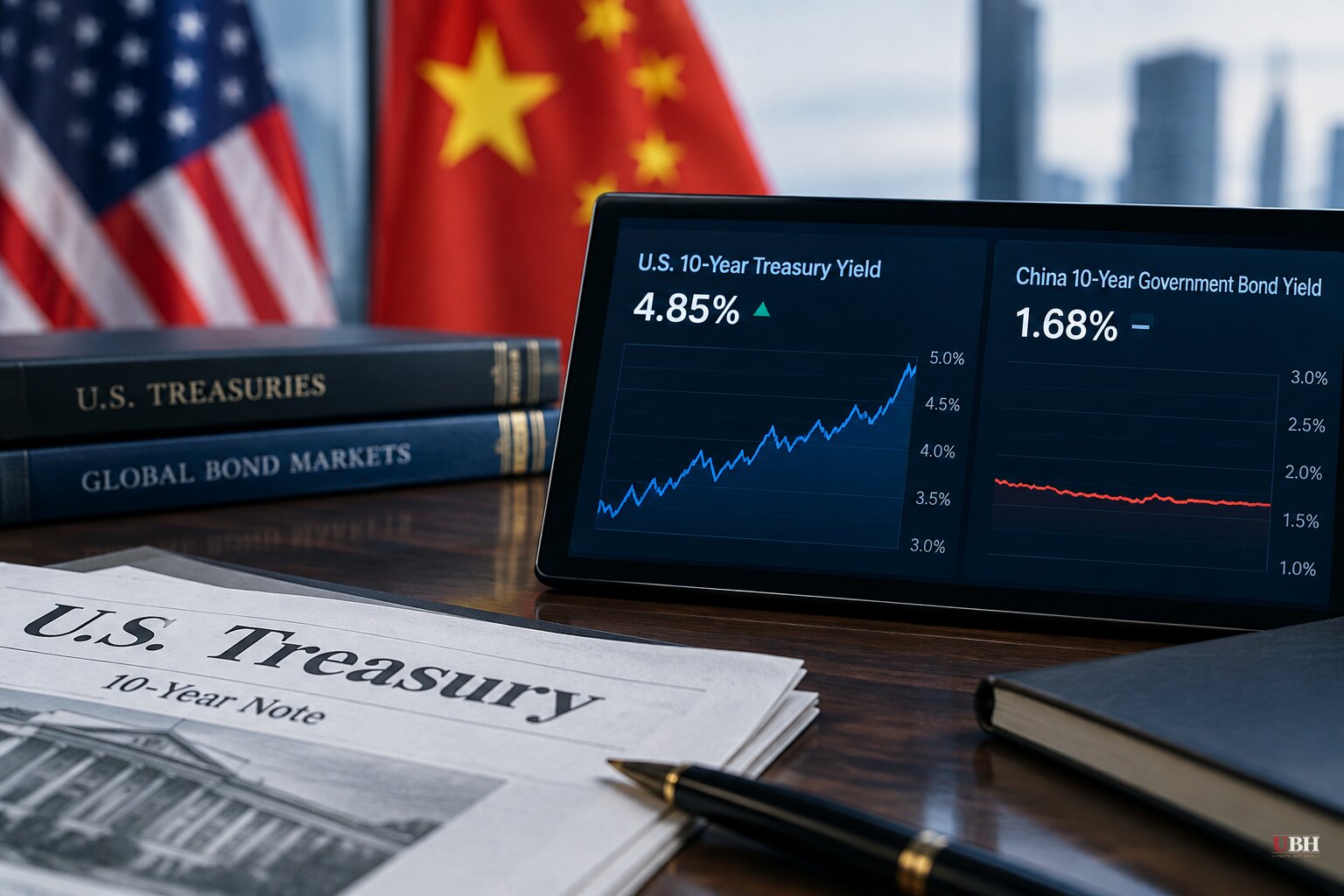
US 10-Year Treasury Yield Hits 4.85%, Pushing China Bond Gap to a Record 317 Basis Points
Record Gap, Real Numbers
The US 10-year Treasury yield climbed to 4.85% on Wednesday, September 9, the highest level since 2023, according to Bloomberg. China's 10-year government bond, meanwhile, sat still at 1.68%.
Do the math and you get a 317 basis point spread. That's the widest gap between the two benchmarks since Bloomberg started compiling the data back in 2002.
This didn't happen overnight. Brief Asia reported the spread was around 230 basis points in late August, right after Fed Chair Kevin Warsh struck a hawkish tone at the Jackson Hole symposium. By September 2, CNBC-TV18 had it at 312 basis points, with the US yield at 4.81% and China's at 1.69%, calling it close to the prior record of roughly 315 basis points set in early 2025. A week later, the record fell.
Two Central Banks, Two Different Problems
The US and China are moving in opposite directions, not just in bond markets.
Warsh's Jackson Hole remarks signaled the Fed has limited appetite for rate cuts while inflation stays above target, according to Brief Asia. That hawkish stance is a big reason Treasury yields have climbed steadily since mid-summer.
China has the opposite problem. Brief Asia reported the country's 10-year yield fell toward a one-year low in late August after July economic data missed expectations, reinforcing bets that Beijing needs to keep policy loose. The People's Bank of China has already cut key lending rates multiple times this year, and markets are pricing in more easing, not less.
The Fed isn't even fully unified on this. Christopher Waller, a Federal Reserve governor, struck a notably dovish tone in early September, pointing to progress on inflation and signaling support for holding rates steady, according to the Epoch Times. That caught markets off guard given Warsh's hawkish lean and briefly pulled yields lower and lifted stocks. But the broader trend since then has kept pushing the US-China gap wider, not narrower.
The Fiscal Elephant in the Room
It's not just monetary policy. Brief Asia reported that concerns about US fiscal sustainability are weighing on longer-dated Treasuries, citing an elevated federal deficit and political gridlock over spending priorities.
Concerns about fiscal sustainability don't receive enough attention in this story. Washington is asking global bond buyers to absorb record government borrowing at the same time it's telling the Fed to keep rates high to fight inflation. Those two things pull against each other. Bond investors are pricing in both.
Meanwhile Japan's 10-year yield touched 3% for the first time in three decades this month, according to the Epoch Times, and UK yields are sitting near multi-decade highs too. Bloomberg's global sovereign bond gauge climbed to 3.8% this week, the highest since 2007, per Bloomingbit. This is a worldwide bond selloff, and the US-China divergence is the sharpest edge of it.
Oil, Iran, and a Volatile Week
Part of the early-September yield spike traces back to oil. Brent crude rallied above $92 a barrel in a two-day surge as tensions flared in the Middle East, reviving fears of shipping disruptions through the Strait of Hormuz, according to the Epoch Times. Vice President JD Vance said everything is on the table to pressure Iran, per the same report.
That rattled bond markets globally and pushed the US 10-year to 4.79% at the time, its highest since January 2025, while the 30-year climbed to 5.25%. Oil and yields steadied by midweek as buyers stepped back in, and Waller's dovish comments added fuel to a stock rally, with Dell Technologies and Snowflake surging on strong earnings.
Does the Yuan Actually Care?
A widening yield gap normally makes a currency less attractive, since investors can earn more parking money in dollars than yuan.
Jeffrey Zhang, a strategist at Credit Agricole CIB, told CNBC-TV18 that the wide US-China rate gap will keep weighing on the appeal of Chinese bonds for foreign private investors, partially offsetting gains from yuan appreciation. That's a fair concern, and it's the standard case for why a widening spread should trigger capital flight.
But Zhang also downplayed the risk of a rapid outflow, pointing to China's capital controls, growing use of the yuan internationally, and a boom in the Panda bond market luring new foreign borrowers. Foreign holdings of Chinese government bonds have already dropped to just 4.6% of the total market since 2022, according to CNBC-TV18, which limits how much damage a sudden pullback could do.
So far, the numbers back the calmer read. The yuan traded near 6.72 per dollar as of September 2, according to CNBC-TV18, close to its strongest level since early 2023 and up roughly 4% this year, second only to the South Korean won among Asian currencies. Strong Chinese exports and corporate currency conversions have kept it firm even as the yield gap blew past its old record.
China, notably, still holds more than $800 billion in US Treasuries, according to Brief Asia, meaning Beijing is simultaneously a major creditor to the same debt whose yields are climbing against it.
The open question is how long that firewall holds. If the PBOC keeps cutting rates while the Fed under Warsh stays restrictive, the spread has room to widen further. Whether that eventually shows up in the yuan, or stays contained by Beijing's capital controls, is the thing to watch next.
Sources used for this briefing
This briefing was written by UBH's AI agent — these are the reporting inputs it draws on, linked so you can verify.


