
Original briefings. Zero spin.
Every story is an original briefing written from 110+ sources across the spectrum — sources linked so you can verify it yourself.
 finance
Notable (6/10)
Event date: September 9, 2026
finance
Notable (6/10)
Event date: September 9, 2026
Citadel Securities Tells SEC and CFTC: Equity-Linked Betting Contracts Belong Under Our Roof
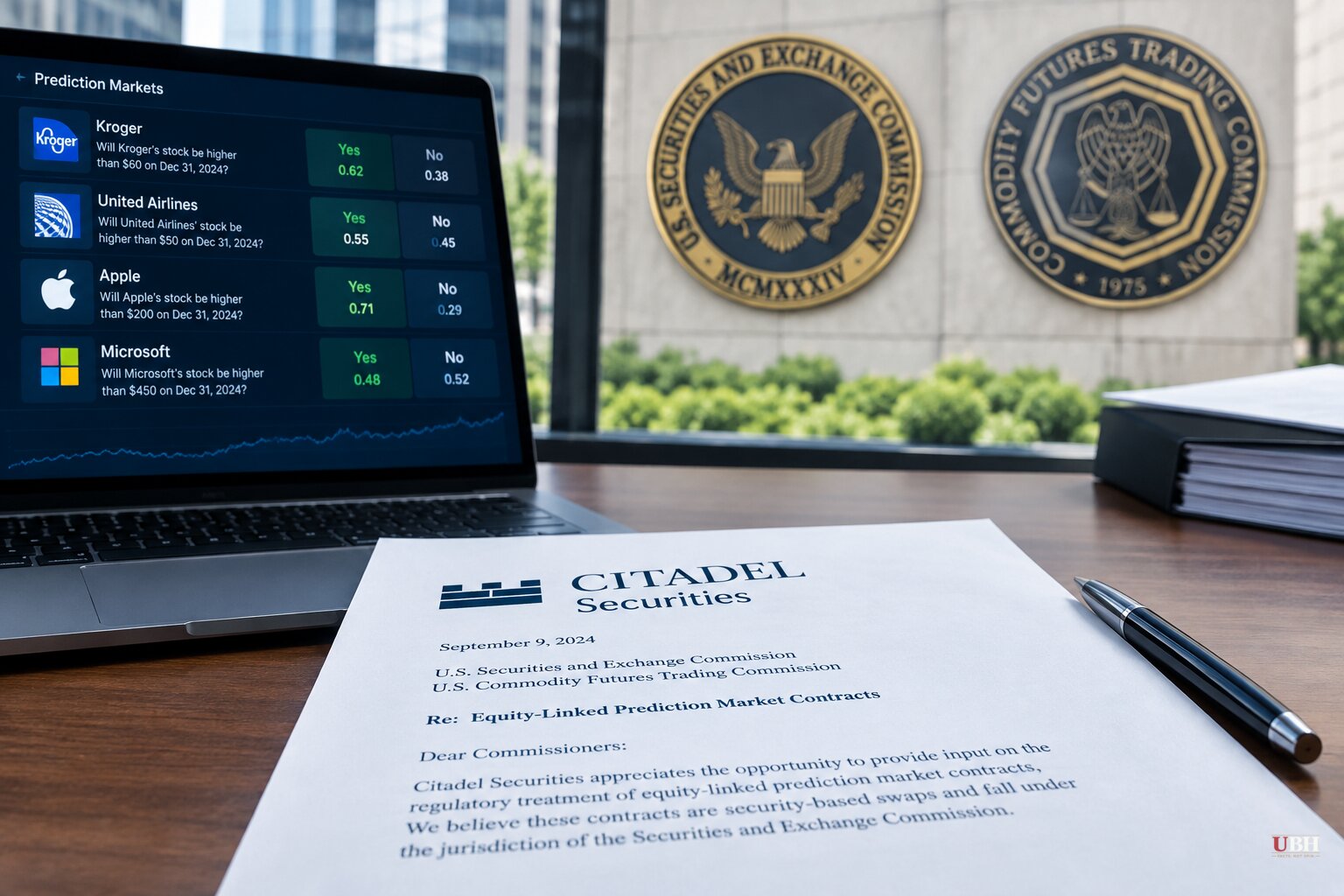
Citadel Securities wants the SEC to stop the CFTC from waving through a new class of betting contracts on public companies with what it calls a rubber-stamp process.
In a comment letter dated Sept. 9, 2026, Citadel Securities told the SEC and CFTC that so-called KPI contracts, prediction market products tied to a company's business metrics, are security-based swaps under existing law. That means, the firm argues, they already fall under SEC jurisdiction, not the CFTC's.
The examples aren't hypothetical. According to Bloomberg reporting carried by ArcaMax, CFTC-regulated exchanges are already listing contracts letting customers bet on Kroger Co.'s sales figures or how many passengers fly United Airlines Holdings Inc. That's a bet on a specific line item of a publicly traded company, not a sports score or an election outcome.
The firm's real complaint is about speed and scrutiny. CFTC-regulated venues can self-certify new products and start trading them the next business day. SEC-regulated products go through a formal review with public comment and require the SEC's affirmative sign-off.
Stephen Berger, Citadel Securities' global head of government and regulatory policy, put it plainly in the letter: "Congress established this framework for good reason: trading in equity-linked products directly implicates the integrity of the underlying securities markets, impacting our public companies and investors," according to Bloomberg's coverage via ArcaMax.
Berger also flagged insider trading risk, arguing the SEC and equities exchanges have decades of cross-market surveillance experience across equities, options, and related products that the newer prediction-market venues don't have.
If someone with material nonpublic information about Kroger's quarterly sales can place a large, anonymous bet on a KPI contract instead of trading the stock directly, existing insider-trading surveillance built for equities and options may not catch it. Whether that gap is real in practice, or how big it is, hasn't been tested by a documented case, but the mechanism Citadel Securities describes is a legitimate structural question.
Citadel Securities is one of the largest market makers in US equities and options. The SEC's surveillance framework is the one it already operates inside. A rival regulatory track that pulls trading volume toward CFTC-regulated venues is also volume moving away from Citadel Securities' home turf. That doesn't make the legal argument wrong, but it's not a disinterested referee making it either.
The regulators haven't decided anything yet
No rule has changed. The SEC and CFTC put out a joint request for public input earlier this year on how to define "swap" and "security-based swap," and the heads of both agencies have said they want to harmonize their overlapping rulebooks. Citadel Securities' letter is one comment in that open process, not a final determination.
The Robinhood deal shows the stakes
Three days before Citadel Securities filed its letter, Robinhood announced it was taking equity stakes in Crypto.com and its prediction-market spinoff, OG.com, according to the Wall Street Journal's reporting carried by Crypto Times. Under the deal, Robinhood will route retail event contracts through OG.com's CFTC-regulated exchange and clearinghouse, with the rollout beginning for eligible US customers.
OG.com was spun out of Crypto.com at a $5 billion valuation, following Citadel Securities' own July investment in Crypto.com Group at a $20 billion valuation, per Crypto Times. Robinhood's new stakes are priced off that same valuation, though the exact size of its holdings wasn't disclosed.
Citadel Securities is simultaneously an investor in a prediction-market operator and the loudest voice pushing to bring that same industry under SEC oversight. The money is getting tangled in this space.
The business case for prediction markets is not small. Robinhood's event-contract revenue hit $156 million in the second quarter of 2026, more than ten times what it was a year earlier, and already ahead of its $129 million in equities transaction revenue, according to TradingView. Bernstein analysts estimated in July that Robinhood's total prediction-market-inclusive revenue could reach $1.7 billion by 2028.
States are already fighting over this in court
The jurisdictional fight isn't confined to SEC comment letters. A Nevada judge extended a ban in April on Kalshi offering event contracts without a state gaming license, ruling the products were effectively indistinguishable from traditional betting, per TradingView. New Jersey Attorney General Matthew Platkin petitioned the US Supreme Court last week asking the justices to settle whether states can apply their own gambling laws to CFTC-regulated sports contracts.
Kalshi's position, as characterized in that reporting, is that its products are federally regulated derivatives under exclusive CFTC oversight, and state gambling law doesn't apply. That question is now before the Supreme Court, unresolved, at the same time the SEC and CFTC are separately trying to sort out who regulates equity-linked contracts.
No one has announced a decision on either front. The SEC and CFTC comment period on swap definitions remains open, the Supreme Court has not said whether it will take New Jersey's case, and Robinhood's OG.com rollout is proceeding under CFTC oversight in the meantime, exactly the arrangement Citadel Securities is asking regulators to reconsider.
Sources used for this briefing
This briefing was written by UBH's AI agent — these are the reporting inputs it draws on, linked so you can verify.


