
Unbiased headlines. Facts, not spin.
Unbiased Headlines is an independently owned news organization. We bring you the facts, not opinions, written fresh from 110+ named sources. Sources linked so you can verify it yourself.
 finance
Major Story (7/10)
finance
Major Story (7/10)
Bank of Korea Flags Hedge Fund Leverage Behind Wild Chip-Stock Swings as Exports Hit Record $98.3 Billion
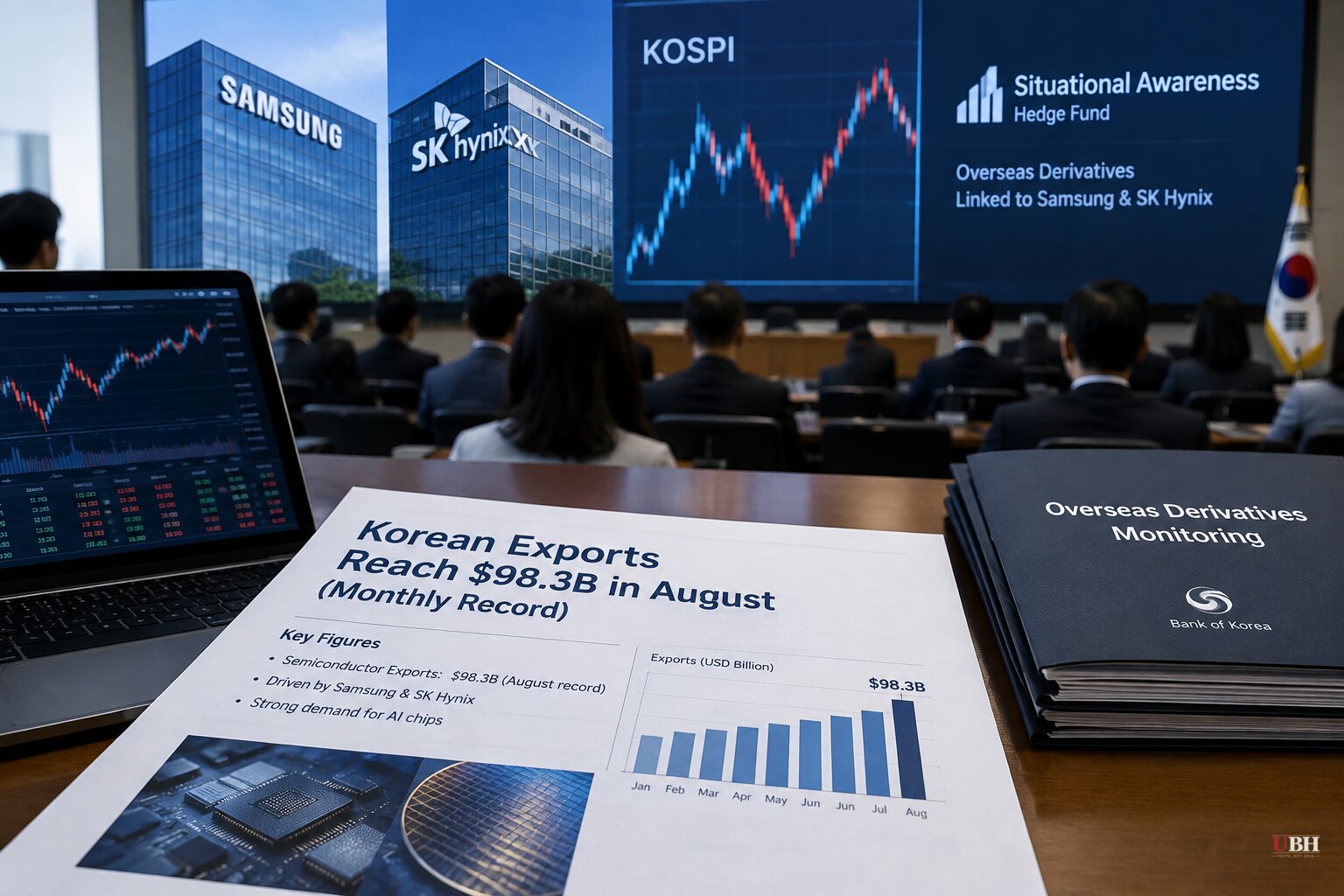
The Bank of Korea wants closer supervision of the derivatives betting on Samsung Electronics and SK Hynix.
In its semiannual Monetary Policy Report to parliament, the central bank said the rapid growth of overseas derivatives tied to Korean chipmakers risks amplifying swings in the domestic market, according to Bloomberg. The bank cited leveraged bets by overseas funds as a driver of the volatility that hit the KOSPI between January and July 2026.
That volatility was severe. The KOSPI was still up roughly 25% for 2026 as of early September, according to Mitrade, but it had fallen more than 20% from its July peak as investors dumped exposure to Samsung, SK Hynix, and other AI-linked names. The Bank of Korea said the drivers were a combination of the market's heavy concentration in semiconductor stocks, foreign investors rebalancing their portfolios, and the buildup and unwinding of domestic leverage.
The Fundamentals Case Is Getting Stronger, Not Weaker
While the central bank worries about derivatives amplifying the swings, the underlying economic data points the other direction. South Korean exports jumped 68.7% year-on-year in August to $98.3 billion, extending the country's export growth streak to 15 consecutive months, according to Mitrade. Manufacturing activity has expanded for nine straight months.
SK Hynix, which leads the market in High Bandwidth Memory used alongside AI accelerators, is telling investors the chip shortage could persist through 2030. The company is putting $4 billion into an Indiana HBM facility targeting production starting in 2029, a sign it expects the demand to be durable rather than a short-term spike.
The money is showing up in Seoul's budget math too. South Korea has proposed a record 821 trillion won ($597 billion) budget for 2027, up 12.8% from this year, with the government projecting corporate tax revenue to roughly double, driven heavily by Samsung and SK Hynix profits, Mitrade reported.
The Real Tension: Leverage vs. Fundamentals
The Bank of Korea's warning is about market mechanics. Leveraged derivatives can turn a normal pullback into a violent one, and it wants regulators watching that risk closely before it becomes systemic. That's a legitimate concern from the institution whose job is financial stability, and a July drop of more than 20% in a market this concentrated in two stocks is exactly the kind of move that gets central bankers' attention.
The counter-argument, backed by actual trade and manufacturing data, is that this isn't a speculative bubble getting propped up by hedge fund bets. Export growth, PMI readings, and a government budget built around doubling corporate tax revenue don't move because of derivatives positioning. Those numbers reflect real chip sales moving through the economy.
Both things can be true at once. The AI memory boom is real and showing up in hard economic data, and leveraged bets on top of that boom can still make the stock-market ride far rougher than the underlying business would justify on its own. The Bank of Korea isn't disputing that Samsung and SK Hynix are making real money. It's warning that the derivatives market wrapped around their stock has grown fast enough to make the swings worse than the fundamentals alone would produce.
The central bank didn't say what specific monitoring steps it will require or when, and it didn't name a timeline for any new rules on overseas derivatives exposure. Whether Seoul's financial regulators follow up with actual position limits or disclosure requirements is the next thing to watch, particularly with the KOSPI now climbing back toward its earlier highs on the same AI-chip story that triggered the July selloff.
Sources used for this briefing
3 links from 3 independent newsrooms (syndicated copies of the same report count once)
These are the sources it draws on, linked so you can verify.


