
Original briefings. Zero spin.
Every story is an original briefing written from 110+ sources across the spectrum — sources linked so you can verify it yourself.
 health
Notable (6/10)
Event date: September 3, 2026
health
Notable (6/10)
Event date: September 3, 2026
University of Edinburgh Study Finds AI Medical Scribes Miss Vital Patient Information, Risk Deskilling Doctors
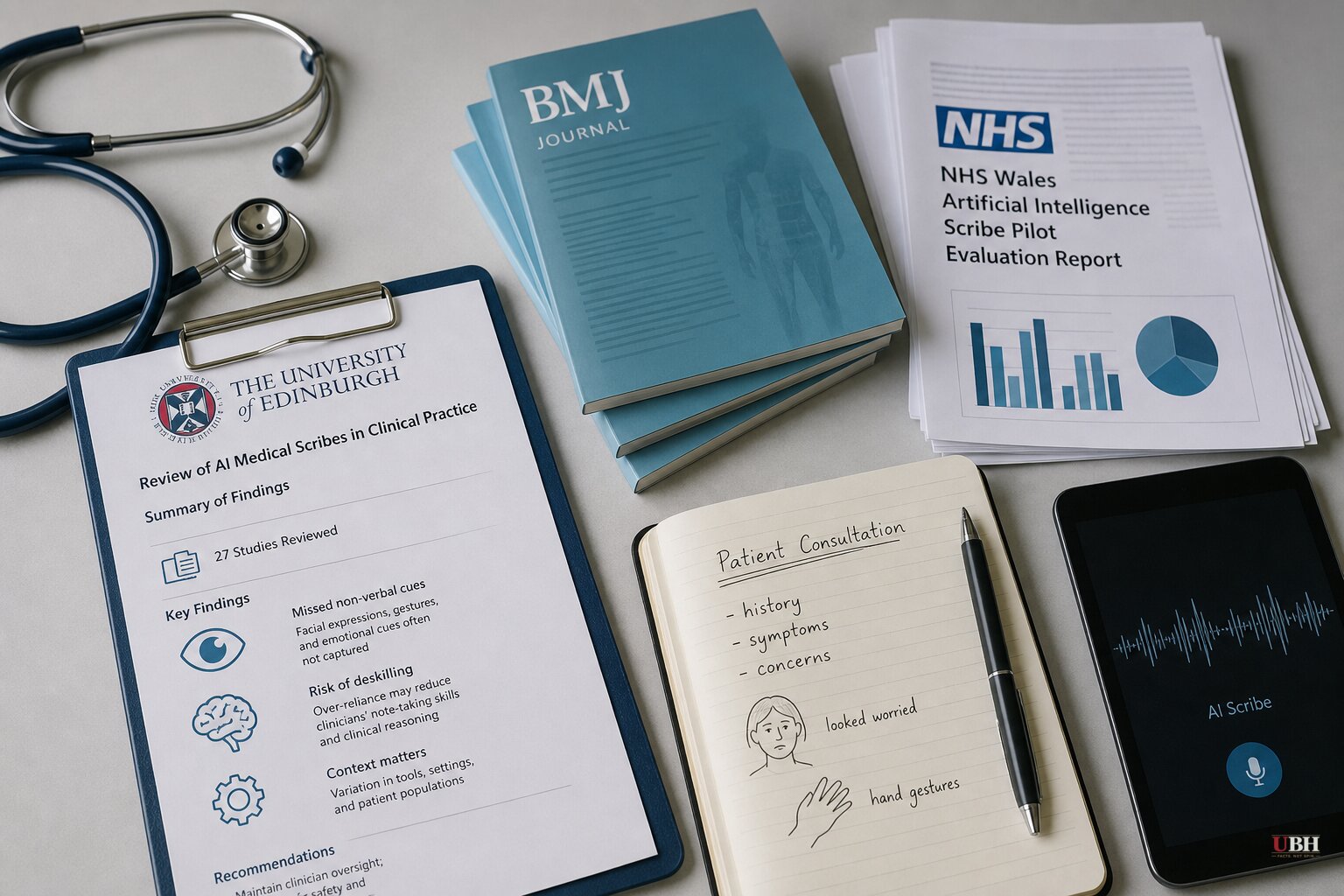
Nearly 40% of GPs in the UK are now using AI tools called ambient scribes to take notes during patient visits, according to the BBC. A new peer-reviewed review out of the University of Edinburgh says that convenience comes with a catch: the tech can miss information that actually matters.
The review, led by researchers at Edinburgh's Centre for Biomedicine, Self and Society and published in BMJ Digital Health and AI, examined 27 published studies on ambient AI scribes. These tools listen to a consultation, convert speech to text, and generate clinical notes or letters automatically.
The researchers found the technology has real upside. It frees clinicians from paperwork and lets them focus on patients or complex cases. The BBC reported that one clinic in Dudley credited the transcription tool Heidi with cutting a six-month backlog of patient letters down to 14 days.
But the review also found the tools carry what researchers called a "written language bias." They convert spoken words into text and then treat that text as the whole record. That means they can miss facial expressions, gestures, tone of voice, and emotional affect, according to Dr Lucas Seuren, a research fellow at Edinburgh who worked on the study.
"Ambient scribes cannot capture the potentially vital information a clinician can glean from gestures, facial expressions, movement and emotional affect," the researchers wrote, as quoted by the Independent.
There's a patient-trust problem too. The review found patients may hold back on sensitive topics, like substance abuse, domestic abuse, or mental health struggles, when they know a machine is recording and processing the conversation. Seuren said this risk falls hardest on people who already face marginalization in health care.
Doctors Losing Their Own Skills
The review flagged another risk: deskilling. Manual note-taking forces doctors to actively reason through what a patient told them. Offload that job to AI, and clinicians reported not recognizing their own notes or forgetting patients by their next visit, according to the study findings reported by Medical Xpress and News Medical. Doctors are losing the mental reps that build clinical judgment in exchange for saved time.
Real Errors, Not Hypotheticals
While the Edinburgh review focused on structural risks, the Guardian reported concrete cases logged by Healthwatch England, the NHS's official patient watchdog. In one case, an AI scribe's summary told a patient she had "demyelination," a term associated with nerve damage tied to multiple sclerosis. The correct result was "null demyelination." The patient, herself an NHS health professional, caught the error herself and called it "a very traumatising experience."
In another case documented by Healthwatch, an AI scribe mixed up a prescribed drug with a different one carrying a similar name. A third case involved an AI-generated letter that dropped instructions for a patient to get a repeat migraine prescription from their GP. Patients caught these errors, not doctors, according to Healthwatch.
Healthwatch also noted something conservatives ought to find alarming on its own: the UK's Medicines and Healthcare products Regulatory Agency has decided not to classify AI scribes as medical devices. That means there's no England-wide requirement that they be proven safe or effective before hospitals deploy them. GPs and hospitals in England are currently using 27 different AI scribe products, per the Guardian.
Meanwhile NHS England's official policy tells hospitals to "deploy ambient voice technology at pace," while separately warning doctors to review AI notes and get patient consent first, the Daily Mail reported. Rolling out unregulated software "at pace" across a national health system, while the agency's own watchdog is finding patients catching diagnostic errors before doctors do, is not a great look for government oversight.
It's Not Just Britain
The pattern isn't confined to the NHS. The Epoch Times reported that in Australia, AI scribe use among GPs hit 40% by November 2025, double the 22% rate from August 2024. An Australian report cited by the outlet documented scribes "hallucinating" clinical details, including one case where a scribe recorded a patient's breast cancer on the wrong side of her body, and another where the word "not" was dropped from "does not have epilepsy," flipping the meaning entirely.
Australia's Therapeutic Goods Administration told the Epoch Times it would only regulate a scribe if it generates a diagnosis or treatment recommendation beyond plain transcription, a narrower bar than what critics say the risk actually calls for. The Royal Australian College of General Practitioners and the Australian Medical Association both issued statements this year urging that clinical decisions keep a human checkpoint, and that doctors verify data storage and patient consent before adopting the tools.
The Malpractice Question Nobody's Answered Yet
Healthcare Dive reported that a study in the Annals of Internal Medicine graded notes from 11 commercial AI scribe tools against notes from 18 human clinicians across 10 quality categories. The AI notes scored lower across the board, with the biggest gaps in thoroughness, organization, and usefulness.
Bill Satterwhite, a physician and attorney at Huron Consulting Group, told Healthcare Dive there are no public malpractice cases tied to AI scribes yet. He added that doesn't mean none exist, since lawsuits involving sensitive medical records take years to surface. Doctors remain legally responsible for whatever the AI writes down, regardless of who or what typed it.
The strongest case for these tools remains straightforward: fewer hours buried in paperwork, more time actually talking to patients, and real productivity gains clinics have already measured. The Edinburgh researchers don't dispute that. Their conclusion is narrower: the systems need to preserve the patient's actual voice in the record, not silently replace it, and regulators in both the UK and Australia haven't caught up to a technology already used by 4 in 10 doctors.
Whether the MHRA reverses its decision not to classify these tools as medical devices, or whether Australia's TGA tightens its "beyond transcription" threshold, remains an open question. Neither agency has announced a policy change as of this writing.
Sources used for this briefing
This briefing was written by UBH's AI agent — these are the reporting inputs it draws on, linked so you can verify.


