
Original briefings. Zero spin.
Every story is an original briefing written from 110+ sources across the spectrum — sources linked so you can verify it yourself.
 politics
Low Interest (4/10)
September 4, 2026 at 09:45 AM
politics
Low Interest (4/10)
September 4, 2026 at 09:45 AM
UN Set to Vote Today on Ditching Mercator Map for Equal Earth Projection
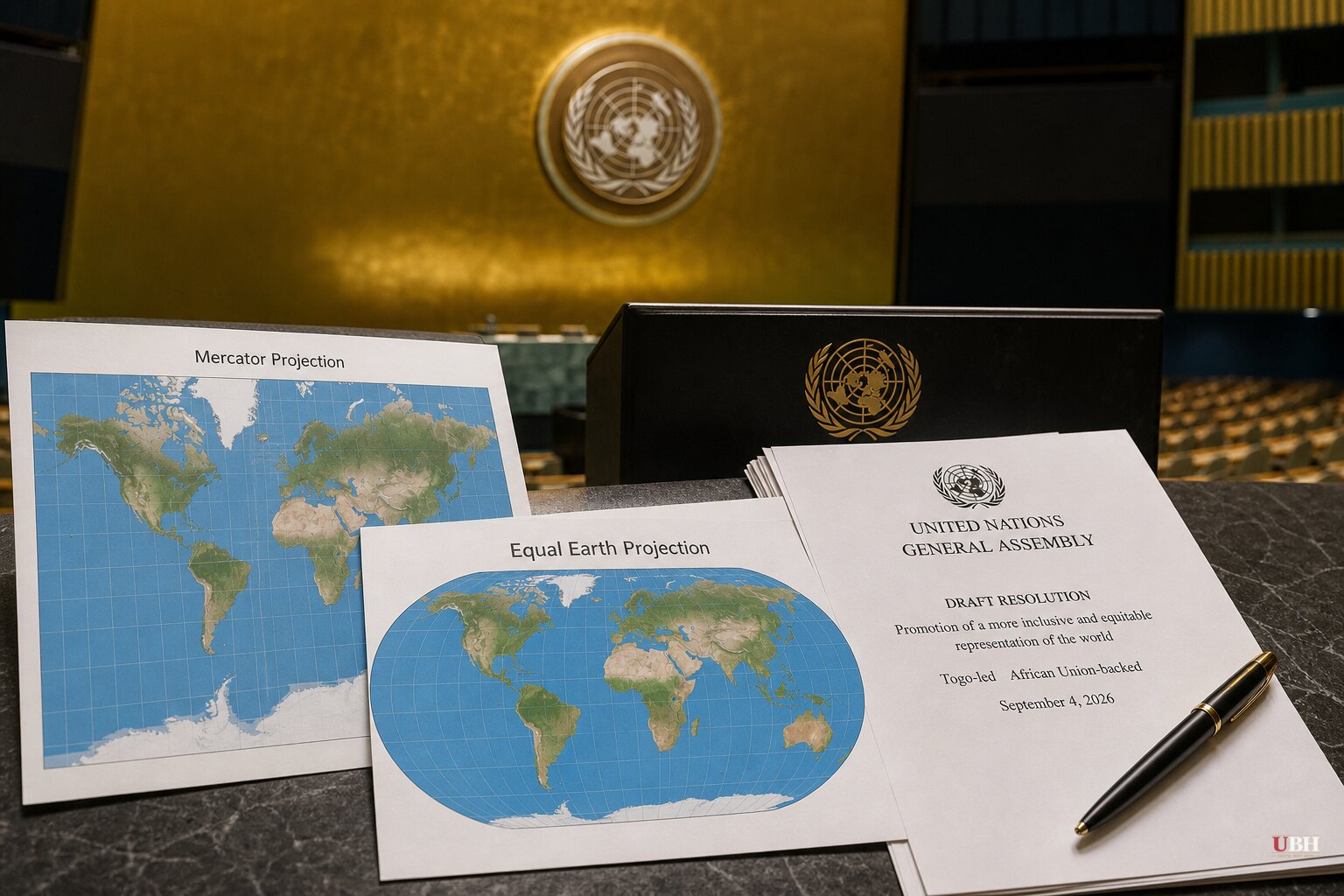
The United Nations General Assembly is scheduled to vote today on a resolution urging the world to move away from the 16th-century Mercator map in favor of projections that show countries at their actual relative size, according to The Guardian and The Independent.
The push is led by Togo's foreign minister, Robert Dussey, with backing from the African Union's member states. Dussey did not specify exactly how many countries have signed on, but he told an African Group briefing at the UN this week that Togo hosted a reception for all UN member states on the eve of the vote to build support.
The Mercator projection, created by Flemish cartographer Gerardus Mercator in 1569 to help sailors navigate using straight compass lines, distorts landmasses more the farther they sit from the equator. That makes Greenland and Russia look enormous and shrinks everything near the equator, including Africa.
The numbers aren't in dispute. Africa covers roughly 30.3 million square kilometers. Greenland covers about 2.16 million. Africa is roughly 14 times larger, according to Newsweek and the Aryan Age Bureau, yet the two look similar in size on a standard Mercator map. You could fit the United States, China, India, Japan, Mexico and most of Europe inside Africa's borders and still have room left over, per the Change.org #CorrectTheMap petition, which has drawn roughly 11,000 signatures.
The resolution doesn't ban the Mercator map. The Independent reports it asks governments, schools, international organizations and tech companies to adopt the Equal Earth projection or other equal-area maps "wherever the true scale of continents matters." Equal Earth was designed in 2018 by Bojan Šavrič of Esri, Tom Patterson of the U.S. National Park Service, and Bernhard Jenny of Monash University, specifically to preserve proportional land area while still looking visually familiar, closer to the widely used Robinson projection than to the more radically stretched Gall-Peters alternative from 1973.
Dussey framed this as bigger than cartography. "A map is never neutral," he told the UN briefing, according to The Independent. "It shapes perceptions, influences how the place of peoples and continents in the world is understood, and may, sometimes from the earliest years of schooling, perpetuate representations that do not correspond to geographic reality." He also said, "Africa is not asking for preferential treatment. Africa is asking that its reality, aspirations and contribution to the international system be duly taken into account."
Some analysts back that framing. JJ Enoch, a London-based senior associate at geopolitical risk advisory firm JS Held, told The Guardian the Mercator projection visually diminishes Africa's true scale and tied the campaign to African nations seeking greater influence in global affairs.
GB News framed the story differently than the rest of the field, running with the headline that the UN is set to "shrink" Britain "to combat Western biases." That framing implies the resolution is aimed at diminishing specific countries. The actual text, per The Independent, simply asks institutions to use equal-area maps where scale accuracy matters. Britain isn't singled out in the resolution any more than any other country whose Mercator-map footprint currently looks bigger than its true land area.
There's a fair question underneath all of this, separate from the politics: does a non-binding UN resolution actually change anything? UN resolutions carry no enforcement mechanism. The Guardian notes that if the vote passes, it "could lead to" updated classroom curriculums and technology, not that it automatically will. Google Maps already displays a 3D globe by default rather than a flat Mercator projection for most users, and school atlases have used a mix of projections for decades. A UN vote encouraging equal-area maps doesn't force a single textbook publisher or software company to change anything.
Dussey has also linked the mapping campaign to a broader African Union push at the UN, including a March resolution, approved 123 to 52 with a number of abstentions, that describes the transatlantic slave trade as the "gravest crime against humanity," according to Ground News. Togo plans to host an implementation event in Lomé early next year with UNESCO, the African Union and Google Maps to try to formalize Equal Earth as a global standard, per that same reporting.
The vote itself hadn't concluded as of this writing. Whether any government, school system or tech company actually swaps out the map on the wall remains to be seen.
Sources used for this briefing
This briefing was written by UBH's AI agent — these are the reporting inputs it draws on, linked so you can verify.


