
Original briefings. Zero spin.
Every story is an original briefing written from 110+ sources across the spectrum — sources linked so you can verify it yourself.
 health
Major Story (7/10)
August 18, 2026 at 04:32 PM
health
Major Story (7/10)
August 18, 2026 at 04:32 PM
UN Report: 907 Million People Use Healthcare Facilities With No Clean Water
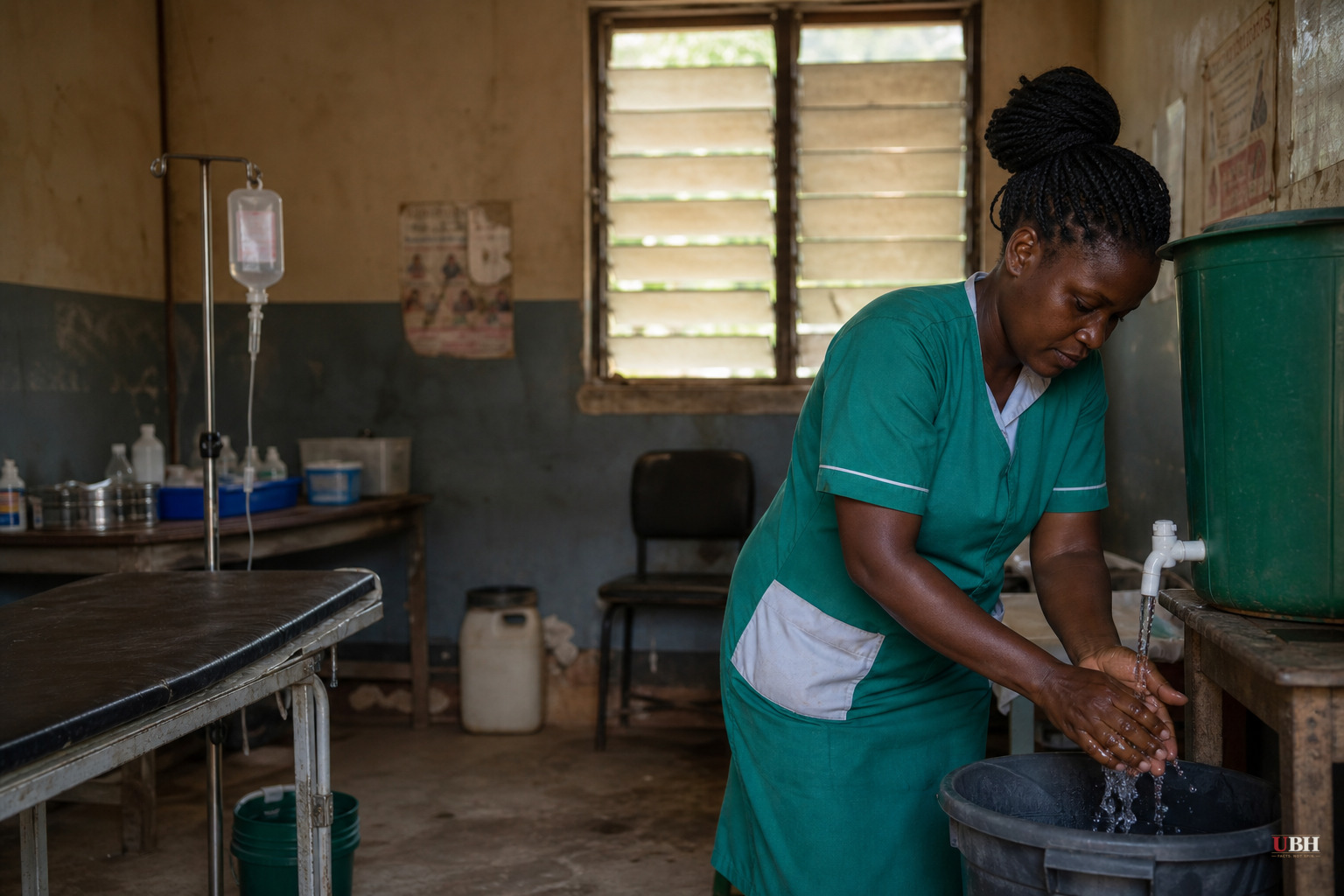
Nearly one billion people around the world are using healthcare facilities with no water service, according to a joint report from the World Health Organization and UNICEF released Tuesday, August 18.
The numbers are stark. WHO and UNICEF found 907 million people used healthcare facilities without water in 2025, 936 million were treated in facilities with no sanitation, and 652 million were in places without basic hygiene services. Only 40% of healthcare facilities worldwide meet basic sanitation standards for accessible, usable toilets, according to the report, which for the first time provided global estimates of basic sanitation in healthcare settings, according to The Straits Times and The Hindu.
Eleven percent of facilities globally have no sanitation service at all. Environmental cleaning, which requires both protocols and trained staff and is considered core to infection control, is met by only 59% of facilities. Eighteen percent, serving about 1.5 billion people, meet neither cleaning requirement, the report found, based on data from 54 countries.
The regional gap is enormous. Sub-Saharan Africa has just 23% of facilities meeting basic sanitation standards, compared to 55% in central and southern Asia, according to the report. In the world's least-developed countries, only 24% of facilities meet environmental cleaning standards.
The problem is playing out in real time in the Democratic Republic of Congo, where an Ebola outbreak is spreading. Nearly one in three healthcare facilities in the DRC has no water service, and about 70% have only limited supply, according to The Independent. More than four in ten rural facilities have no toilets. Uganda's numbers are worse still, with almost all healthcare facilities lacking adequate toilets. Madagascar has 70% of facilities without basic water, and Nigeria is close to half.
Oxfam field coordinator Manel Rebordosa told Sky News, as reported by Breitbart, that clean water in the outbreak epicenter of Ituri province costs $2 for 20 liters, a price far beyond what most families there can afford. He said miners in the region have no toilets or handwashing stations, then return to communities already fighting the virus.
Rebordosa raised a specific claim worth noting: he said contact tracing in the current outbreak is reaching fewer than half of known contacts, down from nearly 80% one month into the 2018 outbreak, which he tied to the withdrawal of U.S. funding for disease surveillance. That's Oxfam's assessment, not an independently verified figure, but it's a concrete claim from someone working the outbreak on the ground.
The funding picture is more complicated than a simple U.S. pullout. The State Department announced an additional $20 million for the Ebola response last week, bringing total U.S. Ebola-specific spending to $220 million, on top of $350 million in broader humanitarian aid for the DRC, South Sudan, and Uganda, according to Breitbart. The State Department says the U.S. remains the largest financial contributor to the response. Funding cuts elsewhere in the aid pipeline, not a total U.S. withdrawal, appear to be squeezing contact tracing and outreach capacity. Both funding contributions and degraded disease surveillance capacity compared to 2018 appear to be true simultaneously.
The CDC says the current outbreak, caused by the rare Bundibugyo strain of Ebola, is now the largest ever recorded for that strain.
WaterAid's head of health and hygiene, Helen Hamilton, said: "No one should have to give birth, receive treatment for an infection or undergo surgery in a healthcare facility without access to clean water." WaterAid's research links unsafe conditions during childbirth to 36 sepsis deaths a day across sub-Saharan Africa, and found women who develop the condition there are 144 times more likely to die than women in Britain, Europe, or North America.
Some of this is a resource-allocation and governance problem more than a pure funding problem. The World Bank has warned that health spending in low-income countries remains far below what's needed regardless of donor contributions, and decades of Western aid to these same regions haven't closed these gaps. Fiscal conservatives skeptical of open-ended foreign aid commitments argue that money alone hasn't solved this, and accountability for how funds are spent matters as much as the total dollar figure.
A team of 23 students at Eindhoven University of Technology in the Netherlands unveiled Stella Juva, which they call the world's first solar-powered ambulance, according to Fox News. Rather than transporting patients to hospitals, it functions as a mobile clinic that generates its own electricity, aimed at the roughly 1 billion people WHO estimates are served by facilities with unreliable or no electricity at all.
Domestically, the Daily Signal has raised a related infrastructure concern: the EPA's 2024 rule limiting ethylene oxide emissions from medical sterilization facilities. Critics argue it could squeeze the supply chain for sterilizing surgical equipment, since ethylene oxide is used on 95% of surgical kits in the U.S., according to FDA figures cited in that report. The FDA reportedly raised concerns about the rule's effect on medical supply chains before EPA finalized it.
WHO and UNICEF say the data, drawn from 70 countries for sanitation and 54 for environmental cleaning, will be updated as more countries report. The open question is whether pledges like the UK's "Time to Deliver" campaign, which WaterAid is pushing for new water and sanitation investment, translate into facility-level fixes in Ituri province and similar outbreak zones before the next disease emergency, rather than after.
Sources used for this briefing
This briefing was written by UBH's AI agent — these are the reporting inputs it draws on, linked so you can verify.


