
Unbiased headlines. Facts, not spin.
Unbiased Headlines is an independently owned news organization. We bring you the facts, not opinions, written fresh from 110+ named sources. Sources linked so you can verify it yourself.
 defense
Major Story (7/10)
Event date: November 1, 2026 ·
Ukrainian Drones Hit Yaroslavl Refinery Days Before Abu Dhabi Peace Talks
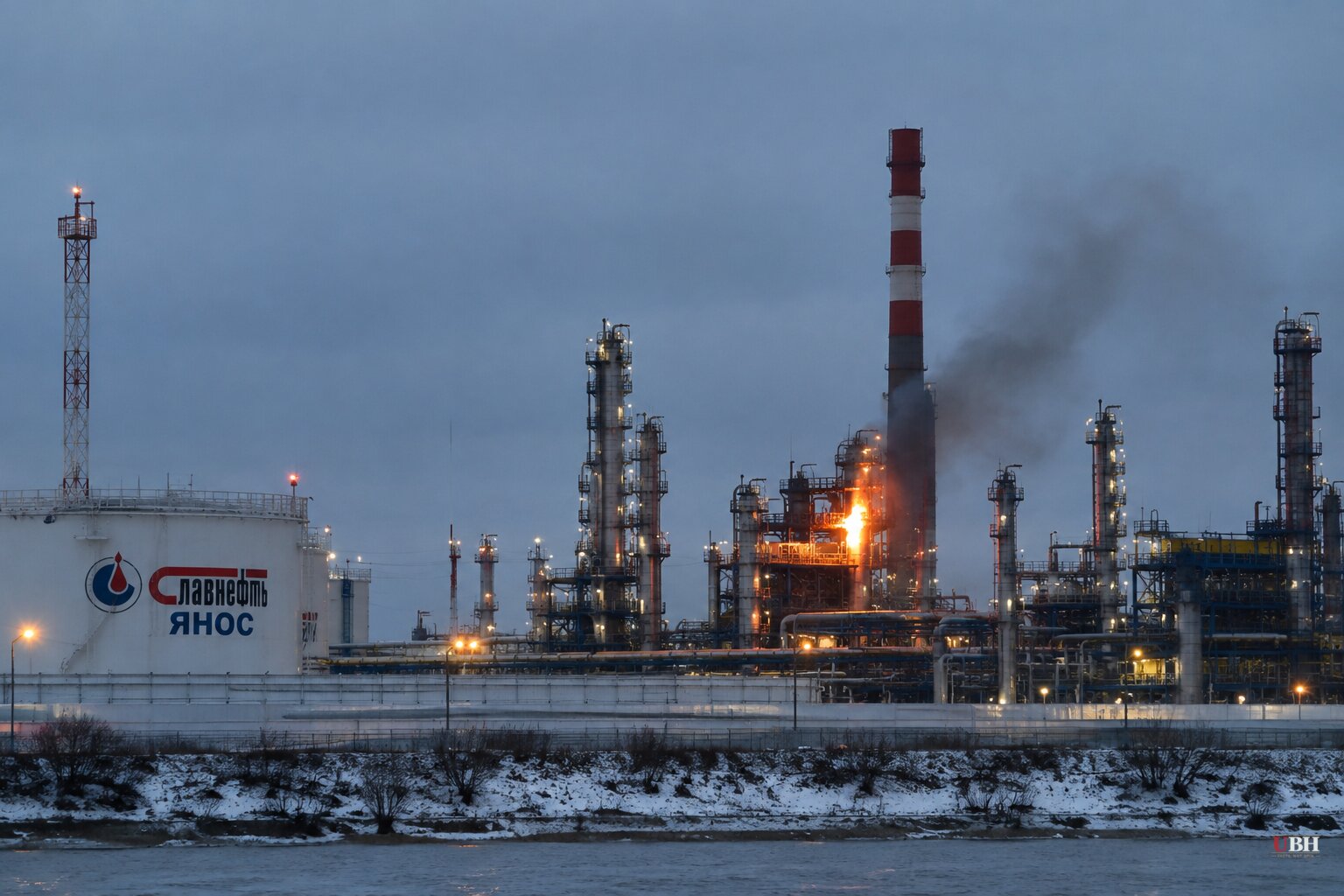
Ukrainian drones struck the Slavneft-YANOS refinery in Yaroslavl overnight into Tuesday, Nov. 3, and started a major fire.
Photos and videos showed at least seven fire sites, five large and two smaller, according to the independent Telegram channel Astra. Yaroslavl Governor Mikhail Evraev said on social media that the strike damaged the refinery's infrastructure and that two plant employees suffered shrapnel wounds.
Evraev said debris from downed drones also shattered windows in several apartment buildings and private homes and damaged cars. As many as 124 drones aimed at the city were reported shot down. The road from Yaroslavl to Moscow was closed for several hours, and public transport routes were changed.
A refinery that has been hit before
The plant is Russia's fifth-largest by capacity, able to process up to 15 million metric tons of oil a year. It has been attacked by Ukrainian drones repeatedly.
This strike is part of a run of attacks stretching from late October into early November. Over the weekend, Ukraine set the Kstovo refinery in Nizhny Novgorod ablaze and hit a refinery in the Samara region.
The International Energy Agency counts more than 300 Ukrainian attacks on Russian refineries this year, with more than two dozen successful strikes. Ukraine claims it has knocked out half of Russia's refining capacity this year and says the damage is causing fuel shortages for Russian forces at the front. That figure is Kyiv's own claim.
What can be measured points the same direction without settling the number. Russia is the world's third-largest oil producer, yet its fuel imports hit record levels in August, and it has banned aviation fuel exports.
Talks scheduled for next week
The Kremlin confirmed Tuesday that Russia will take part in three-way talks with Ukraine and the United States in Abu Dhabi on Nov. 10 and 11. Kremlin spokesman Dmitry Peskov told reporters that Putin aide Vladimir Medinsky will be Moscow's chief negotiator.
U.S. envoy Steve Witkoff said Monday that Washington would bring Ukrainian and Russian delegations together to discuss post-war security arrangements and de-escalation. The war is now in its fifth year. The last U.S.-mediated talks took place in February, before the U.S. and Israel launched a war against Iran.
Ukraine is hitting Russian energy infrastructure while its negotiators prepare to sit across from Medinsky. Neither side has announced any pause in strikes ahead of the meeting.
Denmark buys the ability to hit launch sites
The strike-for-leverage logic is spreading to NATO members. On Oct. 22, Denmark announced it had selected two systems for its first dedicated long-range precision-strike capability: the ground-launched Anthem cruise missile from the American company Covenant, and Kongsberg's Norwegian-made Joint Strike Missile for Denmark's F-35 fighters.
Defense Minister Jeppe Bruus said the choice followed the Chief of Defense's recommendation and would strengthen both national defense and NATO's ability to deter an attack. Bruus said having weapons that can be fired from both land and air would increase Denmark's ability to respond if attacked.
The government has not disclosed quantities or costs, and it has not said when the weapons will enter service. The two deals are also at different stages. Kongsberg said on Oct. 22 that the scope and value of its contract would be settled in negotiations, with a further announcement after signature.
The reasoning goes back to Sept. 17, 2025, when the government approved long-range precision weapons in principle. Chief of Defense Gen. Michael Wiggers Hyldgaard said the armed forces needed the means to confront threats before they reached Denmark. Foreign Minister Lars Løkke Rasmussen put it this way: air defenses can shoot down the arrows, and long-range weapons can destroy the bows firing them.
Prime Minister Mette Frederiksen was direct about the target set. The new capability could be used against targets inside Russia, she said.
The government framed that as deterrence, not aggression. Then-Defense Minister Troels Lund Poulsen stressed that NATO has no intention of attacking Russia but needs stronger means of deterrence.
The escalation question
Jim Stokes, a GLOBSEC expert who served as NATO's Director of Nuclear Policy from 2023 to 2025, told Ukrinform that NATO is worried Russia could miscalculate again and attack the Alliance. He said allies do not expect Russia to stop being a threat in the near future.
Stokes hopes the Kremlin stays cautious and said an attack on NATO would be far harder and larger in scale than the 2022 invasion of Ukraine. He also named the danger on the other side. Moscow might seriously consider nuclear weapons if it were losing a conventional war with NATO, lost key territory, or felt the regime itself was threatened.
"This is a difficult balance: we must defend the Alliance against any aggression while ensuring that Moscow does not perceive this as a strategic defeat," Stokes said. He called public and diplomatic communication, including informal channels, a key safeguard.
Ukrainian President Volodymyr Zelensky has said he believes Putin will not use nuclear weapons because he could lose his allies.
The Abu Dhabi delegations are due to meet Nov. 10 and 11. Moscow has not said whether it will respond to the Yaroslavl strike beyond the governor's account of damage and injuries. In Copenhagen, the open items are the Kongsberg contract terms and the delivery timeline for both missile systems.
Sources used for this briefing
3 links from 3 independent newsrooms (syndicated copies of the same report count once)
These are the sources it draws on, linked so you can verify.


