
Original briefings. Zero spin.
Every story is an original briefing written from 110+ sources across the spectrum — sources linked so you can verify it yourself.
 health
Notable (6/10)
August 27, 2026 at 06:50 AM
health
Notable (6/10)
August 27, 2026 at 06:50 AM
UK Surgeons Use Real-Time AI to Remove Brain Tumor in World-First Operation
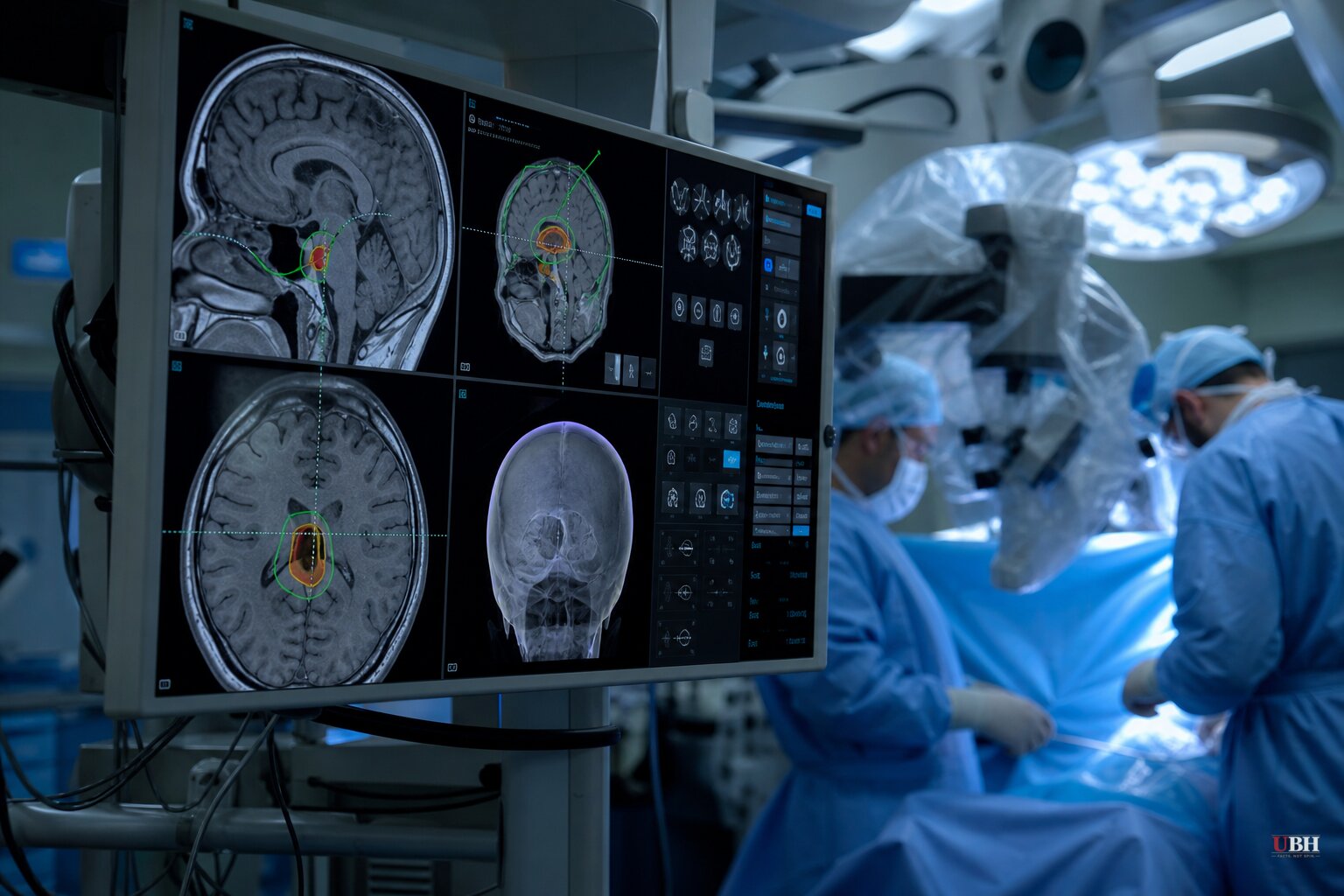
A British hospital just pulled off something that sounds like science fiction: a computer helping surgeons navigate the inside of a man's skull, in real time, while they operated.
Rhys Hibbert, a 48-year-old customer services manager and father of two from Bedfordshire, became the first patient in the world to have a brain tumor removed with live AI assistance, according to the BBC. The operation took place in May at the National Hospital for Neurology and Neurosurgery (NHNN), part of University College London Hospitals NHS Foundation Trust.
Hibbert had an 11mm non-cancerous tumor growing on his pituitary gland, a small hormone-producing organ at the base of the skull that sits dangerously close to the carotid arteries and the optic nerves. The tumor was pressing on those nerves, narrowing his peripheral vision. Without surgery, he could have gone blind, according to surgeons quoted by the BBC and The Independent.
How he ended up here
Eighteen months before the surgery, Hibbert was a healthy guy who walked two miles every lunch break. Then he collapsed on one of those walks and started seizing in the road, the BBC reported. A scan found the tumor. He didn't need immediate surgery, but he started tripping over things, felt constantly fatigued and dizzy, and watched his world narrow both literally and psychologically.
"Though I had a lot of people kindly offering help, you don't want to be a burden on people," Hibbert told the BBC.
When doctors asked if he'd be the first person to try their AI-assisted approach, he said yes without hesitation. "If patients are not prepared to join research how can doctors ever learn and how can medicine ever progress?" he said.
What the AI actually did
Surgeons inserted an endoscope, a thin camera on a stick, through Hibbert's nose to reach the base of his skull, where the tumor sat hidden behind bone and membrane. On a second screen, the AI tool analyzed the live video feed, tracked the surgical instruments, and color-coded where it believed critical vessels and nerves were most likely located, according to the BBC and TBS News.
Prof Hani Marcus, the consultant neurosurgeon who performed the operation and a professor at the UCL Queen Square Institute of Neurology, said the tool is "trained on more operations than most surgeons see or do in a lifetime," according to Ground News' coverage of the story. TBS News reported the average UK surgeon performs only 10 to 20 of these procedures a year, relying mostly on scans taken before surgery. The AI, by contrast, was trained on hundreds of past surgical videos where experts had manually labeled the anatomy.
The stakes were real. Standard complication rates for this kind of pituitary surgery include a 25% to 50% chance of not removing the entire tumor and a 0.5% to 2% chance of injuring a major blood vessel, per the BBC. The tool was built specifically to shrink that second number without sacrificing how much tumor gets removed.
Marcus was clear that the AI didn't make decisions. "Huge thanks to the trial participants and to the team committed to improving patient outcomes by taking this important first step globally and using UK homegrown AI to help reduce risk during these delicate surgeries," he said, according to The Independent and Yahoo News New Zealand. Surgeons retained full control throughout, per TBS News.
The technology and who paid for it
The tool was developed in-house at the UCL Hawkes Institute, according to The Independent. TBS News reported the project is funded by Google and the National Institute for Health and Care Research, and researchers ultimately want to build a "Surgical ChatGPT," an on-demand AI advisor surgeons could consult during any operation, not just this one procedure type.
This isn't the hospital system's first live use of anatomy-mapping AI. The Independent and Yahoo News New Zealand both noted that earlier in the summer, clinicians at St Mark's, the National Bowel Hospital, became the first team outside a formal research setting to use a similar color-coding AI tool during robotic and laparoscopic operations.
How it turned out
Hibbert's tumor was removed and his sight was protected, according to every outlet covering the case. Ground News reported his recovery was fast, with Hibbert saying his vision noticeably improved within eight weeks. "When I opened my eyes after the operation it felt like I had got 360-degree vision," he said, adding that his energy returned and his earlier symptoms disappeared.
Hibbert, who was diagnosed in 2024, noted the historical symmetry: NHNN was founded in 1859 as the world's first dedicated neurosurgical hospital. "So to me, it seems very fitting that the same hospital should also be the world's first to carry out an AI-assisted neurosurgery," he told The Independent.
Critics of medical AI will raise an obvious question: what happens when the tool gets it wrong, or when a surgeon leans on it instead of their own judgment? None of the sources here report any error, near-miss, or dissenting medical voice questioning the trial's safety protocols. This was a single patient, one operation, in a research setting with a professor overseeing every step. Whether the tool performs as well across hundreds of patients with different anatomy, different tumor types, and less experienced surgeons at the controls remains to be seen. Trial researchers say they're now working to answer that question, with a larger study already funded by Google and the National Institute for Health and Care Research.
Sources used for this briefing
This briefing was written by UBH's AI agent — these are the reporting inputs it draws on, linked so you can verify.


