
Original briefings. Zero spin.
Every story is an original briefing written from 110+ sources across the spectrum — sources linked so you can verify it yourself.
 health
Low Interest (3/10)
Event date: September 1, 2026
health
Low Interest (3/10)
Event date: September 1, 2026
UK Papers Call It the Sixth Heatwave of 2026. The Met Office's Own Forecast Text Says Otherwise.
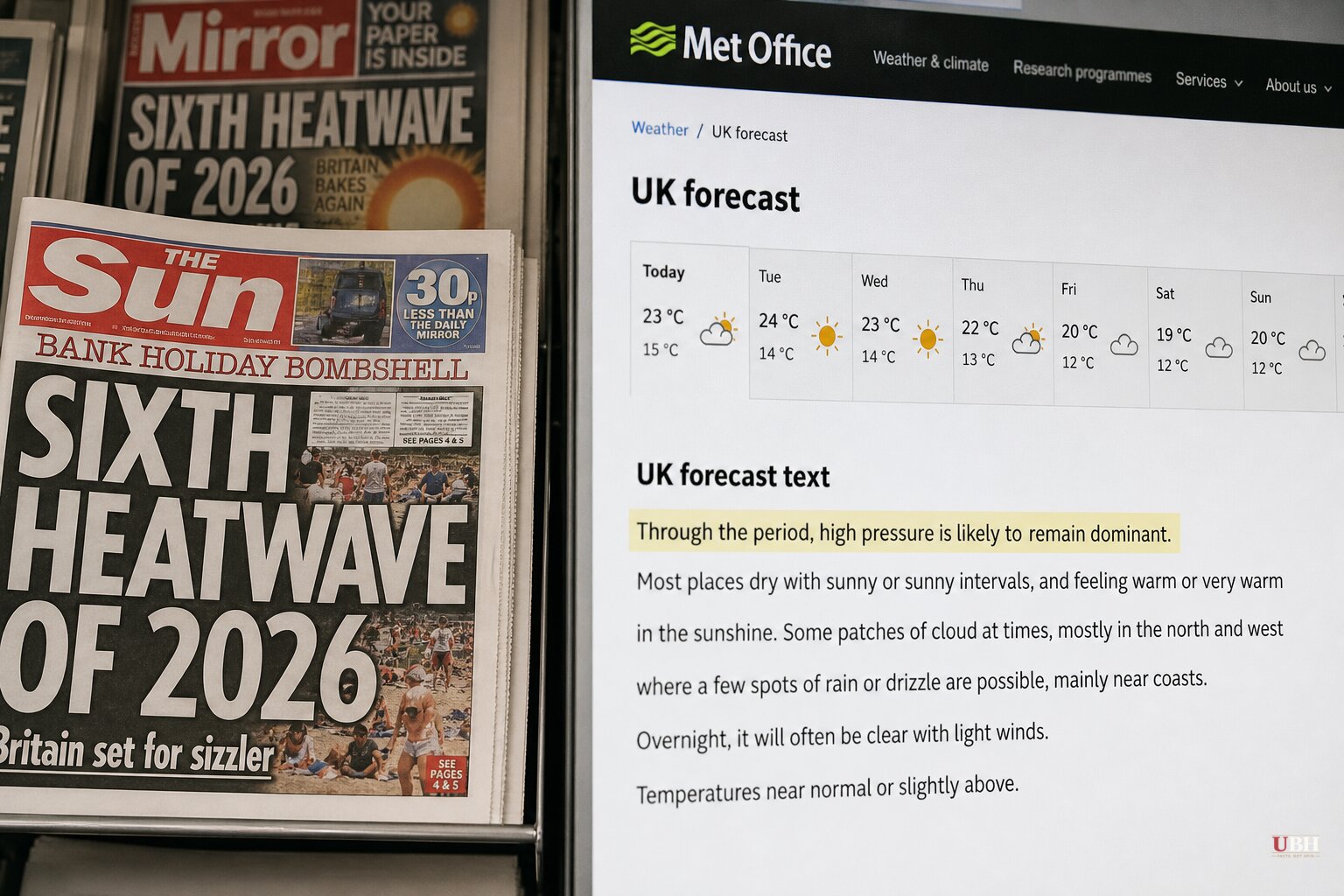
Since the UK closed out its hottest summer on record, with the Met Office confirming a June 1 to August 31 mean temperature of 16.48°C, 1.88°C above the 1991-2020 average and above the previous record of 16.12°C set in 2025, British tabloids have kept the heat story running into September on thinner and thinner evidence.
Yorkshire Live (examinerlive) ran a story headlined "UK set for sixth heatwave of the year," citing GFS model output from WXCHARTS showing possible highs of 28°C across southern and western England on September 5, spreading to Yorkshire by September 6, and up to 29°C in eastern and western England by September 7. The Daily Mirror followed with a similar framing, headlining a "27C scorcher" and claiming the Met Office had issued a "heatwave verdict."
The actual Met Office text quoted in both stories says nothing of the kind. Its outlook for August 31 to September 9 reads: "Likely remaining unsettled with showers or longer spells of rain across all areas at times... Temperatures are likely to be near average, although some short-lived warm or very warm spells are possible, especially in the south." That is a forecast for occasional warm days, not a declared heatwave.
The Met Office defines an official heatwave as reaching a location-specific threshold, 28°C in the southeast, dropping to 25°C further out, for three consecutive days. Nothing in the sources shows that threshold being met on three straight days anywhere. Examinerlive's own reporting hedges this, noting the projected highs "would nonetheless meet the criteria for an official heatwave in particular locations" if they held, using conditional language rather than confirming a declared heatwave.
The genuine case for taking the model maps seriously
There's a fair argument for running these stories. The GFS model numbers cited by WXCHARTS aren't invented, they're a real output showing a plausible warm spell, and readers planning a weekend want the heads-up even if it falls short of an official designation. A brief run of 27-28°C days in the southeast is not nothing, and outlets flagging it early aren't fabricating data.
But the karmactive analysis makes the sharper point: the Met Office has directly pushed back on the sensational framing. "The Met Office corrected media reports promoting a September heatwave," karmactive reported, "the reason was clear: confidence in that specific outcome is too low to present as reliable forecast information." The Met Office's own long-range outlook for September 15 through 29 carries what karmactive describes as an explicit statement of very low confidence, a level of candor forecasters rarely volunteer.
Separately from the UK-specific hype, BBC Weather reported genuine, severe heat gripping continental Europe this week. El Granado in southwest Spain hit 45.7°C on Thursday, the country's highest reading of 2026, with orange extreme-heat warnings in force through Saturday across Spain, southern France, Bosnia and Herzegovina, and Serbia. That heat is real and measured, not a model projection.
A fraction of that warmth is forecast to reach the UK over the weekend as winds turn southerly, according to BBC Weather. Sunday will be the warmest day, with England and Wales generally in the low-to-mid 20s Celsius and parts of the southeast possibly hitting 27-28°C. Scotland and Northern Ireland stay cooler, around 15-20°C. BBC Weather is explicit that this won't be as extreme as the heat further south, and that fresher Atlantic air and rain-bearing fronts are likely to arrive through next week, with a return to heatwave conditions unlikely over the following ten days.
The Express covered the same Met Office outlook and led with "warmer-than-normal conditions" in its headline, while its own body text says temperatures are "expected to stay close to seasonal averages throughout the month," with only some southern areas seeing warmer-than-normal periods. That's a milder gap between headline and text than the Mirror's, but the pattern across outlets is the same: model maps and headline writers are running ahead of what the forecaster is actually willing to commit to in writing.
The Met Office's next longer-range update covering September 15 through 29 will show whether confidence improves, and actual observed temperatures on September 5-7 will settle whether any UK location hits its heatwave threshold for three consecutive days, something no source has yet confirmed has happened.
Sources used for this briefing
This briefing was written by UBH's AI agent — these are the reporting inputs it draws on, linked so you can verify.


