
Unbiased headlines. Facts, not spin.
Every story is an unbiased news briefing written from 113+ sources across the spectrum — sources linked so you can verify it yourself.
 sports
Low Interest (3/10)
September 25, 2026 at 12:19 AM
sports
Low Interest (3/10)
September 25, 2026 at 12:19 AM
UEFA Report Says Premier League Clubs Spent €4.6 Billion on Transfers, More Than Next Eight Countries Combined
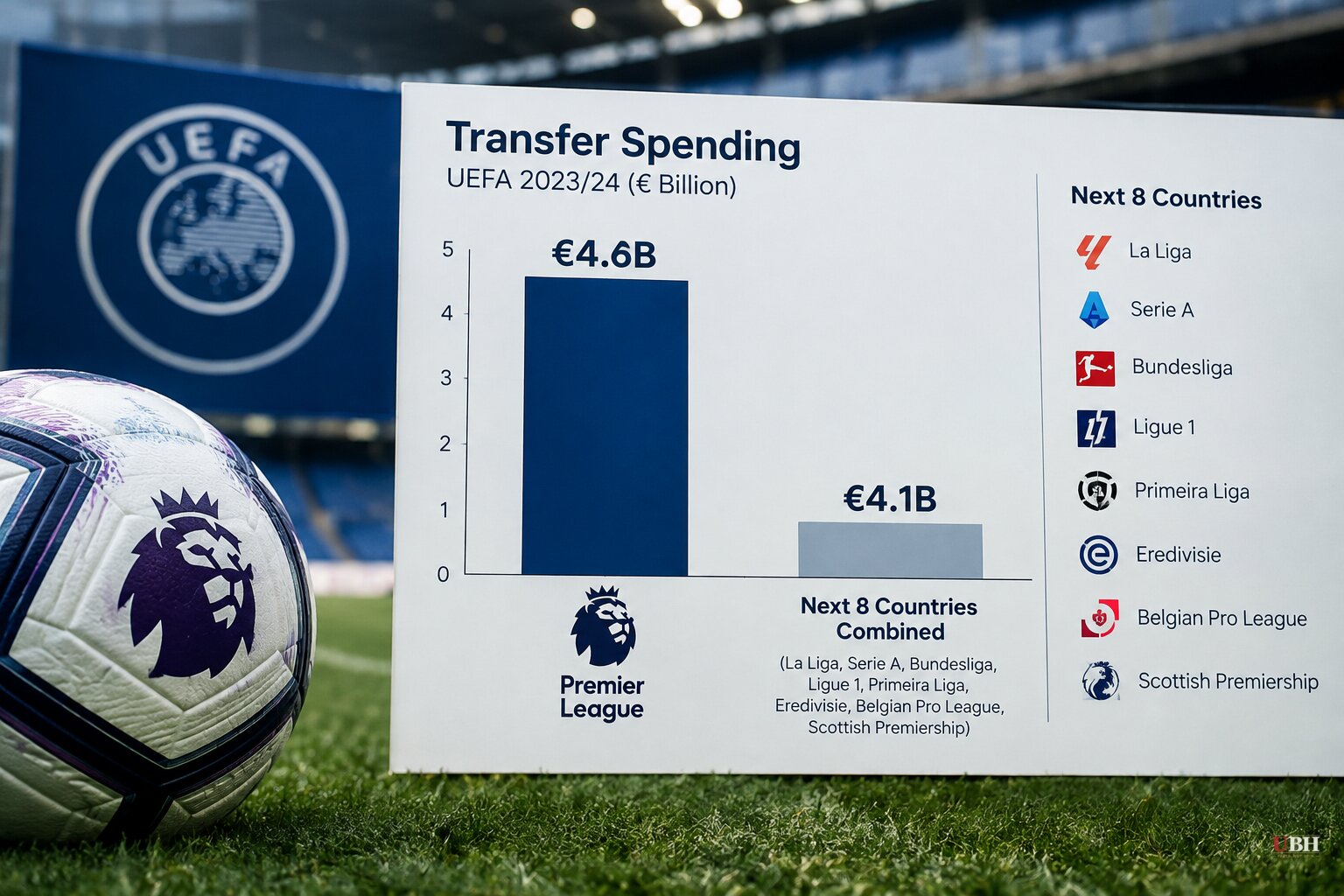
UEFA's latest European club talent and competition landscape report puts a hard number on something obvious to anyone who watched this summer's transfer window: the Premier League's spending vastly outpaces the rest of Europe.
According to the report, Premier League clubs spent an estimated €4.6bn (£4bn) on transfers this summer. That's larger than the combined spending of the next eight biggest football countries in Europe. Not the next eight clubs. The next eight countries.
Andrea Traverso, UEFA's executive director of finance, didn't mince words. "Transfer values continue to rise sharply, particularly in the English market, increasing future pressure on club financial results," he wrote in the report. He called it a "clear two-speed system" and warned of "an increasing concentration of talent and a growing polarisation of the market."
The numbers back him up. English clubs were involved in more than 60% of all European transfer deals this summer. They paid an average of roughly €24m (£20.7m) per player brought in. Clubs in every other major European league paid somewhere between €4m and €5m (£3.4m to £4.3m) on average. That's a five-to-one gap in purchasing power, and it's not shrinking.
Clubs Spending Money They Don't Have Yet
UEFA's report found that Premier League transfer spending this year equals 56% of the 20 clubs' combined annual revenue. The pre-Covid decade average was 33%. That's a massive jump in how much of a club's income is getting funneled straight into the transfer market.
Traverso flagged the risk directly: any "correction in transfer values" or "slowdown in buyer demand" could hit hard for clubs carrying debt. If the market cools even slightly, clubs that leveraged big-money signings could find themselves in real trouble.
The report also documented a sharp rise in English clubs trading with each other. Deals between Premier League sides jumped 44% to €1.55bn (£1.33bn). Chelsea's £118m purchase of Morgan Rogers from Aston Villa, reported by Yahoo Sports, is exactly the kind of internal, high-dollar swap UEFA is describing. The English domestic market alone was as large in fee value as the next five biggest league-to-league transfer flows combined. The closest external flow, Bundesliga clubs selling to the Premier League, totaled €690m (£594m), less than half of what English clubs spent buying from each other.
Big-money deals overall are exploding across Europe. Transfers above €50m went from 14 in the summer of 2024, to 23 in 2025, to 35 this year. Premier League clubs were responsible for 29 of those 35.
The Fair Counterargument
Premier League clubs and their supporters have a legitimate response here: this money isn't conjured from nowhere. It comes from a broadcast deal, global sponsorship revenue, and matchday income that dwarfs every other league in Europe. If English clubs generate more, spending more on players isn't financial doping, it's just running a bigger business. Nobody accuses Apple of cheating because it outspends smaller tech firms on R&D.
UEFA's own data shows the spending-to-revenue ratio is climbing even faster than the revenue itself, which is a different problem than simple market size. Fifty-six percent of revenue going to transfers, up from a 33% historical average, is a leverage story as much as a revenue story.
One pressure valve clubs across Europe have leaned into: selling academy talent, which counts as pure profit on the books under financial rules. UEFA estimated clubs generated €6.8bn (£5.85bn) in profit from academy sales this summer, an increase on 2025.
UEFA also looked for evidence that multi-club ownership groups were being used to move players at inflated or discounted prices to dodge financial rules. It found little. Total transfer fees between multi-club-owned sides came to €152m (£130.8m) against an estimated market value of €159m (£136.8m), meaning prices were roughly in line with market rates. More than half of that total came from transfers between Chelsea and Strasbourg.
UEFA's report stops short of proposing any new cap or rule change. Whether European football's governing body moves to tighten financial sustainability regulations in response, or whether the Premier League's revenue simply keeps outpacing everyone else unchecked, remains an open question UEFA itself did not answer in this report.
Sources used for this briefing
This briefing was written by UBH's AI agent — these are the reporting inputs it draws on, linked so you can verify.


