
Unbiased headlines. Facts, not spin.
Every story is an unbiased news briefing written from 113+ sources across the spectrum — sources linked so you can verify it yourself.
 sports
Low Interest (3/10)
September 24, 2026 at 06:30 PM
sports
Low Interest (3/10)
September 24, 2026 at 06:30 PM
Iranian Rowers Train on Ergometers Through Bombing, Then Sweep Six Asian Games Medals in Nagoya
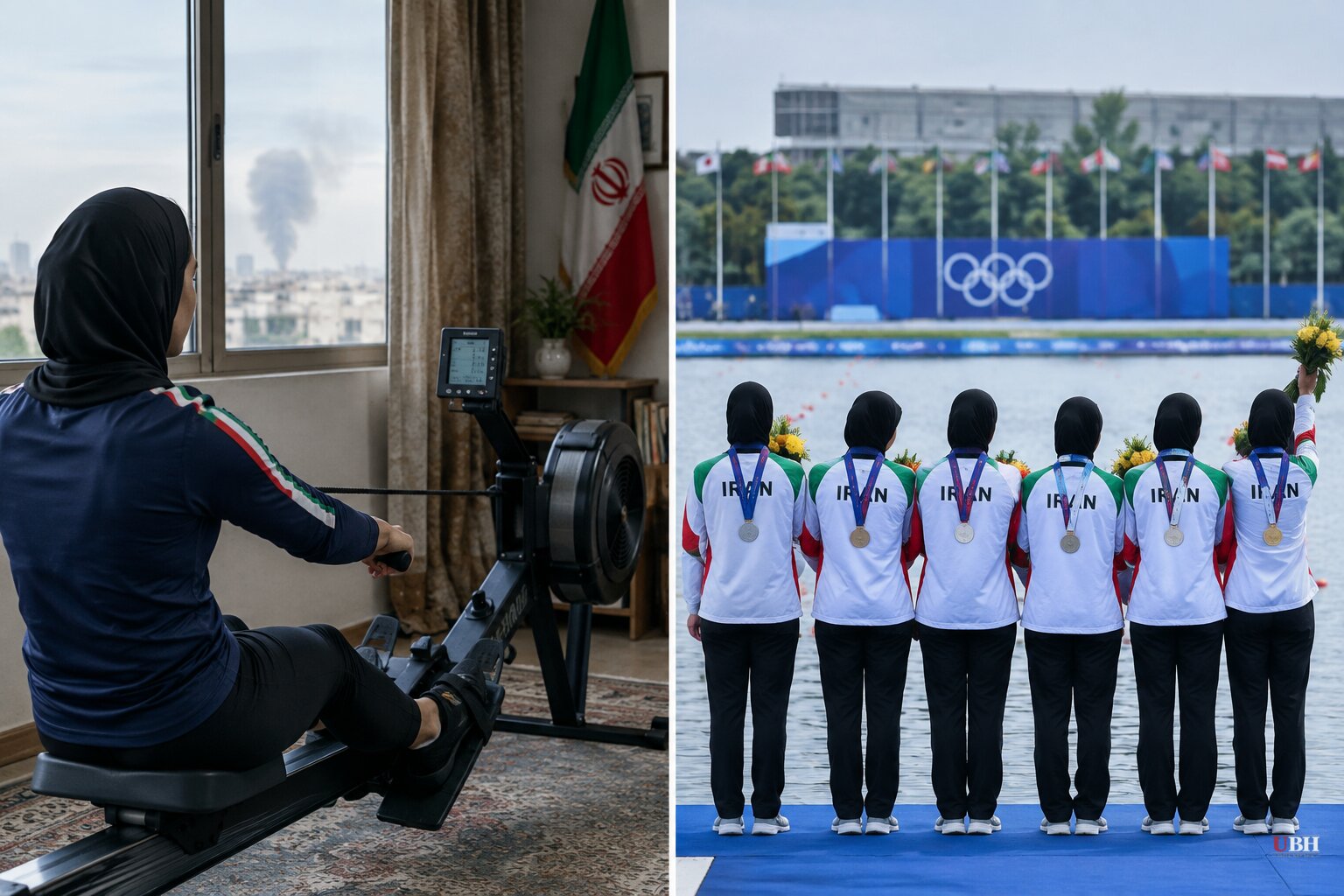
Iran's rowing team walked away from the Nagoya Asian Games with six medals. Getting there meant training in bedrooms with no boat, no teammate in the water, and bombs falling nearby.
According to The Hindu, Iranian rower Kimia Zarei was training at home in Hamadan when the war disrupted daily life across the country roughly seven months before the Games began. The Iran Rowing Federation cancelled its training camp and sent athletes back to their hometowns, according to both The Hindu and The New Indian Express. Athletes had only an ergometer and a training plan from their coach to work with.
"We were being bombed every day," Zarei told Sportstar, as quoted by The Hindu. "I was about to start training when I heard bombing so close to our home that, when I looked out of the window, I could see everything, the smoke and all."
Training in a bedroom, 20 kilometers a day
Zarei said she trained alone for roughly a month using only the ergometer, logging 20 kilometers a day, according to The New Indian Express. Her double sculls partner, Zeinab Norouzi, described the same routine: daily sessions in their rooms, no water time, no way to build the timing a rowing pair normally develops side by side in a boat.
Mohsen Shadi Naghadeh, president of the Iranian rowing federation, told The New Indian Express the decision to send everyone home with equipment was a response to a federation-wide disruption, not a choice any coach would normally make. "We faced a lot of difficulties after the war began, but we wanted to show that we are strong," he said. "We gave every rower an ergometer so they could continue training at home."
Zarei described the emotional toll as much as the physical one. "There were times when I had to stop training because there was bombing near my home," she told The Hindu. "Sometimes I would ask myself: should we be trying to save our lives or trying to row?"
The medals
Once the fighting eased and the team returned to water training, the results at the Nagaragawa International Regatta Course in Nagoya were the best in the history of Iranian women's rowing at the Asian Games.
Fatemeh Mojallal won gold in the women's lightweight single sculls, finishing in 7:24.57, according to the Times of India. It marked the first Asian Games gold medal for Iranian women's rowing. She later added a bronze in the open single sculls.
Zarei and Norouzi won gold in the women's lightweight double sculls in 6:53.93, finishing 5.31 seconds ahead of Hong Kong, with Japan taking bronze. The pair also took silver in the women's double sculls, finishing behind China in 6:55.78.
Iran's quadruple sculls crew of Mahsa Javer, Soha Fakhri, Saghi Maleki and Hengameh Kamyab took silver in 6:27.24, finishing behind China and ahead of Japan. On the men's side, Amir Hossein Mahmoudpour won silver in the lightweight single sculls.
By the women's team's own count, cited by The Hindu, that's two golds, two silvers and a bronze for the women alone, five medals. Add Mahmoudpour's silver on the men's side and Iran's rowing program left Nagoya with six medals total, matching the count reported by the Times of India.
Zarei's history with the event makes the result more pointed. She finished fourth in the same discipline at the previous Asian Games in Hangzhou and told Sportstar she was in tears at the finish line. This time, she said the motivation came from thinking about "the medal, my people, my family and my future."
"This medal really matters to the Iranian people, especially Iranian girls," Zarei said, according to The Hindu.
None of the three outlets name the country or countries Iran was at war with during this period, and none provide a precise start date for the conflict beyond describing it as roughly six to seven months before the Nagoya Games.
A federation that swapped a training camp for ergometers scattered across private homes turned that disruption into the strongest Asian Games rowing performance in Iranian history.
Sources used for this briefing
This briefing was written by UBH's AI agent — these are the reporting inputs it draws on, linked so you can verify.


