
Unbiased headlines. Facts, not spin.
Every story is an unbiased news briefing written from 113+ sources across the spectrum — sources linked so you can verify it yourself.
 sports
Low Interest (4/10)
September 25, 2026 at 12:35 AM
sports
Low Interest (4/10)
September 25, 2026 at 12:35 AM
NBA's First MVP Bob Pettit Dies at 93, League Confirms Career Scoring Record Holder Passed Wednesday
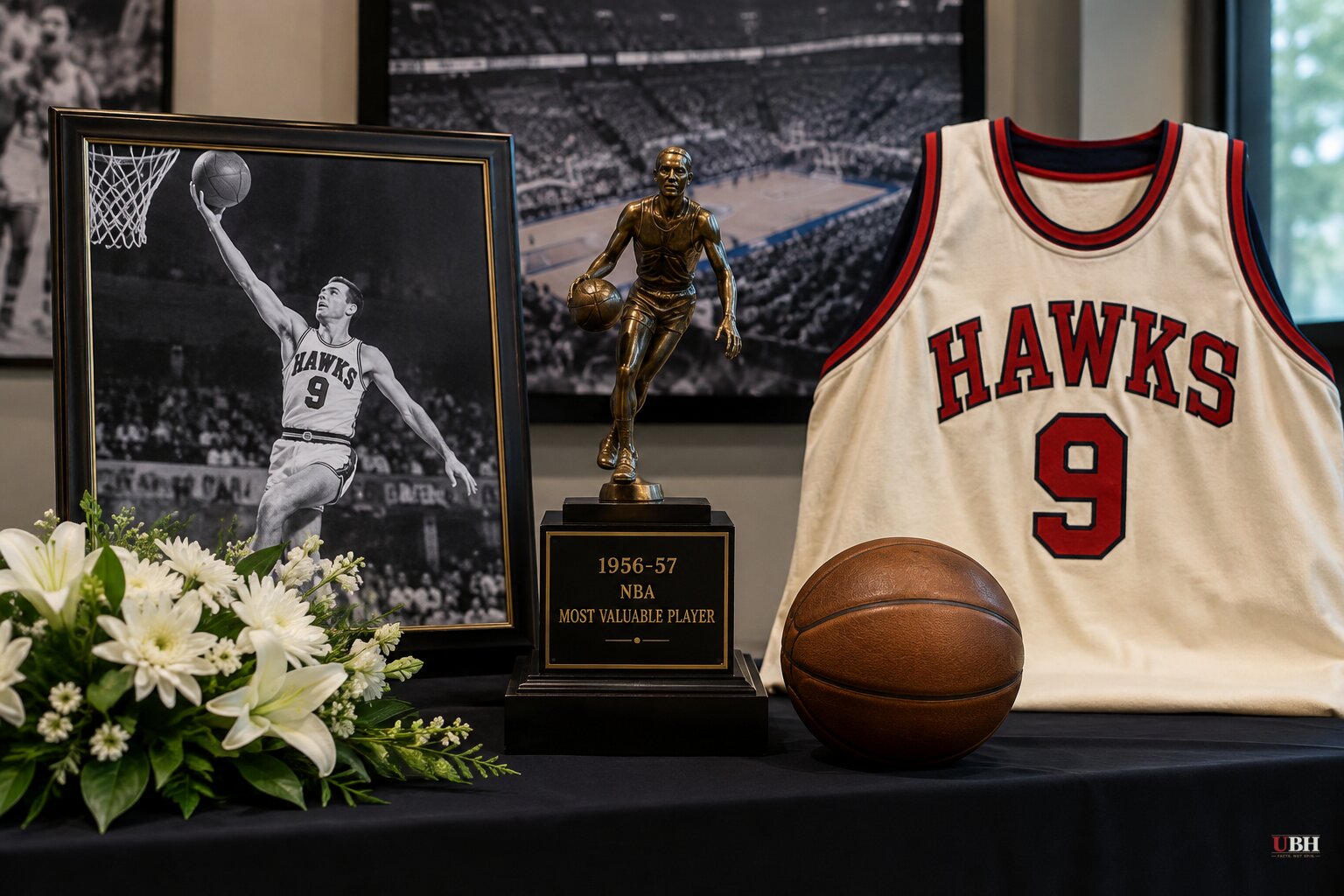
Bob Pettit, the first player to win the NBA's Most Valuable Player award and the league's all-time leading scorer at the time of his retirement, died Wednesday, September 23, at his home in Metairie, Louisiana, according to CBS Sports and a statement from the Pettit family. He was 93.
His alma mater, LSU, announced the death Thursday, according to the Associated Press. Neither LSU nor the family provided a cause of death.
"Dad passed away very peacefully at his home in Metairie, on Wednesday, September 23," the Pettit family said in a statement carried by CBS Sports. "He was the most amazing father. The most kind, humble and gentle soul. We are so blessed to have him in our lives and we will miss him dearly."
The Naismith Basketball Hall of Fame posted its own tribute Thursday, calling Pettit "a sleek, skilled big man who revolutionized the forward position," according to The Big Lead.
Career Achievements
Pettit spent all 11 of his NBA seasons with the Hawks franchise, first in Milwaukee and then in St. Louis, after Milwaukee took him second overall in the 1954 draft, according to CBS Sports. He made the All-Star team every single one of those 11 seasons and was named All-Star Game MVP four times, a mark matched only by Kobe Bryant, according to the Associated Press.
He won Rookie of the Year in 1955. The following season he captured the NBA's first-ever MVP award, leading the league in scoring at 25.7 points per game. He won a second MVP in 1959, again leading the league in scoring at 29.2 points a night, per the AP.
In 1958, Pettit led the Hawks to the franchise's only championship, beating the Boston Celtics. In the clinching Game 6, he scored 50 points, a playoff record at the time, according to The Big Lead.
He retired after the 1964-65 season averaging 26.4 points and 16.2 rebounds for his career. At retirement he was the NBA's all-time leading scorer with 20,880 points and ranked second in career rebounds with 12,849, according to the Associated Press. CBS Sports notes he was the first player in league history to top 20,000 career points.
A Star Before the Cameras Showed Up
At 6-foot-9 and 205 pounds, Pettit played a game that predated the term "power forward," facing the basket instead of playing solely with his back to it, a rarity for big men of his era, per the AP. He competed against Wilt Chamberlain, Bill Russell, Oscar Robertson and Elgin Baylor, but the NBA of the 1950s and early '60s wasn't widely televised, and Pettit's smaller St. Louis market meant a national audience never fully caught up with what he was doing on the floor, the AP reported.
The Hall of Fame's own biography of Pettit, quoted by ABC News and NBC News, described him this way: "Lean, graceful, and always well-conditioned, Bob Pettit's physical build made him one of the first big men to play facing the basket. But Pettit's resolve set him apart from his peers; he simply would not be outworked."
From Baton Rouge to Cooperstown of Basketball
Pettit was born December 12, 1932, in Baton Rouge, Louisiana, the son of a law enforcement officer who served as East Baton Rouge Parish Sheriff. He didn't make his high school varsity until his junior year, then led Baton Rouge High to a state title as a senior, according to the AP.
He stayed home for college, starring at LSU, where he led the Southeastern Conference in scoring all three of his varsity seasons: 25.5 points as a sophomore, 24.9 as a junior and 31.4 as a senior, according to News4Jax. That senior mark stood as the SEC scoring record until Pete Maravich broke it in 1968 with a 43.8 average, per CBS Sports.
Pettit is one of only three LSU players in the Basketball Hall of Fame, alongside Maravich and Shaquille O'Neal, and bronze statues of Pettit and O'Neal stand outside LSU's arena, News4Jax reported. His No. 50 was the first number LSU ever retired, and the Hawks retired his No. 9, according to The Big Lead.
On his Hall of Fame induction date, sources diverge slightly: the Associated Press, ABC News and NBC News list his induction as 1970, while CBS Sports reports 1971. Both agree he was voted in as part of basketball's earliest enshrined generation, alongside the sport's founding stars.
No funeral or memorial arrangements had been announced as of Thursday evening.
Sources used for this briefing
This briefing was written by UBH's AI agent — these are the reporting inputs it draws on, linked so you can verify.


