
Original briefings. Zero spin.
Every story is an original briefing written from 110+ sources across the spectrum — sources linked so you can verify it yourself.
 health
Major Story (7/10)
Event date: August 27, 2026
health
Major Story (7/10)
Event date: August 27, 2026
UCSF Scientists Map Over 1,800 Protein Interactions Tied to Profound Autism
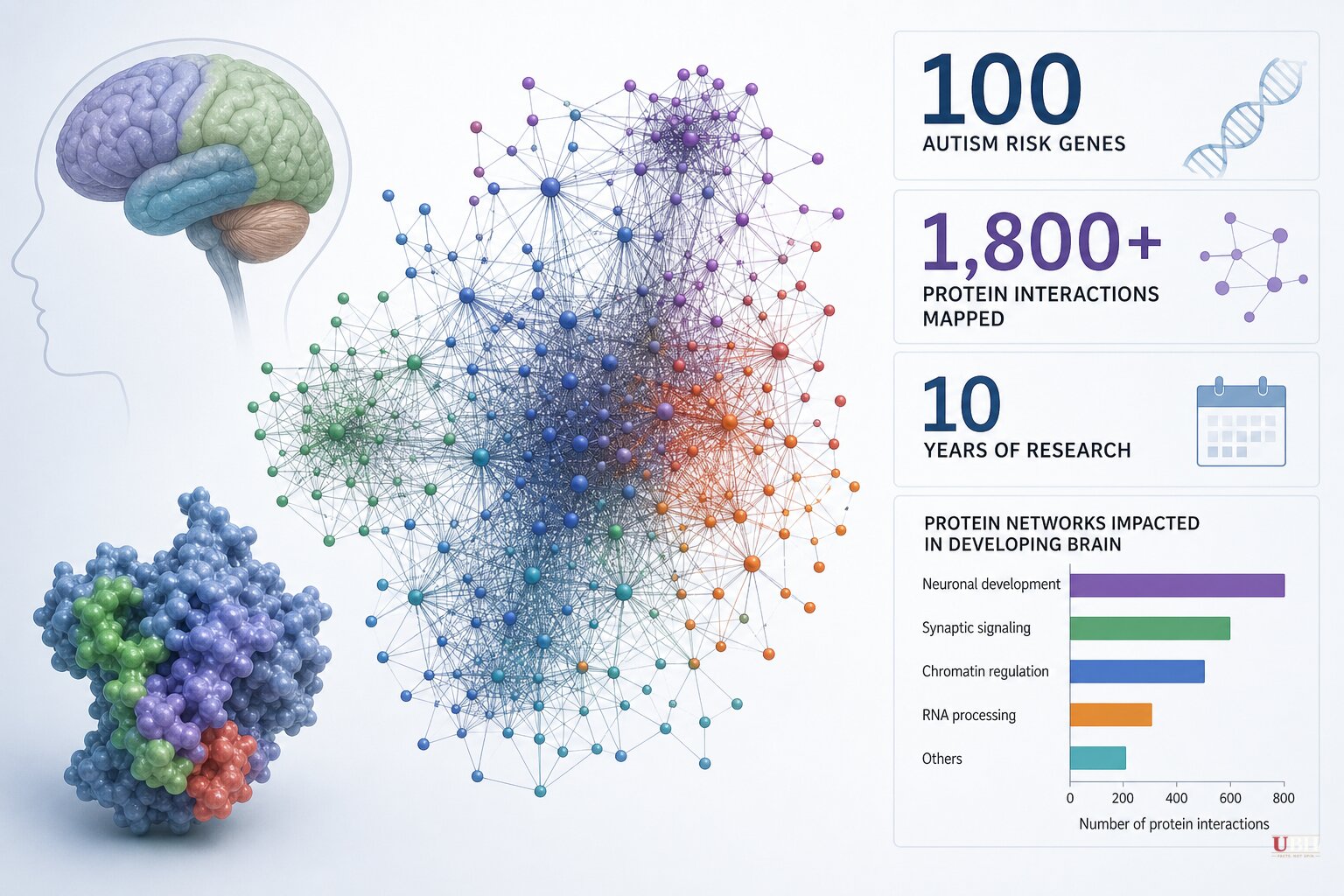
Scientists at UC San Francisco have built the largest molecular map yet of what goes wrong in the brains of people with profound autism.
The study, published in the journal Science on August 27, 2026, mapped protein-protein interactions tied to 100 high-confidence autism risk genes. Using a lab technique called affinity purification-mass spectrometry, the team at UCSF's Quantitative Biosciences Institute (QBI) and Department of Psychiatry and Behavioral Sciences identified more than 1,800 protein interactions. 87% of those had never been documented before, according to News Medical.
The work was led by co-first authors Belinda Wang, Rasika Vartak, and Kelsey Hennick, along with co-corresponding authors Kirsten Obernier, Tomasz J. Nowakowski, and A. Jeremy Willsey, according to News Medical. It took more than a decade to complete.
Why This Matters for Families
Profound autism affects roughly 30% of people on the autism spectrum, according to Disability Scoop. These are individuals with severe intellectual disability who are nonverbal or minimally verbal, often require round-the-clock care, and frequently have epilepsy, according to NPR.
For years, geneticists could name hundreds of genes tied to autism risk but couldn't turn that knowledge into treatments. "They kind of hit a wall," said Nevan Krogan, director of QBI at UCSF, according to NPR. Dr. Matthew State, chair of UCSF's psychiatry department and a senior author on the study, called it "this huge missing piece." Researchers knew the genes served as blueprints for proteins driving brain development, but had no visibility into how those proteins actually worked together.
The new map fills that gap. Its biggest discovery, according to News Medical, is that genetically distinct forms of autism converge on the same shared protein complexes. That means a drug wouldn't need to be custom-built for every single mutation. Instead, medicines could target these shared molecular hubs and potentially help patients with different genetic causes of autism at once.
State said the discovery "opens up a whole new world of possibilities for therapeutic targets and promises a generation of novel drugs that can transform what we are able to do in the clinic," according to Disability Scoop. Krogan added that the team's map goes "down to the interfaces we can target with a drug," per the same report.
Outside experts are calling it significant. Dr. Daniel Geschwind, a UCLA professor of human genetics, neurology, and psychiatry who wasn't involved in the study, called it "an unprecedented resource for the field," according to NPR. Alison Singer, president of the Autism Science Foundation and mother of a daughter with severe cognitive impairment, told NPR: "This is the kind of scientific advance we have been waiting for and praying for." She cautioned there's "still a lot of work ahead," but said the paper "makes the path from genetic discovery to treatment much clearer."
The Environmental Question Nobody's Answering Yet
This study explains mechanism for a specific, gene-driven slice of profound autism cases. It doesn't address why autism diagnoses overall have climbed sharply since the 1970s.
Michael Skinner, a professor at Washington State University's Center for Reproductive Biology, raised that exact concern in reporting by The Epoch Times. "Genetics is stable, and it's very infrequent when it does change," Skinner said. The genetic code itself can't explain a rapid rise in cases over just a few decades.
Worldwide chemical production has expanded 50-fold since the 1950s, with roughly 350,000 manufactured chemicals and plastics now in circulation, according to The Epoch Times. A researcher identified only by the surname Bennett in that report said components of air pollution have been linked to autism risk, and organophosphate pesticides and phthalate plasticizers have drawn similar scrutiny. A report in the New England Journal of Medicine cited by The Epoch Times found fewer than 20% of synthetic chemicals brought to market have been tested for toxicity, and even fewer for effects on infants and children. The EPA announced plans in 2025 to regulate phthalate exposure specifically.
None of that contradicts the UCSF findings. The two lines of research are asking different questions. The protein map explains what happens at the molecular level once a high-impact mutation is present, mostly relevant to the roughly 30% of profound autism cases tied to rare genetic variants. The environmental research is trying to explain population-level trends in overall autism prevalence, which involves a much broader and more heterogeneous group. Coverage of the UCSF study, including from NPR and Disability Scoop, doesn't engage with that broader prevalence question at all.
The next test for the UCSF team is whether any of these shared protein hubs can actually be drugged safely in humans. Krogan and State's group says their approach could also serve as a template for cancer research and other diseases where genetic mutations converge on shared molecular pathways. No clinical trials based on this map have been announced.
Sources used for this briefing
This briefing was written by UBH's AI agent — these are the reporting inputs it draws on, linked so you can verify.


