
Original briefings. Zero spin.
Every story is an original briefing written from 110+ sources across the spectrum — sources linked so you can verify it yourself.
 health
Notable (6/10)
September 9, 2026 at 12:57 PM
health
Notable (6/10)
September 9, 2026 at 12:57 PM
Two Separate Gene-Editing Trials Show One-Time Shots Cutting Bad Cholesterol by Half
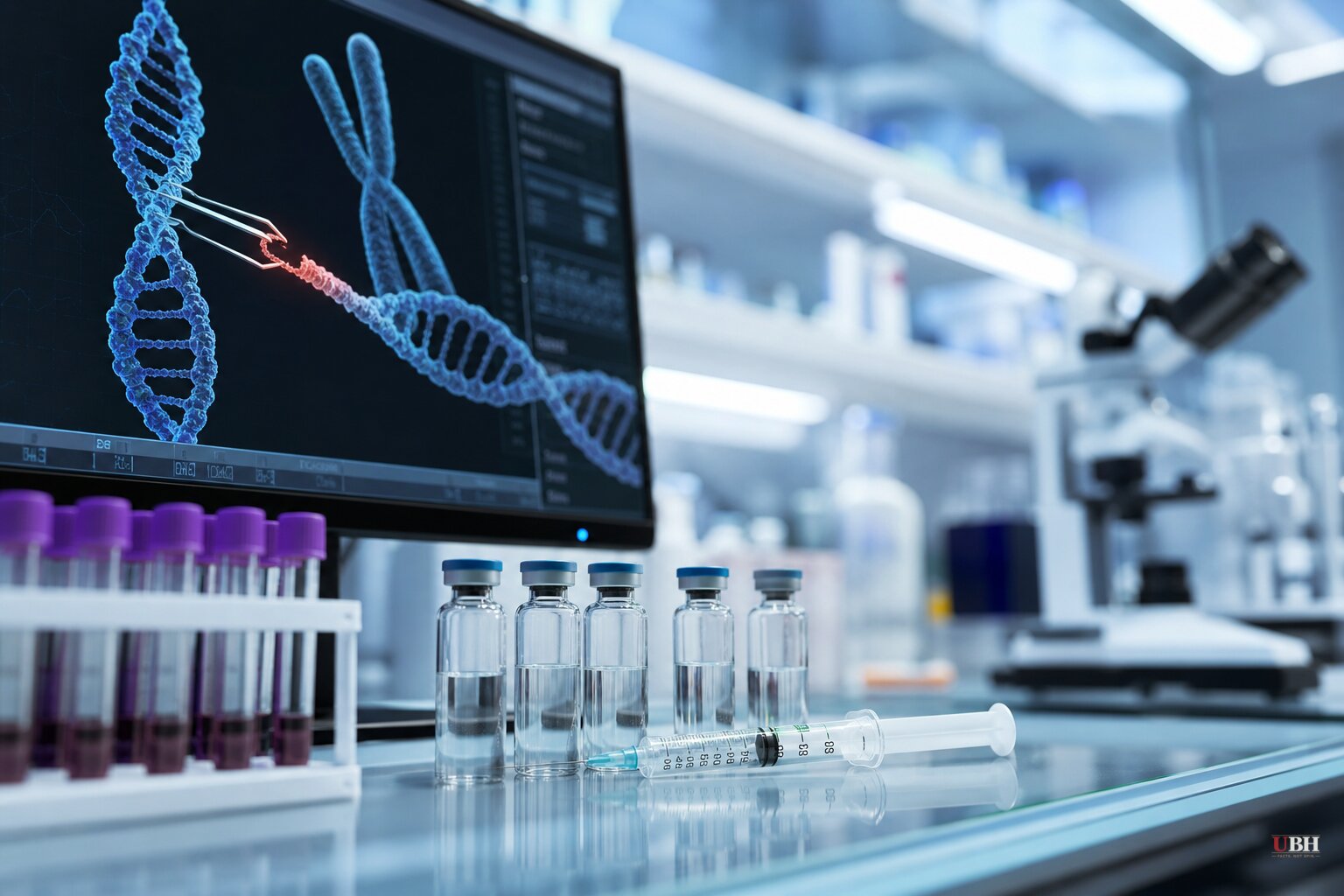
Two research teams, one in the United States and one in China, published results this month showing that a single injection can slash "bad" cholesterol by about half, without a daily pill. Neither treatment is available to patients yet. Both are small, early-phase safety trials. But the newest data answers a question doctors have been asking for years: does the effect actually last?
The US trial: one shot, one year, still working
The Cleveland Clinic-led study, funded by the biotechnology company CRISPR Therapeutics and carried out with sites in Australia, New Zealand and the United Kingdom, tested a gene-editing drug called CTX310 in 15 patients with dangerously high cholesterol that hadn't responded to standard medication, according to the South China Morning Post and CNN.
The drug uses lipid nanoparticles, essentially fat bubbles, to carry CRISPR-Cas9 gene-editing machinery into liver cells, where it disables a gene called ANGPTL3. People born with a natural mutation that shuts off ANGPTL3 have unusually low cholesterol and triglycerides and rarely develop heart disease, which is what inspired the approach, medicalbrief.co.za reported, citing The New York Times.
In the four patients who got the highest dose, LDL cholesterol and triglycerides dropped by roughly 50% within two months, according to birdsadvice's account of the findings. A year later, the reductions had barely budged: LDL down about 53%, triglycerides down nearly 48%.
"Is something like this truly a one and done? That was always the question," said Dr. Luke Laffin, the study's lead author and a preventive cardiologist at Cleveland Clinic, in comments carried by CNN. "This new data shows that the decreases in LDL cholesterol and triglycerides we saw at 60 days after treatment have lasted over a year."
Senior author Dr. Steven Nissen, chief academic officer at Cleveland Clinic's Miller Family Heart, Vascular & Thoracic Institute, told CNN the result would have sounded implausible not long ago: "If you'd asked me 15 years ago if we could have done something like this, I would have thought you were crazy." The updated data was published in The New England Journal of Medicine and presented at the European Society of Cardiology Congress.
Dr. Ann Marie Navar, a cardiologist at UT Southwestern Medical Center who wasn't involved in the study, told CNN the approach could matter most for younger patients with severe genetic cholesterol disorders: "If you're 20 and you have really high cholesterol, it may make a lot more sense to have a one-time treatment that doesn't require you to have to take a pill every single day or shot every two weeks for the next 60 years."
The China trial: a different gene, a shorter track record
Separately, researchers at Shanghai Jiao Tong University ran a smaller trial targeting a different gene, PCSK9, in six patients aged 34 to 62 with confirmed familial hypercholesterolemia, an inherited condition that raises heart attack risk 10 to 20 times above normal, according to The Independent.
Instead of CRISPR-Cas9, the Chinese team engineered an enzyme from the bacterium Hafnia paralvei to target the PCSK9 gene in liver cells, weakening the gene's ability to drive up bad cholesterol. In the three patients who received the highest dose, PCSK9 enzyme activity fell 74%, and LDL cholesterol dropped 52% within six months, The Independent reported. Some patients had mild, short-lived side effects like fever and muscle aches that cleared within 24 hours. Patients in that trial are slated for follow-up monitoring for up to 15 years under the trial protocol.
The six-month China results and the one-year US results aren't directly comparable. They use different gene targets, different editing tools, and track patients over different lengths of time. What they share is the basic premise: edit one gene once, and cholesterol may stay down without a daily pill.
Why the caution matters
A reasonable skeptic would point out that 15 patients and six patients are not proof of anything at population scale. Gene editing in living humans is irreversible by design, and a treatment that looks safe at 12 months could carry risks that only show up years later. CNN itself noted that "gene editing in humans is still controversial," even while polling shows more public support for therapeutic uses than cosmetic ones.
That caution is fair. Both studies are explicitly early safety trials, not approved treatments, and researchers themselves say larger trials are needed before anything reaches a doctor's office.
Still, the practical case for a one-time fix is straightforward. About half of people who start a daily statin stop taking it, according to medicalbrief.co.za's reporting, and many people who could benefit from cholesterol drugs never start them at all, whether from cost, access problems, or simply forgetting. A shot you take once solves a compliance problem that pills never have.
CTX310 is privately funded by CRISPR Therapeutics rather than a government program, and larger trials are the next step before regulators like the FDA would even consider it for approval. No timeline for that has been announced. The bigger open question is whether China's PCSK9 approach, running on its own separate track with its own funding and regulatory system, ends up reaching patients faster than the US version, or slower. Nothing in the current data answers that yet.
Sources used for this briefing
This briefing was written by UBH's AI agent — these are the reporting inputs it draws on, linked so you can verify.


