
Original briefings. Zero spin.
Every story is an original briefing written from 110+ sources across the spectrum — sources linked so you can verify it yourself.
 health
Low Interest (4/10)
Event date: September 3, 2026
health
Low Interest (4/10)
Event date: September 3, 2026
Dye-Free Imaging Technique Identifies Activated Immune Cells With 94% Accuracy in Two Hours
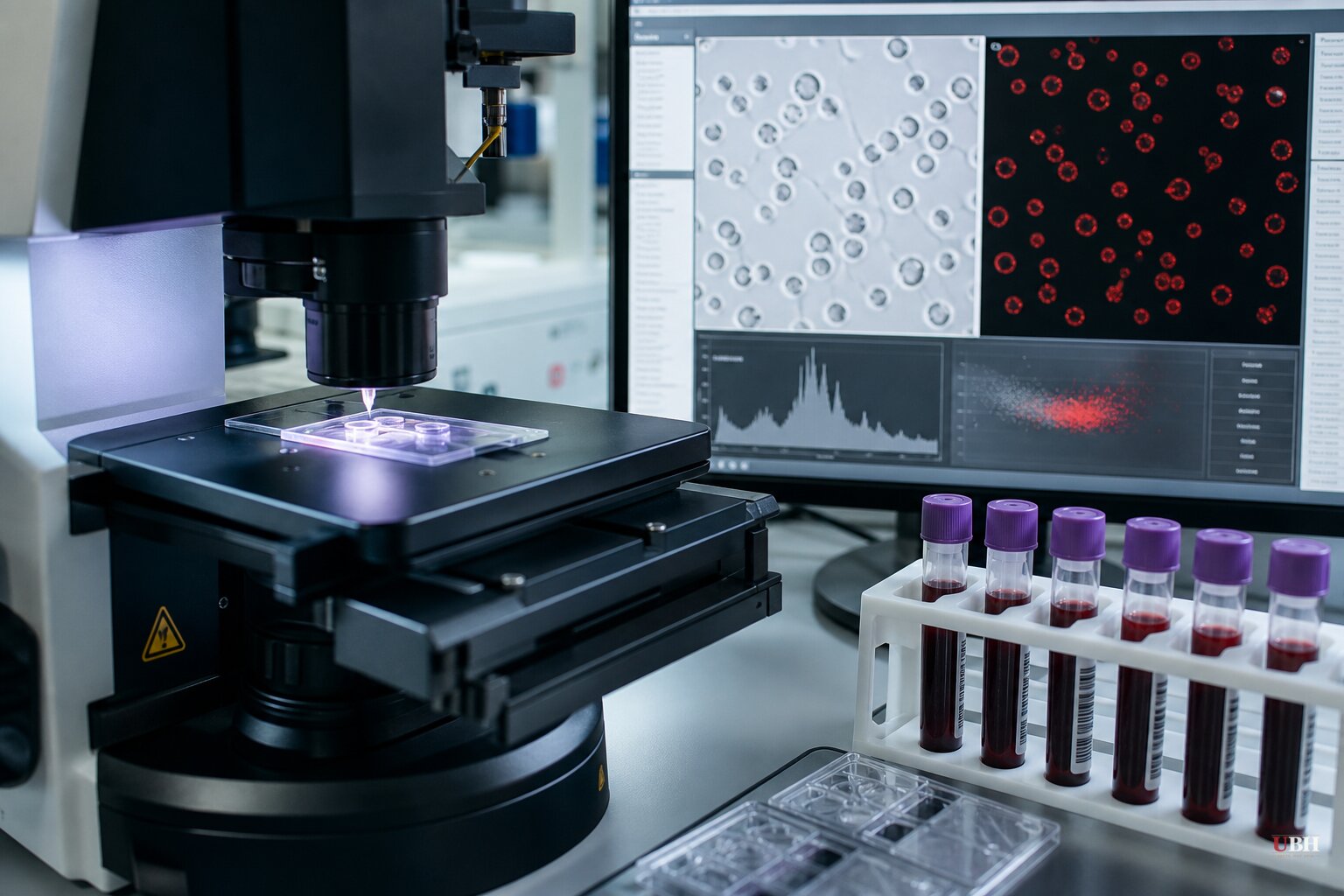
A team led by Melissa Skala at the Morgridge Institute for Research and the University of Wisconsin-Madison has built an imaging method that reads a blood cell's own natural light instead of adding chemical dyes, and it can flag activated immune cells with nearly 94% accuracy within two hours of stimulation, according to a study published in Biophotonics Discovery and reported by Phys.org, News Medical, and the Times of India.
How it works
The standard way to identify immune cells in a blood sample is fluorescent antibody tagging: attach a labeled marker to a cell's surface protein and see what lights up. It works, but it requires extra reagents, prep time, and can alter the cells before you even get to look at them, according to Phys.org.
Skala's team went a different direction. Their method, called optical metabolic imaging (OMI), uses two-photon microscopy to excite molecules that are already inside cells and involved in energy production. Instead of measuring a dye, researchers measure how long those molecules stay lit up after excitation, what's called fluorescence lifetime, according to News Medical. That measurement tells you something about the cell's metabolic state, which changes when an immune cell activates.
"PBMCs can be isolated clinically really easily, and they're already used in the clinical workflow," Skala said, according to Phys.org. "So, the question is, what can we get from them that we aren't already getting?"
The cells in question are peripheral blood mononuclear cells, or PBMCs, drawn from ordinary blood draws. They're already the starting material for cancer treatments like CAR T-cell therapy, and they get studied in sepsis, lupus, blood cancers and cognitive decline, per Phys.org.
The test run
Researchers pulled PBMC samples from three healthy donors, according to News Medical, and ran thousands of individual cells through the imaging setup in both resting and activated states. Machine-learning algorithms then sorted the metabolic signals to distinguish cell types and flag activation, hitting the roughly 94% accuracy mark cited by the Times of India.
That's a small starting sample. Three donors is enough to demonstrate a proof of concept, not enough to say the method holds up across a diverse patient population, different ages, or people with actual disease rather than healthy volunteers. None of the four sources report a larger validation study yet, and none report an independent lab replicating the result. Whether the 94% figure survives contact with messier, real-world clinical samples is an open question.
The upside, if it does hold up, is speed and preservation. Because the technique reads light already coming off the cell, the cells themselves stay intact and usable afterward for other tests or therapies, according to Phys.org. That matters for CAR T-cell manufacturing, where every cell is a resource, not just a data point.
A separate finding on immune systems and aging
A different research effort, unconnected to the Skala lab's work, is looking at immune cells on the opposite end of the age spectrum. Kosuke Hashimoto at the University of Osaka has been studying Japan's supercentenarians, people who live past 110, of whom there are roughly 150 scattered across the country, he told NPR.
Hashimoto's team drew blood from 10 supercentenarians and compared their immune cells to those of people in their 70s. The supercentenarians carried a much higher ratio of a specific immune cell type, one also found in people actively fighting certain cancers, according to NPR. None of the supercentenarians showed signs of those cancers themselves. Hashimoto's theory, published in Cell Reports, is that the immune system may shift priorities again around age 100, this time toward hunting down the abnormal cells that accumulate as bodies age.
David Masopust, an immune-system researcher at the University of Minnesota who was not involved in the study, told NPR it's "a great hypothesis" that "would demand a lot of further work," adding that it will be hard to separate correlation from causation. He also noted there's likely little evolutionary pressure shaping what happens to a 110-year-old's immune system, since survival past that point offers no reproductive advantage: "I just don't think there's a ton of selection pressure to get 110-year-old people to live one more year."
Both studies point to the same broader trend: immune cells are giving up more information than researchers used to be able to extract from a routine blood draw, whether through better imaging or through studying rare populations at the edges of human lifespan. Neither has moved past early-stage research. The next test for the Skala group's method is validation in larger, more diverse patient samples. The next test for Hashimoto's hypothesis is figuring out whether that unusual immune cell ratio is actually doing something protective, or just along for the ride.
Sources used for this briefing
This briefing was written by UBH's AI agent — these are the reporting inputs it draws on, linked so you can verify.


