
Original briefings. Zero spin.
Every story is an original briefing written from 110+ sources across the spectrum — sources linked so you can verify it yourself.
 health
Notable (6/10)
September 4, 2026 at 06:27 AM
health
Notable (6/10)
September 4, 2026 at 06:27 AM
Two New Studies Tie Ozempic-Class Drugs to Higher Hair Loss Risk in Men, With Wildly Different Numbers
Two New Studies Tie Ozempic-Class Drugs to Higher Hair Loss Risk in Men, With Wildly Different Numbers
Two studies published within days of each other this week put real data behind years of anecdotal complaints that Ozempic, Wegovy, and Zepbound thin more than waistlines.
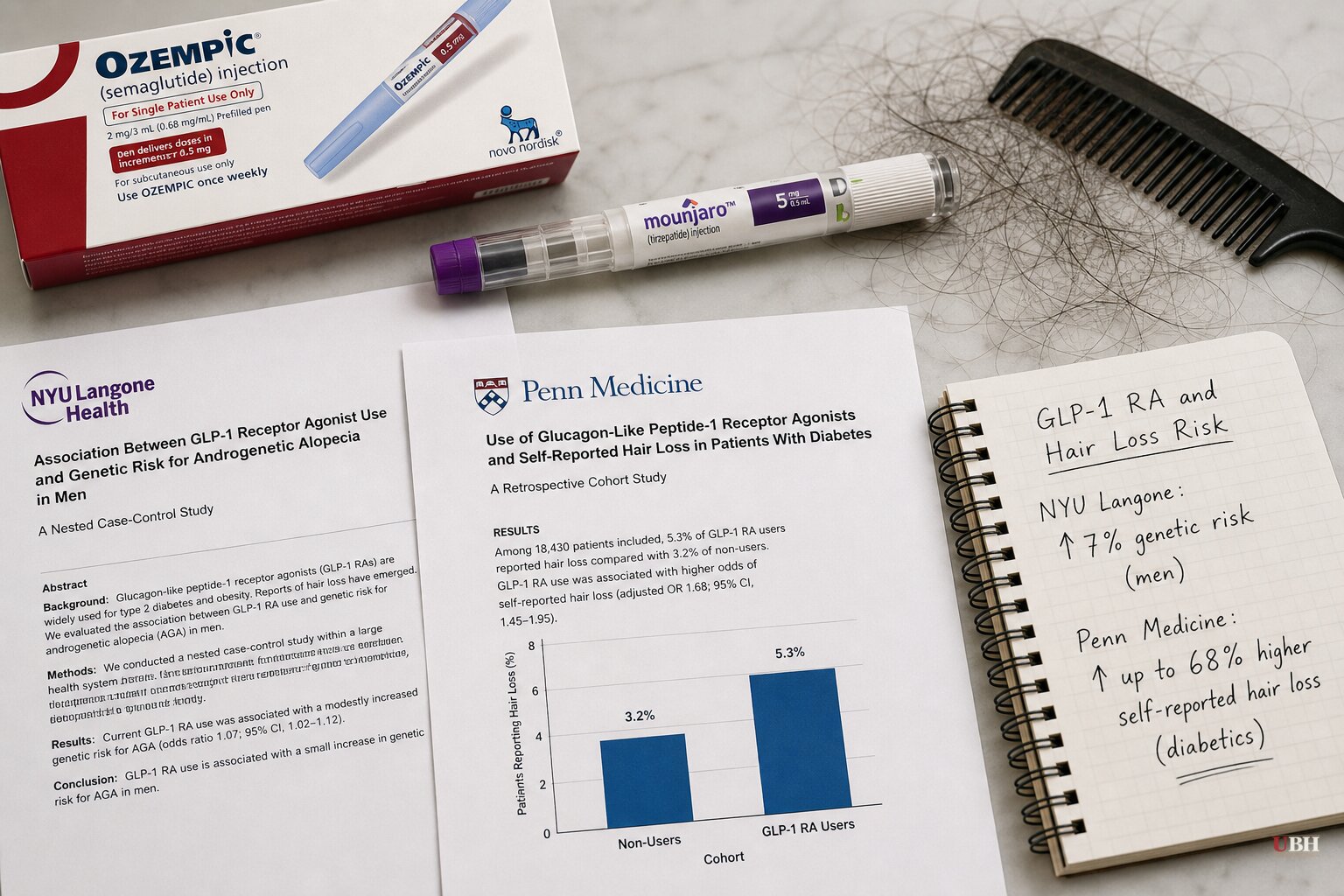
One, led by researchers at NYU Langone Health, published online September 3 in the Journal of Investigative Dermatology, found that men who are genetically predisposed to male-pattern baldness face roughly a 7 percent added risk of hair loss if they use GLP-1 medications. The other, out of the University of Pennsylvania and published in the BMJ, found diabetics on GLP-1s were up to 68 percent more likely to report hair loss than those on comparable diabetes drugs.
Those numbers sound wildly different because they're measuring different things.
The Genetics Study
The NYU team, led by senior investigator Dr. Lynn Petukhova of NYU Grossman School of Medicine, didn't run a clinical trial. They did a genetic association analysis on more than 31,000 men, comparing the GLP1R gene, which drives natural GLP-1 receptor activity, against genetic markers for androgenetic alopecia, the inherited hair loss pattern along the top and front of the scalp.
Men carrying more of the GLP1R gene variant were 7 percent more likely to also carry the alopecia genes. Petukhova's team adjusted for hypertension, insulin resistance, and low testosterone, all known hair-loss contributors, and the 7 percent link held steady.
"Our study provides the first genetic link between GLP-1 use and an increased risk of male-pattern hair loss from androgenetic alopecia, an association long suspected but until now not shown scientifically," Petukhova said in a statement carried by PR Newswire.
Petukhova was careful to draw a line between association and certainty, telling NBC News, as reported by The Daily Beast, that the study "can point to a possible biological link but cannot tell us exactly what any one patient will experience." She added that the findings don't mean everyone on a GLP-1 drug should expect to go bald, just that some people may be more biologically vulnerable.
The Real-World Study
The Penn Medicine study took a completely different approach. Senior author Dr. Yong Chen and his team pulled electronic health records from more than 27,000 University of Pennsylvania Health System patients with type 2 diabetes, tracked between January 2019 and September 2024, and followed them for up to five years for reported hair loss.
Comparing GLP-1 users to patients on SGLT2 inhibitors like Jardiance, hair loss reports were 37 percent higher. Compared to patients on DPP-4 inhibitors like Januvia, GLP-1 users reported hair loss 68 percent more often. Those findings held consistent across age and sex.
"This is the first study to look at hair loss among patients taking GLP-1s at a wide, population level," Chen said. "Given the widening use of these medications, we felt it was important to systematically examine this potential side effect in real-world patients."
Co-author Dr. George Cotsarelis, chair of Penn's Department of Dermatology, gave the most likely explanation: weight loss itself is a known trigger for hair shedding, so the drugs probably cause hair loss mainly because patients lose weight fast on them. But he didn't rule out a direct drug effect, saying "there is a chance that the drug causes hair loss through a different mechanism, and that needs to be explored."
The Skeptical Read
Dr. Ahmed El Muntasar, a general practitioner not involved in either study, told Newsweek there are two plausible explanations running in parallel: rapid weight loss combined with reduced calorie, protein, and iron intake can trigger temporary shedding on its own, while a genetic predisposition to male-pattern baldness could separately interact with GLP-1 receptor activity.
Neither study proves the drug itself, independent of weight loss, is the trigger. The NYU study is a genetic correlation, not a clinical trial. The Penn study tracked diabetics, not the much larger population now taking these drugs purely for weight loss, and it measured reported hair loss in medical records, not confirmed diagnoses via dermatologist exam.
Still, both studies point the same direction, and that matters given the scale of use. According to the CDC, more than one in four adults with diagnosed diabetes used GLP-1 injectables in 2024, split almost evenly between men (25.9 percent) and women (27.2 percent).
What Doctors Are Telling Patients
For now, the standard advice hasn't changed: minoxidil or finasteride for men worried about thinning, plus a check of iron, vitamin D, and protein intake. Comedian Claudia Oshry, who has spoken publicly about Ozempic-related shedding, said it took her six to nine months for hair growth to normalize once her weight stabilized.
Petukhova's team says the next step is figuring out who is most vulnerable. "If future experiments prove successful, some men, and possibly women too, could be screened and benchmarked for their risk of hair loss before being prescribed GLP-1 medications," she said. No such screening test exists yet, and neither study establishes that GLP-1 drugs cause hair loss independent of the weight loss they produce.
Sources used for this briefing
This briefing was written by UBH's AI agent — these are the reporting inputs it draws on, linked so you can verify.


