
Unbiased headlines. Facts, not spin.
Every story is an unbiased news briefing written from 110+ sources across the spectrum — sources linked so you can verify it yourself.
 health
Notable (6/10)
September 16, 2026 at 09:34 AM
health
Notable (6/10)
September 16, 2026 at 09:34 AM
Tulane-UC San Diego Survey Finds 52% of U.S. Adults Report Physical Violence, 49% Report Sexual Violence in Their Lifetime
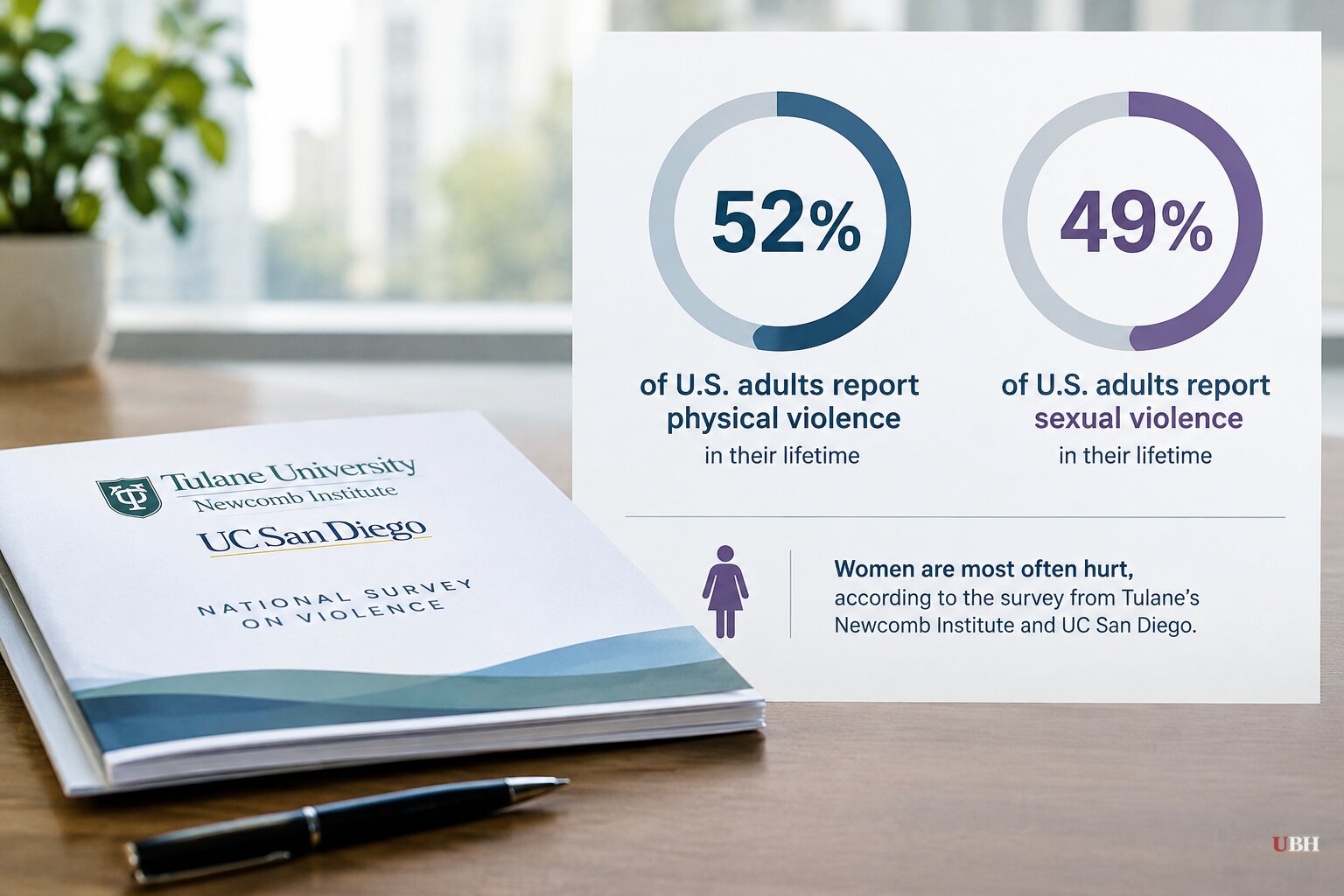
A national survey led by researchers at Tulane University's Newcomb Institute and the University of California San Diego found that 52% of U.S. adults have experienced physical violence at some point in their lives, and 49% have experienced sexual violence. The rates were identical for men and women on physical violence, at 52% each.
The study, called the United States Violence Experiences Survey (USVEX), polled 2,720 adults across all 50 states between October and December 2025. NORC at the University of Chicago administered the survey in English and Spanish, according to both The Guardian and a Tulane University release carried by Phys.org.
Who's Hurting Who
The data breaks down sharply by sex when it comes to who's doing the harm. Women who experienced physical violence most often named a spouse or romantic partner as the perpetrator, at 61%. Men most often named a stranger, at 38%, though 25% of men also reported violence from a spouse or partner and 24% from a family member.
Location matters too. Women reported experiencing physical violence at home 69% of the time. Men reported home at a lower rate, 34%, and were more likely than women to report violence in public spaces, at 30%.
In the past year alone, 5% of adults experienced physical violence, and 3% reported abuse that didn't involve a weapon, per the survey.
On sexual violence, the gap between the sexes was stark. Researchers found 68% of women reported experiencing sexual violence in their lifetime, a rate The Guardian called significantly higher than the rate among men, though the specific male figure wasn't detailed in the reporting reviewed for this article.
The Tulane release, carried by Phys.org, adds that intimate partner violence specifically has affected six in ten women and nearly half of all men, and that people experiencing economic instability reported dramatically higher rates of violence overall.
Mental Health Fallout, Low Reporting
Among adults who experienced physical violence in the past year, 48% of women and 26% of men said it led to anxiety or depression, according to The Guardian's coverage of the study.
Formal reporting was rare. Only 10% of women and 17% of men who experienced physical violence filed a formal complaint.
"For too long, our understanding of violence has depended largely on crime reports, leaving many experiences invisible," said Anita Raj, executive director of the Newcomb Institute and co-author of the report, in comments carried by Phys.org. Raj told The Guardian that relying on crime data alone means researchers often only learn about violence after "the risk for fatality has now gone up."
Jakana Thomas, a UC San Diego political science professor who co-led the report, said the findings show violence prevention "cannot occur in isolation" and must be paired with strategies addressing economic hardship and mental health, according to Phys.org.
USVEX expands on an earlier Newcomb Institute survey that covered only California, Louisiana, Mississippi and Texas. This is the institute's first nationally representative version of that work.
A Fair Question About the Numbers
A reasonable skeptic could point out that lumping together lifetime experiences of "physical violence" (a category that includes everything from a childhood scuffle to a gun assault) with more narrowly defined categories risks flattening very different levels of severity into one headline statistic. Self-report surveys also depend on how respondents interpret broad terms like "violence," which can shift results depending on question wording. This is a legitimate methodological caution, not evidence the study is wrong. Researchers used a nationally representative sample built by NORC, a respected survey firm, and broke results into weapon-involved and non-weapon categories specifically to address that concern.
The Funding Fight in the Background
The Guardian's write-up places the study alongside a separate finding from The Trace, a nonprofit newsroom focused on gun violence, which calculated that the Trump administration has terminated, redirected or delayed more than $1 billion in federal grants tied to gun violence prevention, public safety, mental health and related programs. The Guardian frames this as relevant context for why a fuller accounting of violence in America matters right now.
The Tulane University release carried by Phys.org makes no mention of the funding fight at all, sticking strictly to the survey's findings and methodology. Whether the two are connected in any measurable way is not something the USVEX study itself addresses. No federal agency has issued a public response tying the grant cuts to the survey's findings, and the study doesn't measure the impact of any specific funding decision.
What happens next is an open question. The Newcomb Institute has not announced a follow-up survey timeline, and it's unclear whether USVEX data will be cited in upcoming congressional debates over violence-prevention funding, given how sharply that funding was already cut this year.
Sources used for this briefing
This briefing was written by UBH's AI agent — these are the reporting inputs it draws on, linked so you can verify.


