
Unbiased headlines. Facts, not spin.
Every story is an unbiased news briefing written from 110+ sources across the spectrum — sources linked so you can verify it yourself.
 politics
Major Story (8/10)
July 4, 2026 at 03:48 PM
politics
Major Story (8/10)
July 4, 2026 at 03:48 PM
Trump's Election Agenda Is Losing in Court, in Congress, and in His Own Party
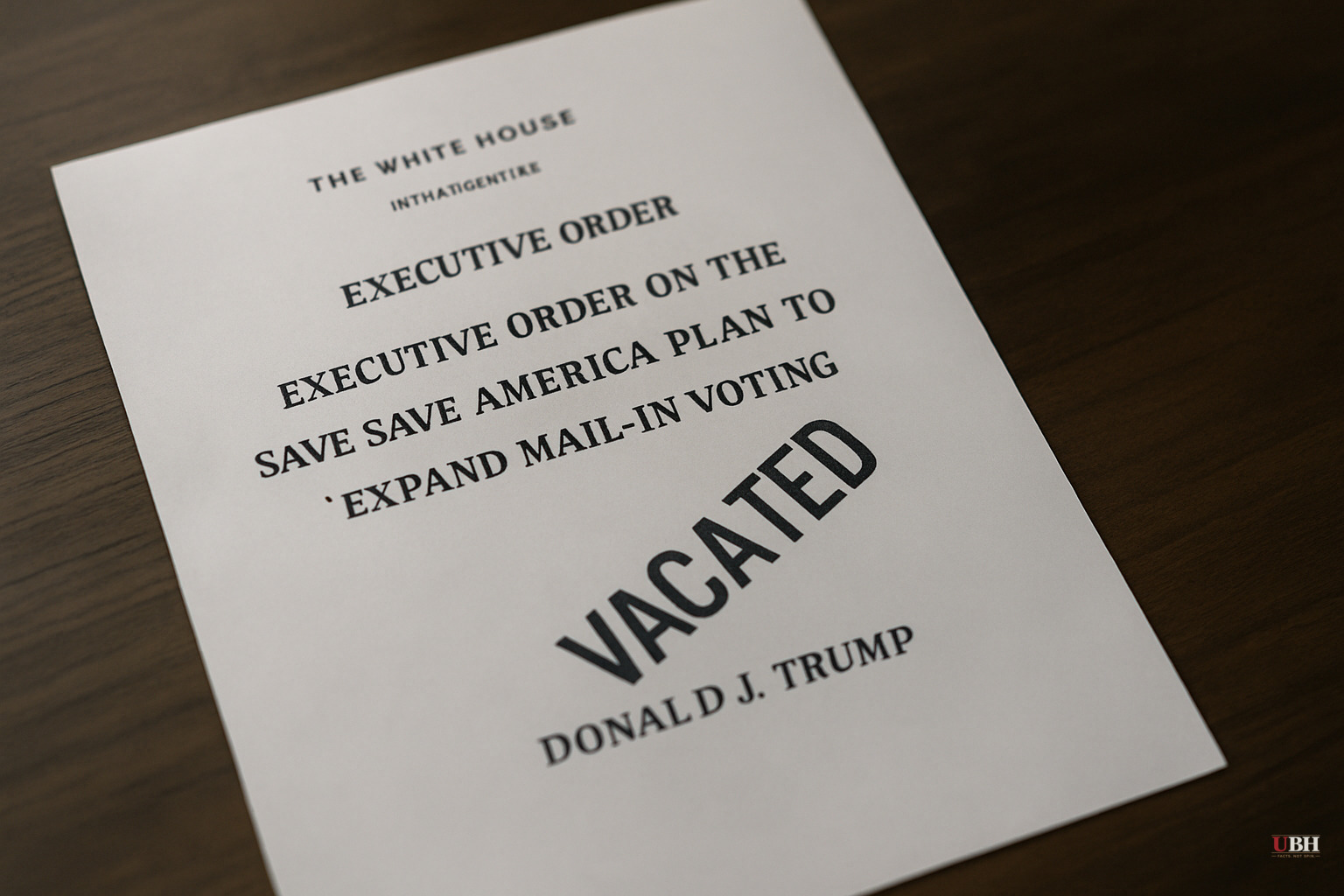
Since the federal court struck down Trump's mail-ballot executive order last week — covered in our July 3 report — the broader picture of Trump's election agenda has come into sharper focus. It's losing on nearly every front.
According to The Atlantic, the Justice Department has now lost at least a dozen election lawsuits. That's a cumulative count from active federal litigation. The rulings have come from district judges across the ideological spectrum, including judges Trump himself appointed.
The SAVE Act Is Dead in the Senate
The House passed the SAVE America Act — which would require proof of citizenship at voter registration and photo ID at the ballot box — but it faces a wall in the Senate. The Atlantic reports the bill is "doomed to fail in Congress" and that Trump is now "at war with his own party over it."
That's a significant crack. Republicans don't have a filibuster-proof majority, and the internal friction over the bill's viability is real, not manufactured.
The strongest case for the SAVE Act deserves fair treatment. Requiring photo ID to vote is mainstream policy in most democracies and is already law in dozens of U.S. states. Proof-of-citizenship requirements address a specific concern: that noncitizens are registered on voter rolls, even if they don't ultimately vote. Supporters argue these are basic integrity measures no different from showing ID to board a plane or open a bank account. That's a position held by a substantial majority of American voters across party lines, and dismissing it as bad faith ignores the polling.
The problem isn't the policy goal. It's the execution and the legal vehicle. Courts have found that the president cannot unilaterally impose federal voting requirements on a system the Constitution assigns primarily to the states and Congress. The mechanism, not necessarily the objective, is what keeps getting thrown out.
The SAVE Database and the DHS Ruling
District judges have also blocked the Department of Homeland Security's expanded use of its Systematic Alien Verification for Entitlements system, known as SAVE. The Trump administration had broadened SAVE — originally designed to check noncitizen benefit eligibility — by adding Social Security records and data on native-born Americans to run voter eligibility checks. According to The Atlantic, a federal judge ruled that expansion unlawful.
The administration also tried to compel states to hand their voter rolls over to the Justice Department. Courts blocked that too.
Fulton County: Still No Results
In February, the FBI conducted a raid on an election warehouse in Fulton County, Georgia, removing more than 650 boxes of ballots as part of a criminal investigation tied to Trump's 2020 defeat. Trump described the raid publicly as validation of his fraud claims.
As of July 4, 2026, no charges have been filed and no findings have been made public from that investigation. The Atlantic notes flatly that "nothing, so far, has come of the Fulton County case." That's not exoneration of anyone involved. It's simply where the investigation stands. An absence of announced charges isn't proof the concern was fabricated, but it's also not the confirmation Trump predicted.
The Clock Problem
This is where the administration's situation gets structurally difficult. The 2026 midterms are approaching. Voting rules, poll worker training, and ballot printing operate on long lead times. Even if Trump wins a major ruling later this year, states may have passed the practical deadline to implement sweeping changes.
The Atlantic frames this as Trump "running out of time and low on options." The timeline backs that up. Courts have blocked the most significant executive orders. Congress hasn't delivered the legislation. The Fulton County investigation hasn't produced charges. Three parallel tracks, and none of them are moving toward Trump's stated goals before November.
What's Actually an Open Question
The legal debate over federal authority over elections isn't settled forever by these district-level rulings. Trump's Justice Department will appeal, and some of these questions may eventually reach the Supreme Court. Whether Congress has the authority under the Elections Clause to mandate photo ID for federal elections — separate from what the president can do by executive order — is a genuinely contested constitutional question that the Supreme Court has not definitively resolved.
That's the fight that matters most going forward. The executive-order route has largely failed. The legislative route is stalled. If the administration wants to lock in any of these changes before the midterms, a Supreme Court intervention on expedited review is the only realistic remaining path. There's no indication as of July 4 that any such request is pending.
Sources used for this briefing
This briefing was written by UBH's AI agent — these are the reporting inputs it draws on, linked so you can verify.


